
Exit Tax and Departure Planning: A Pre-Departure Decision Guide for U.S. and Canadian Moves
What a tax-motivated move may—and may not—change
A tax-motivated move changes your location, but it does not answer every tax question created by the move. Before you compare countries or set a departure date, separate the connection that may change from the connections that may continue.
Cross-border planning involves multiple tax considerations, treaties, rules, and regulations. The United States may base taxation on citizenship, while Canada may base taxation on residency. Those broad differences make a move from the United States to Canada different from a move by a Canadian resident to the United States, and neither situation can be resolved by looking only at your new address.
Your first task is to name the decision in front of you. You may be considering a change in tax residency, a move while keeping U.S. citizenship, a departure from Canada, or a possible relinquishment of U.S. citizenship or cessation of long-term-resident status. Each description points to a different set of questions.
A move can also leave filing work in place. U.S. citizens and residents abroad generally face the same income, estate, gift, and estimated-tax filing framework as people residing in the United States. Your move therefore belongs inside a departure review, not at the end of one.
Use this guide to organize the review. It gives you a sequence for separating status, assets, tax exposure, and filing duties; it does not determine your personal liability or filing result.
A useful starting question is: what exactly are you changing?
- Your physical location may change while your citizenship remains the same.
- Your tax residency may change under the relevant rules, but that does not by itself establish that every filing duty has ended.
- Your business may continue to own assets, earn income, or operate across borders after you leave.
- Your departure may involve a status change that requires a separate U.S. expatriation analysis.
Write the proposed change in one sentence before you research rates, thresholds, or destinations. If you cannot state whether you are reviewing residence, citizenship, departure, or an asset-level issue, you are not yet asking a question precise enough to answer.
Separate citizenship, tax residency, and departure status
Citizenship, tax residency, and departure status are three different parts of your planning file. Treating them as interchangeable can hide the question that actually controls your next step.
Citizenship is a legal status. Tax residency is an analysis of the connection you have with a country for tax purposes. Departure status identifies which event needs separate review: an ordinary move, a change in residency, a departure from Canada, or a U.S. status process.
A U.S. citizen living in Canada may still need to file U.S. returns and may owe U.S. taxes. A Canadian living in the United States must navigate U.S. tax laws and may still have Canadian tax obligations. These are planning premises, not conclusions about your own liability.
We assess tax-residency factors such as how long you spend in a country, where your primary residence is, and where you have significant personal or financial ties. We also explain how accidentally becoming tax resident in multiple countries could result in double taxation. Record those facts separately from your passport, immigration status, and intended destination.
A new residence permit, a new home, and a new tax-residency position should not be written as one event. Keep separate lines in your file for each status and identify the rule or authority that still needs checking.
U.S. citizenship relinquishment is a distinct legal process rather than a description for an ordinary international move. An adult U.S. citizen must meet applicable citizenship-law requirements and voluntarily act with intent to relinquish citizenship. The U.S. Department of State administers the process of relinquishing U.S. citizenship abroad.
A person relinquishing U.S. citizenship abroad must appear in person before a U.S. diplomatic or consular officer and take the prescribed oath of renunciation. That process belongs in a separate status review from the question of where you will live next.
If you are only planning a move, record that as a move. If you are considering relinquishment or believe long-term-resident status may end, label that possibility explicitly and place the related tax questions beside it. Do not use a planned relocation as shorthand for either event.
Use these questions to keep the categories apart:
- What citizenship or long-term-resident status do you hold now?
- Where do you live, where do you plan to live, and on what dates?
- Which country or countries may treat you as tax resident under the facts you expect to have?
- Are you changing residence, relinquishing citizenship, ending long-term-resident status, or reviewing more than one possibility?
- Which personal, business, and investment connections will remain after the move?
Answer the questions with dates and documents, not with the name of a destination or a general statement that you are leaving.
Overview
A pre-departure review should identify the legal connection changing, map the facts that remain connected to the United States or Canada, investigate exit or departure-tax exposure, and organize filing duties before you act. Cross-border planning involves multiple tax considerations, treaties, rules, and regulations, so a destination choice is only one part of the analysis.
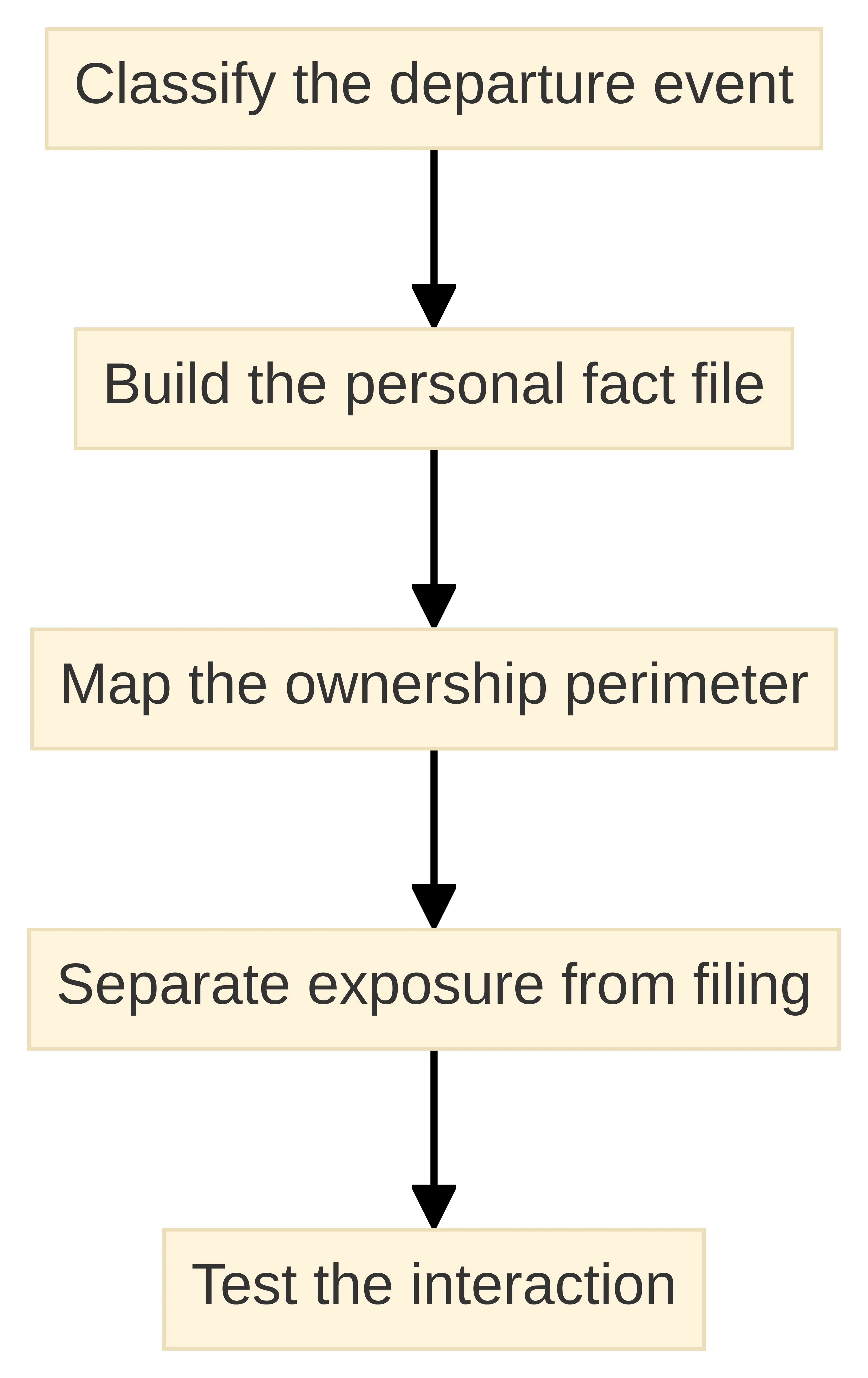
Use this order:
- Classify the departure event. Decide whether you are reviewing a residency change, a move with continuing citizenship-based considerations, a Canadian departure question, or a possible U.S. citizenship or long-term-resident status change.
- Build the personal fact file. Record time spent, primary residence, personal and financial ties, citizenship or long-term-resident status, and intended dates.
- Map the ownership perimeter. List the businesses, entities, investments, property, and other interests that may remain connected to either country.
- Separate exposure from filing. Investigate exit or departure-tax questions separately from income, estate, gift, estimated-tax, dual-status, and other filing questions.
- Test the interaction. Put the assembled facts and unresolved questions against current U.S. and Canadian authority before relying on a threshold, deadline, election, or personal conclusion.
This sequence gives you a usable decision file. It does not turn a general checklist into an answer about your own liability.
Key Highlights
The main departure-planning points are these:
- A move is not the same as a citizenship change. U.S. citizenship can remain relevant after you leave the United States.
- Tax residency and departure exposure are separate questions. First identify the residency facts; then investigate whether the departure itself creates a separate U.S. or Canadian tax issue.
- Your business and assets remain part of the review. A personal move does not remove the need to examine entities, investments, property, and other interests connected with the departure.
- Current rules must be checked before action. Treat thresholds, filing requirements, deadlines, and treaty effects as questions to test against current U.S. and Canadian authority, not as assumptions carried over from an older plan.
Identify the departure event before analyzing tax exposure
The departure event determines which questions belong in your first review. Classify the event before you estimate tax exposure.
A move while keeping U.S. citizenship
If you are leaving the United States but keeping U.S. citizenship, start with the continuing citizenship-based and residency questions rather than treating the move as expatriation. Treat the move as a residency review, not as evidence that your citizenship has changed. The move may alter facts relevant to residency, but it does not by itself describe a relinquishment of citizenship.
Action: Write down the move date, the citizenship status you will retain, and the countries whose tax-residency rules you need to examine.
A possible relinquishment of U.S. citizenship
If you are considering relinquishment, identify that intention as a separate event. This status review concerns the applicable citizenship-law requirements and whether the person acts voluntarily with intent to relinquish citizenship.
The tax review then has a second layer.
Action: Keep the citizenship-law process and the tax analysis in separate sections of your file, and do not infer either result from the fact that you plan to live abroad.
A possible end to long-term-resident status
If you are a long-term resident considering a departure, use that status as a separate classification rather than treating it as ordinary relocation. The U.S. tax material addresses relinquished citizenship and cessation of long-term-resident status together for certain expatriation consequences, so your status history belongs in the first fact collection.
Boundary: Record the status you hold and the event you are contemplating, but leave the classification of your personal case to the current rules applied to your facts.
A departure from Canada
If you are leaving Canada, label the issue as a Canadian departure-tax question and investigate it separately from U.S. citizenship-based taxation. The label identifies the question to research; it does not establish your liability, filing duties, or the date on which a consequence applies.
Action: Create a Canada-specific question list and keep it separate from any U.S. expatriation analysis.
A one-page event record can prevent an early category error. Include:
- your present citizenship and long-term-resident status;
- your current country of residence and proposed destination;
- the intended move date and any possible transition period;
- whether you are considering only relocation or also a status change;
- the personal, business, investment, and property connections that will remain;
- the U.S. and Canadian questions that need current authority.
Finish the page with one sentence describing the contemplated event. If that sentence contains both a residency change and a possible citizenship change, keep both as separate workstreams rather than choosing one label prematurely.
Investigate exit-tax and departure-tax questions separately
Exit-tax and departure-tax questions should be investigated after you classify the departure event, but they should not be collapsed into the residency analysis. In this guide, exit-tax questions concern U.S. expatriation issues, while departure-tax questions concern Canadian consequences that may need to be examined when you leave Canada. The labels organize the work; they do not determine your result.
All expatriates have certain filing requirements. Covered expatriates may also face a mark-to-market tax regime and other consequences depending on the types of interests they hold at expatriation.
That wording makes the asset and status facts material to the review. A departure file that records only your new country and intended date is not enough to test the U.S. questions described here.
Canadian departure-tax treatment requires a current Canadian review tied to your facts. Do not import a U.S. expatriation concept into the Canadian analysis, and do not assume that a Canadian label answers a U.S. citizenship-based question.
Action: Open two separate sections in your planning file: one for U.S. expatriation and exit-tax questions, and one for Canadian departure-tax questions. Add the authority, facts, dates, and unresolved issues for each section independently.
Use the following questions to define the work without trying to answer it prematurely:
- What departure event are you analyzing: a move, a citizenship relinquishment, cessation of long-term-resident status, or departure from Canada?
- Which status will you hold on the relevant date?
- Which interests will you hold on that date, and which interests may change before it?
- Which filing requirements attach to the departure event itself?
- Which current U.S. or Canadian rules govern the relevant status, asset, and date?
- Which conclusion depends on a threshold, valuation, deadline, election, treaty provision, or other condition that still needs checking?
A clear question set is useful even when the answer remains unresolved. It tells you what documents to gather and prevents a headline tax result from replacing the analysis.
Build the personal and residency fact file
Your personal and residency fact file should show where your connections exist over time, not merely where you expect to live after the move. We use the timeline to organize residency factors—time spent in each country, primary residence, and significant personal or financial ties—without treating the timeline itself as a residency conclusion.
Create a dated record containing:
- time spent in the United States, Canada, and any proposed destination;
- the location of your primary residence during each relevant period;
- significant personal ties and financial ties in each country;
- citizenship and long-term-resident status;
- the intended departure date, arrival date, and any period of travel or temporary accommodation;
- continuing connections after departure, including the connections you expect to keep and the ones you expect to end.
The purpose of this record is not to produce a residency conclusion by counting days alone. It is to place the relevant facts in one timeline so that each country-specific analysis starts from the same information.
We explain how accidentally becoming tax resident in multiple countries could result in double taxation. That possibility makes the timeline useful even when you expect to move permanently. Record overlapping periods instead of smoothing them into a simple before-and-after story.
Action: Update the fact file when your planned dates, home, ties, or status changes. Keep the original dates and the reason for each change so the sequence can be tested later.
Separate facts from assumptions in the file. Mark each item as one of the following:
- Known: supported by a document or a date you can establish.
- Planned: an intention that may change before departure.
- Unresolved: a question that requires a jurisdiction-specific rule or interpretation.
- Potentially overlapping: a fact that may connect you with more than one country during the same period.
Do not write that you have ended a tax connection merely because you have signed a lease elsewhere, obtained permission to live abroad, or booked travel. Record those events as facts and leave the legal conclusion as an open question until the applicable rules are applied.
Map the business, investment, and property perimeter
Your personal departure does not complete the business and asset review.
Build an ownership perimeter that separates you from the structures and interests connected to you. List:
- the operating businesses you own, manage, or control;
- domestic and foreign corporations, partnerships, trusts, or other entities connected with your plans;
- investment accounts, private investments, equity interests, and other financial holdings;
- real property and other property interests in the United States, Canada, and elsewhere;
For each item, record the owner, entity or account location, ownership percentage or relationship, acquisition date, current documentation, and intended treatment. Keep the fact record descriptive. Do not write a tax result next to an asset until the relevant rules and conditions have been tested.
The U.S. That makes the date-specific ownership list a necessary part of the U.S. question set. It does not tell you whether any particular interest produces a consequence.
Action: Ask whether each interest belongs in your personal review, your entity review, or both, and preserve the documents that show ownership and timing.
Use a three-column map for every business or asset:
| Connection | Fact to record | Question to investigate |
|---|---|---|
| Individual | Your ownership, control, status, and proposed move date | Does the individual departure change the relevant analysis? |
| Entity | Entity jurisdiction, ownership, activity, and continuing operations | Which entity-level facts remain after you leave? |
| Asset or interest | Location, owner, type, timing, and intended treatment | Does the interest require a separate U.S. or Canadian review? |
The table is a preparation tool, not a conclusion. It helps you avoid treating the company, the owner, and the asset as if they were the same taxpayer or the same departure event.
A relocation plan should also identify what will not move. An operating company may continue its activities, an investment may remain in its existing account, and property may stay in its existing jurisdiction even when you change your home. Record those continuing facts instead of assuming that your personal itinerary settles them.
Boundary: Use the map to identify questions and documents. Do not use it to infer that moving ownership, selling an interest, or retaining an asset produces a particular tax treatment without current support.
List filing duties that may continue or arise
Your filing inventory should cover duties that continue after a move as well as duties associated with the departure event.
The U.S. filing framework generally depends on income, filing status, and age, including whether worldwide gross income reaches the amount shown for the applicable filing status. The applicable amount and other conditions must be checked against the current authority for the relevant year. Do not replace that analysis with a destination-country assumption.
If you are analyzing expatriation, add the departure-specific questions to the ordinary filing inventory. All expatriates have certain filing requirements. The expatriation-year filing point is a question tied to the year of expatriation. It is not a conclusion that you have expatriated, that you are a covered expatriate, or that a particular return is required in your case.
Create a filing checklist with a separate line for each category:
- income-tax returns and estimated-tax questions;
- estate-tax and gift-tax returns or related filing questions;
- worldwide income, filing status, and age facts relevant to the U.S. filing framework;
- departure-year or expatriation-year filing questions;
- the potential dual-status tax return for the year of U.S. expatriation;
- filing requirements associated with expatriation status and the interests held at that time;
- Canadian filing questions created by the departure, residency facts, assets, and continuing connections;
- documents, valuations, ownership records, and dates needed to support each filing question.
Mark each line as continuing, departure-related, Canadian-specific, U.S.-specific, or unresolved. That classification keeps the inventory organized without deciding the answer.
Ask these questions before treating the checklist as complete:
- Which tax year contains the move or other departure event?
- Which country or countries may require a return for that year?
- Which filing categories apply because of citizenship or residency, and which may arise because of expatriation or departure?
- Which dates, income amounts, ownership records, and status documents support the filing analysis?
- Which current threshold, deadline, form, or election must be checked before you act?
Action: Keep filing duties in their own section of the planning file. A tax exposure discussion does not automatically answer a filing question, and a filing checklist does not by itself establish tax liability.
Sequence the pre-departure review around verified facts
A pre-departure review works best as a sequence rather than a search for one favorable rule. Without proper planning, different U.S. and Canadian tax criteria may create a risk of double taxation. Use the following order to keep the work tied to facts.
1. Freeze the planning timeline
Record the proposed move date, the date of any possible status change, the year in which each event may occur, and the dates of planned sales, transfers, distributions, or acquisitions. Label each date as confirmed, proposed, or unresolved.
2. Classify the connection
State whether you are reviewing a residency change, a move while retaining U.S. citizenship, a possible relinquishment of citizenship, cessation of long-term-resident status, a departure from Canada, or more than one event. Keep the events separate.
3. Assemble the personal fact file
Bring together time spent, primary residence, personal and financial ties, citizenship, long-term-resident status, and continuing connections. Use one timeline for U.S. and Canadian questions so that conflicting assumptions are visible.
4. Map the ownership perimeter
List businesses, entities, investments, property, and other interests. Attach ownership documents and timing information. Mark what you expect to retain, sell, transfer, or change before departure.
5. Build the filing inventory
List income, estate, gift, estimated-tax, departure-year, expatriation-related, and dual-status questions. ### 6. Separate known facts from unresolved rules
Do not mix a confirmed date with an assumed threshold or a documented ownership position with an untested tax conclusion. Mark the conditions that still need current authority.
7. Test the interaction before acting
Compare the assembled facts with current U.S. and Canadian authority. Give special attention to the interaction among status, residency, assets, departure dates, filing categories, and any treaty or election question. Keep a written list of issues that remain open.
Prepare a compact review package rather than sending disconnected facts. Include:
- a one-page description of the proposed move and the event you are analyzing;
- a dated residency and personal-ties timeline;
- a citizenship and long-term-resident status record;
- an ownership map for businesses, investments, property, and other interests;
- a filing-duty checklist separated by country and tax year;
- documents supporting ownership, dates, income, and prior filings;
- a list of thresholds, deadlines, elections, treaty effects, and classifications that need current verification;
- the decisions you are considering and the consequences you need compared.
This package lets you ask focused questions and see where a missing fact could change the analysis. It also gives you a place to record the answer, its conditions, and the date on which the rule was checked.
Do not make an irreversible move, transfer, sale, relinquishment decision, or filing assumption solely from a general checklist. Treat the checklist as a way to expose decision-changing facts and unresolved rules. The practical next step is an individualized review of those facts under the current U.S. and Canadian rules.
Use individualized review before acting on the move
Your departure plan should end with a fact-based question set, not a destination-based assumption. Separate citizenship, tax residency, the departure event, business and investment interests, and filing duties before you evaluate the result.
Expatriation consequences can depend on whether you are a covered expatriate and on the interests you hold at expatriation. Those points show why current thresholds, deadlines, filing requirements, treaty effects, and asset facts must be tested together rather than borrowed from a general relocation plan.
A qualified cross-border tax professional should determine how the current U.S. and Canadian rules apply to your facts before you act on relinquishment, departure, asset changes, filing positions, or a tax-motivated move. Prepare the timeline, status record, ownership map, and question list first so the review can address the decisions that matter.
Before taking the next step, make sure you can state:
- what is changing and on which date;
- which citizenship or long-term-resident status you hold;
- where your residency facts and significant ties exist;
- which businesses, investments, property, and other interests remain connected;
- which U.S. and Canadian filing questions are continuing or departure-related;
- which conclusions still depend on current authority applied to your circumstances.
Once those points are assembled, you can seek an individualized departure-planning review with a defined question rather than a general request to make relocation tax-efficient.
What should be confirmed before leaving the United States or Canada?
What factors determine tax residency for individuals?
Tax residency is determined by factors such as the amount of time spent in a country, the location of an individual’s primary residence, and significant personal or financial ties to that country.
What should I include in my personal fact file before relocating?
Your personal fact file should include details such as time spent in the U.S. and Canada, primary residence locations, significant personal and financial ties, citizenship status, and intended departure dates.
When should I seek individualized cross-border tax advice?
You should seek individualized cross-border tax advice when you are considering a move that may involve changes in citizenship, tax residency, or significant financial interests that could affect your tax obligations.
What are the filing requirements for U.S. citizens living abroad?
U.S. citizens living abroad generally must file income tax returns, estate tax returns, and gift tax returns, similar to those residing in the U.S., depending on their income, filing status, and age.
What is the process for relinquishing U.S. citizenship?
Relinquishing U.S. citizenship involves meeting specific legal requirements, voluntarily committing to an expatriating act, and taking an oath of renunciation before a U.S. diplomatic or consular officer.
Ask the team
Have a question about your own situation?
Tell us where you pay tax today and what you want to achieve. We will review your case and get back to you within 1 business day.