
Exit Tax and Departure Planning: A Decision Guide for Moving From the U.S. or Canada
The move is not the tax conclusion
Your move answers where you plan to live; it does not, by itself, answer which country treats you as tax resident or which obligations continue after departure. A residence permit, a physical move, a change in tax residence, and a change in citizenship or permanent-resident status are separate questions. Departure planning works only when you test each question against the facts and the rules that apply to you.
We assess tax residency through factors such as how long you spend in a country, where your primary residence is, and where you have significant personal or financial ties. That means your proposed destination is one part of the analysis, not the conclusion. Your home, family arrangements, work pattern, business activity, and continuing connections may all belong in the fact file you prepare for review.
We warn that accidentally becoming a tax resident in multiple countries could result in double taxation. You therefore need a timeline that shows when your current connection changes, when your destination connection begins, and what remains connected to the country you are leaving. Do not treat a new address or immigration document as proof that every prior obligation has ended.
Begin with three questions: what status are you ending, what status are you acquiring, and which income, assets, businesses, or personal ties remain connected to either country? We recommend understanding each country’s tax-residency and residence-permit rules before you commit to a move or restructuring. The rest of this guide turns those questions into a practical review path.
Four departure questions must be kept separate
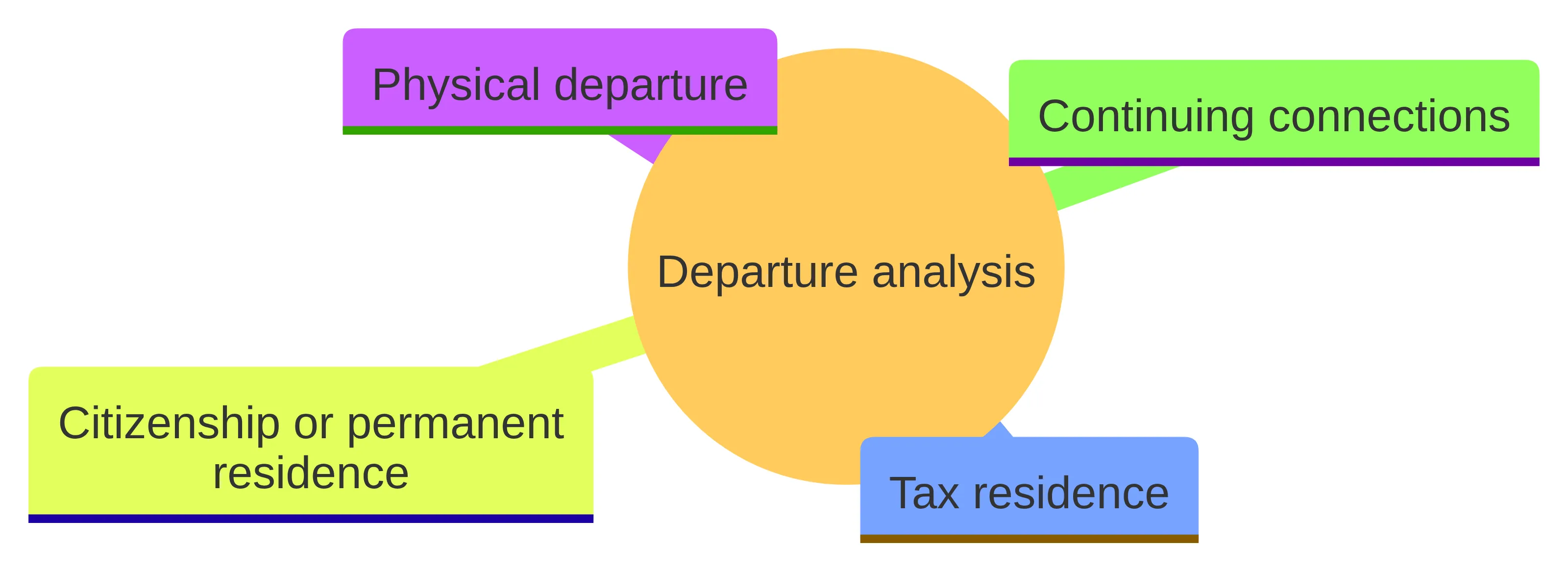
Your departure analysis should separate four questions:
- Are you physically leaving? Record the date you leave, where you go, and whether you return or continue spending time in the country you left.
- Are you changing tax residence? Review your time in each country, primary residence, and personal or financial ties rather than relying on the destination label.
- Are you relinquishing citizenship or permanent-resident status? For U.S. expatriation purposes, an expatriate is a citizen who relinquishes U.S. citizenship or a long-term resident who ceases to be a U.S. lawful permanent resident.
- What continues after departure? Examine source-based income, property, deferred compensation, business interests, reporting, and other connections separately from your physical location.
For U.S. expatriation purposes, the long-term-resident test generally looks to at least 8 years of lawful permanent residence in the last 15 tax years ending with the expatriation year, subject to the IRS treaty-residency rule. If you have held a green card over several periods, assemble the dates and the years involved instead of describing your history only as “formerly resident.” For a U.S. citizen, living abroad does not by itself resolve whether U.S. tax obligations continue; changing tax residence is not the same as relinquishing citizenship. Review ongoing obligations separately from the expatriation rules that apply when citizenship is relinquished. Keep two U.S. tracks in the file. Acquiring another residence or changing tax residence is therefore not a substitute for reviewing the obligations that apply during the period in which citizenship continues. This citizenship-based review is separate from asking whether a particular payment, asset, or activity has a U.S. source.
The expatriation track begins with the status event: relinquishment of citizenship or the ending of a long-term resident’s lawful permanent residence. Section 877A applies to the categories and dates identified above, but that statement alone does not determine whether a person is a covered expatriate or what consequences follow. The U.S. exit-tax review therefore asks whether relinquishing citizenship or ending long-term lawful permanent residence brings the person within the applicable expatriation rules and what tax or reporting consequences those rules may attach; current thresholds, tests, and consequences must be verified against publication-date IRS guidance.
Use separate rows for (1) obligations while citizenship continues, (2) the act and date that ends citizenship or permanent residence, and (3) any reporting or tax consequences that may follow that event. This prevents a destination-country residence permit from being treated as a relinquishment and prevents a relinquishment review from being treated as proof that every earlier obligation ended. Verify the current position against publication-date IRS guidance or qualified cross-border advice.
Canadian residence also requires a fact-specific timeline. If you lived in another country before Canada and leave Canada to resettle there, the CRA says you usually become a Canadian nonresident on the date you leave, even if your spouse or common-law partner temporarily stays to dispose of your home. That example does not answer every Canadian departure question, but it shows why the departure date and resettlement facts belong in the review.
These categories can overlap, but they do not replace one another. You may leave a country without ending every tax connection. You may obtain permission to live somewhere without becoming tax resident there. You may change tax residence without relinquishing citizenship or permanent-resident status. Write each proposed change as a separate line in your planning file, then ask for the consequence attached to that line.
Use this short question set before choosing a structure:
- What legal status do you hold today in the United States, Canada, and the intended destination?
- Which status do you expect to end, and on what date?
- Which status do you expect to begin, and what fact makes that date relevant?
- Which income, property, entity, compensation right, or family connection remains in the former country?
- Which filing, reporting, valuation, or payment question must be answered before the move rather than after it?
A clear answer to these questions will not calculate your liability. It will show where an individualized review is needed.
U.S. expatriation begins with the status being ended
Count the relevant years as a question for review, especially if your residence history includes treaty positions, interruptions, or changes in status. Do not reduce the analysis to the date printed on your most recent green card.
Section 877A applies to U.S. citizens who relinquished citizenship and long-term residents who ended residency on or after June 17, 2008. The date and type of status change therefore belong together in your file. Record the act that ends the status, the date associated with it, and the tax years leading up to that event.
Do not assume that moving to a country with lower personal tax rates automatically ends U.S. expatriation issues. Do not assume that ending a green-card relationship has the same consequences as relinquishing citizenship. Do not assume that a residence permit in the destination country answers whether the United States treats you as having completed the relevant status change. Each assumption should become a question for the professional review.
Prepare a status chronology with:
- every citizenship relevant to the analysis;
- every period of U.S. lawful permanent residence;
- treaty-residency positions that may affect the long-term-resident count;
- the proposed date and legal mechanism for ending the status; and
- any return, travel, or continuing U.S. connection that could affect the transition.
This chronology gives the adviser a defined starting point. It does not decide whether the U.S. expatriation rules apply to you.
The green-card transition requires a status check
Giving up a green card does not produce one automatic tax classification in every fact pattern. The IRS generally considers someone who gives up a green card a nonresident alien unless they meet the substantial presence test. Your review therefore needs both the green-card termination facts and the presence facts for the relevant period.
If you remain a U.S. resident alien after giving up your green card, the IRS generally applies the same income, estate, and gift tax filing and estimated-tax rules whether you are in the United States or abroad. The practical point is simple: physical departure and the end of a green-card status do not settle the tax-residence question on their own.
For a green-card transition, put these items in the review file:
- the date and manner in which lawful permanent residence ended;
- the relevant travel and presence calendar;
- the countries in which you claimed or may have claimed residence;
- any treaty position connected with residence; and
- the returns, payments, and information reporting associated with the transition.
Ask the adviser to test the substantial presence question against the actual dates, not an estimate based on your intended lifestyle.
This distinction matters because a former green-card holder may still have U.S. filing and payment questions even after relocating. It also matters in the opposite direction: treating the person as a nonresident without testing the applicable presence rule can leave an unresolved status issue. Keep the two possible outcomes visible until the facts have been reviewed.
U.S. obligations can continue after departure
A change in residence does not erase every U.S. income connection. A nonresident alien is usually subject to U.S. income tax only on U.S.-source income, although limited exceptions can apply to certain foreign-source income. For your planning file, classify each expected payment by source and by the activity or asset that produces it instead of grouping every post-departure receipt as foreign. That classification point prevents a common category error. A person who is still a U.S. citizen should not be placed into a nonresident-alien analysis merely because the person lives outside the United States. First identify whether citizenship continues, whether lawful permanent residence has ended, and which residence status applies for the period. Only then should the adviser test source, activity, and payment rules for each item. The same receipt can require different questions depending on the person’s status and the agreement or activity that produced it; the departure file should preserve those questions rather than label the receipt solely by destination.
For an entrepreneur, add a status column to the connection map: U.S. citizen, former citizen, current or former lawful permanent resident, or another status that requires confirmation. Add a separate date column for the move, the tax-residence change, the end of permanent residence, and any relinquishment of citizenship. Then link each income or compensation item to the status period in which it arose and to the work or property that produced it. This does not calculate tax. It gives the reviewer a way to distinguish continuing citizenship-based obligations from source-based questions and from the separate expatriation review.
If the proposed plan includes remaining a citizen while living abroad, ask which current U.S. filing and reporting obligations must be reviewed for each relevant year. If it includes relinquishing citizenship or ending long-term-resident status, ask which current expatriation rules and covered-expatriate tests apply. Keep both questions open until the status chronology and current-law review are complete.
For a nonresident alien, U.S. estate-tax exposure may depend on domicile, a separate determination from U.S. income-tax residence. That distinction is especially relevant when you retain a home, family connection, investment, business interest, or other relationship with the United States. Do not treat an income-tax residence conclusion as an estate-tax conclusion.
Deferred compensation creates another review point. Deferred compensation received by a nonresident alien can be taxable in the United States when the person is or was engaged in a U.S. trade or business, including performing personal services in the United States. Identify the agreement, the services that generated the right, the payment schedule, and the location of the relevant work.
The connection may also reach later years. Under IRC 864(c)(6), deferred compensation received by a nonresident alien may remain taxable as effectively connected income in later years even after the person is no longer engaged in a U.S. trade or business. A departure plan should therefore include compensation that has not yet been paid, not only wages or distributions expected immediately after the move.
Create a connection map with one row for each continuing item:
- U.S. real property or other U.S.-connected property;
- services performed in the United States;
- deferred compensation or other contractual payments;
- ownership, management, or income from a business;
- accounts, investments, or rights that may have a U.S. source; and
- family or home facts relevant to domicile.
For every row, ask what produces the income, where the underlying activity occurred, when payment is expected, and whether the item raises a separate estate-tax or reporting question.
If you own or operate a business, your personal departure is only one event in the timeline. The business may continue paying compensation, holding property, serving customers, or using personnel in places connected with the United States or Canada. Keep the owner’s status, the entity’s activities, and each payment stream in separate schedules so that a review does not treat them as one combined fact.
Form 8854 belongs in the expatriation review
Put the relevant status, date, and prior five tax years together before asking what reporting applies. The form question cannot be separated from the underlying expatriation category.
Collect copies of the prior five years of returns, payment records, notices, amended filings, and information reports that relate to the review. Add a list of unresolved balances, positions that required explanation, and documents showing when a filing obligation was satisfied. Use the records to identify questions; do not assume that possessing five years of returns proves compliance.
This section is a preparation prompt, not individualized filing instruction. Ask the professional to identify whether Form 8854 applies to your status, which information belongs on it, whether annual reporting continues, and how the relevant dates interact with other U.S. filings. Keep the answer with your status chronology and do not rely on a generic form checklist divorced from your facts.
Canada uses a different departure-tax lens
Canadian departure planning uses a deemed-disposition lens that differs from the U.S. expatriation framework. Canada’s tax authority provides guidance on deemed dispositions of property for people emigrating from Canada. Start by identifying the property you own and asking how the applicable Canadian departure rules address each category.
Canada’s emigrant disposition guidance addresses Canadian real or immovable property, Canadian resource property, and timber resource property. The guidance also identifies other categories and exclusions that may require a closer review. Do not place every asset into one “departure tax” bucket before classifying its location, legal nature, ownership, and connection to Canada.
Build the Canadian asset inventory before you decide whether to sell, retain, transfer, or restructure anything. For each item, record:
- the legal owner;
- where the property is located;
- the acquisition date and available cost records;
- any valuation or appraisal already obtained;
- whether the property produces income; and
- whether a corporation, trust, partnership, or other arrangement sits between you and the asset.
Use the inventory to frame questions, not to reach a Canadian tax conclusion by yourself.
The U.S. questions in this guide focus heavily on citizenship, lawful permanent residence, expatriation status, source, and continuing connections. The Canadian questions require you to examine emigration, residence, property categories, and the treatment assigned to those assets. Similar language about “leaving” does not mean the two countries use the same trigger or calculation.
If Canada is the country you are leaving, ask for a property-by-property review before transferring ownership or setting a departure date. If Canada is your destination, preserve the same discipline for assets and income that remain connected to the country you are leaving. The destination does not replace the departure analysis.
Canadian residence changes on facts, not on the destination label
Prepare a Canadian departure timeline showing:
- your last day of ordinary residence in Canada;
- the date you leave and the date you establish the next living arrangement;
- where your spouse or common-law partner lives during the transition;
- what happens to the Canadian home; and
- the continuing personal and financial ties that remain after departure.
Add supporting documents rather than relying on a statement that you “moved” on a particular day.
A spouse’s temporary stay to dispose of a home does not automatically answer the result in the CRA example. At the same time, you should not assume that a spouse’s departure, the sale of a home, or the acquisition of a foreign address settles every other Canadian issue. Test the residence question and the property question as separate workstreams.
Ask the adviser to identify the facts that establish your Canadian departure date, the property treatment that follows, and the obligations that may continue after that date. Keep the answer tied to the actual move you propose rather than to a general description of the destination country.
Residence permits do not settle tax residency
We recommend understanding each country’s tax-residency and residence-permit rules to avoid costly mistakes. Before relying on a destination, write down the immigration status you expect to hold, the days you expect to spend there, the home available to you, the work you will perform, and the personal or financial ties you will establish.
Your calendar should show more than the date of your flight. Track where you sleep, work, maintain a primary residence, support family, manage a business, and hold significant financial ties during the transition.
Use two columns in your planning file:
| Immigration position | Tax-residency question |
|---|---|
| What permit, visa, or status will you hold? | What facts make you tax resident, nonresident, or potentially resident under the relevant rules? |
| When does the immigration status begin? | When does the tax-residence period begin or end? |
| What conditions attach to the permit? | What income, assets, ties, and filing obligations must be reviewed? |
| Can the status change during the year? | Does a mid-year change require a separate timeline? |
The table is a planning aid. It organizes the questions but does not determine the result.
Do not use “resident,” “nonresident,” “expat,” or “digital nomad” as a substitute for the underlying facts. Use the formal status name where you know it, identify the country involved, and ask what the status means for the specific tax period under review.
Build the departure file before choosing a structure
Start with identity and status records:
- citizenships and passports relevant to the review;
- green-card or other permanent-resident history;
- prior countries of residence and the dates involved;
- treaty positions or residence certificates;
- immigration applications and permits for the destination; and
- the proposed act and date that will end or change each status.
Label each date as planned, completed, or uncertain. A date that still depends on a future decision should not appear as an established fact.
Next, build a day-by-day or month-by-month calendar for the transition. Include travel, homes available to you, work locations, family arrangements, business activity, and periods spent in each country. These details relate to the factors we use to assess tax residency: time spent in a country, the location of your primary residence, and significant personal or financial ties.
Collect tax and reporting records before the review. If U.S. expatriation rules may apply, place the prior 5 tax years of returns, payment evidence, notices, amended filings, and information reports together because Form 8854 is used to certify compliance with tax obligations in those years and to satisfy initial and annual information-reporting obligations under section 6039G.
Create an asset schedule with the owner, location, acquisition date, cost records, current valuation information, debt, income, and proposed disposition for each item. Include Canadian real or immovable property, Canadian resource property, and timber resource property because Canada’s emigrant disposition guidance addresses those categories. Add securities, interests in entities, trusts, retirement arrangements, insurance, intellectual property, and other rights that may matter to the analysis.
For each business or entity, record the jurisdiction of formation, ownership percentages, management location, operating locations, employees or contractors, bank accounts, intellectual property, customer base, intercompany arrangements, and expected post-move activity. Add the compensation you receive from the business and the compensation you may receive later. Keep company information separate from your personal residence chronology.
Identify deferred compensation and unpaid rights in a separate schedule. Include agreements, service locations, vesting terms, payment dates, and the entity that will pay you.
Take these questions to the professional:
- Which status change is actually proposed, and what date controls it?
- Which country treats you as resident during each part of the transition?
- Which assets require valuation, special classification, or separate treatment?
- Which business activities remain connected to the country you leave?
- Which compensation rights arose from services performed in a particular country?
- Which filings or reports relate to the prior five tax years or the departure year?
- Which assumptions about the destination, residence permit, or home could produce a different result?
- What facts would make the proposed structure unsuitable for further consideration?
Do not choose a structure merely because it appears to solve one tax connection. Ask for the consequences across the complete file.
Test the business and asset perimeter separately
For a business owner, classify each payment by its source and underlying activity rather than by the location of your new home. Ask where the work occurred, where the property is located, which entity made the payment, and what agreement creates the right to receive it.
Review personal and business property separately. Do not copy an income-tax residence conclusion into the estate-tax column without a separate question about domicile and the property involved.
Compensation deserves its own perimeter. Map the service period separately from the payment date, and include deferred amounts in the review.
If Canada is part of the move, separate Canadian property from other assets. Record whether an asset is held personally, through an entity, or through another arrangement, and ask how that ownership path affects the departure review.
Use this business perimeter checklist:
- Where are you performing management and operational services?
- Where are employees, contractors, customers, and suppliers located?
- Which entity owns the relevant contracts, intellectual property, accounts, and property?
- What compensation, distributions, deferred amounts, or sale proceeds may flow to you?
- What activity continues in the former country after your move?
- Does a proposed transfer change ownership without changing the underlying activity?
- Which records prove the location and timing of the work?
These questions identify connections for review. They do not assign a tax character to any payment or entity.
Do not combine the following decisions into one step: changing your residence, moving management, transferring an entity, selling property, assigning compensation, and changing ownership. Sequence them on a timeline and ask what each step changes before you take the next one. A structure selected before the perimeter is mapped may solve one issue while creating another.
Separate what is known from what must be verified
Your departure file can establish the facts you know, but it cannot substitute for a publication-date review of the rules that apply to those facts. Before acting, treat current thresholds, covered-expatriate tests, citizenship-based obligations, state consequences, Canadian departure-tax rules, filing and payment requirements, treaty interactions, forms, and deadlines as verification items.
Date the rule review to the day you will rely on it. A result reached for an earlier tax year may not answer a later departure, and a form or deadline may change between planning and implementation. Ask the professional to identify the authority and effective date for each material conclusion, then preserve that answer with the corresponding fact in your file.
Turn these common assumptions into written questions:
- “I am leaving, so no departure rule applies.”
- “My new residence permit makes me tax resident there.”
- “Giving up my green card ends every U.S. filing question.”
- “My citizenship is unchanged, so expatriation rules cannot matter.”
- “My company moved because I moved.”
- “A Canadian asset is treated the same way as every other asset.”
- “A prior year’s threshold, form, or deadline still applies.”
The correct response to each statement depends on your facts and the rules in force at the relevant time.
For each open item, record four things: the question, the facts supplied, the rule or authority reviewed, and the action that follows. Mark an item unresolved when a date, valuation, ownership record, status document, or jurisdictional position is missing. Do not convert an unresolved item into a projected tax result. Make the citizenship distinction an explicit current-law checkpoint. Ask the reviewer to answer, in writing, whether you remain a U.S. citizen during each period, whether a tax-residence change is being confused with a citizenship change, and which U.S. tax or reporting obligations continue while citizenship remains. If relinquishment is proposed, ask what act and date establish it, whether the long-term-resident rules are relevant, which covered-expatriate tests must be tested, and how Form 8854 fits the status and compliance history. These are separate questions, not a single conclusion called “exit tax.”
Because the applicable rules and filing requirements can change, request the current IRS authority or guidance used for each material answer and note its publication or effective date. Do not rely on a prior-year threshold, an old form instruction, or a general statement that a move ends U.S. obligations. If the facts change—such as the departure date, citizenship decision, green-card history, residence position, asset ownership, or business activity—refresh the review before implementing the next step. This verification step is especially important where the plan involves both continuing citizenship-based obligations and a possible expatriation event.
Use a simple decision gate before signing, transferring, relinquishing, or filing:
- The proposed status change is identified.
- The departure and destination timeline is documented.
- Personal, business, and asset connections are mapped.
- Current rules and material conditions have been checked.
- The consequences of acting now, delaying, or changing the plan are recorded.
If a gate remains open, pause that step and obtain the review needed to close it.
Use a professional review to test the facts
Changes to citizenship, permanent-resident status, tax residence, ownership, compensation, business activity, and significant assets belong in the departure review.
Give the professional a concise brief rather than a preferred answer. State where you live now, where you plan to go, the status you intend to end or acquire, the dates involved, the countries connected to your business, and the assets or compensation that may remain connected to the United States or Canada. Attach the departure file and identify every assumption you have made.
Ask the review to produce a written map of:
- each status being ended, retained, or acquired;
- the residence position for each relevant period;
- the assets, income, business activities, and compensation requiring separate treatment;
- the filings, information reports, valuations, and dates to examine; and
- the facts that would change the proposed course.
This format keeps the advice tied to the decision you are considering rather than to a generic relocation narrative.
Cross-border planning may involve several professional disciplines. The relevant question is not how many advisers you engage, but whether the personal, entity, immigration, property, and reporting facts are being considered together. Ask who owns each conclusion, which assumption it depends on, and what must be updated if your destination, timing, or ownership changes.
The next action is a documented pre-move review
Your next planning step is to document the move before you implement it. Separate physical departure, tax-residence change, citizenship or permanent-resident status, continuing source and domicile connections, business activity, compensation, and asset treatment. Then use the dated fact file to identify which current U.S. and Canadian rules require review.
We collaborate with lawyers, accountants, tax advisors, bankers, registered agents, realtors, and other professionals based anywhere in the world. A qualified professional decides individual suitability, obligations, and filing positions from your facts.
Before the conversation, have your status chronology, residence calendar, five-year filing records where relevant, asset and business schedules, deferred-compensation agreements, destination documents, and list of open questions ready. Ask for each proposed action to be tested against the status it changes, the connection it leaves behind, and the rule in force on the date you act.
What should be clarified before a cross-border departure review?
How can I prepare for potential exit tax implications before moving?
To prepare for potential exit tax implications, gather documentation regarding your citizenship, residency history, asset valuations, and any income sources. Create a timeline of your departure and resettlement plans, and consult a tax professional to review your specific situation.
What are the common mistakes to avoid when planning for departure taxes?
Common mistakes include assuming that a new residence automatically eliminates prior tax obligations, failing to track the timeline of residency changes, and not considering the implications of retaining assets in the original country. It’s important to understand the rules of both the departing and destination countries.
What is the significance of Form 8854 in the expatriation process?
Form 8854 is used by expatriates to certify compliance with U.S. tax obligations for the five years prior to expatriation and to satisfy initial and annual information reporting requirements.
How does the substantial presence test affect tax residency for former green card holders?
The substantial presence test determines whether a former green card holder is still considered a U.S. resident for tax purposes. If they meet the test, they remain subject to U.S. tax rules, including filing requirements, even after relinquishing their green card.
What should I include in my departure planning checklist?
Your departure planning checklist should include a timeline of your residency changes, documentation of your citizenship and residency status, asset inventories, income sources, and any relevant tax filings. Additionally, prepare questions for a tax professional regarding your specific situation.
Ask the team
Have a question about your own situation?
Tell us where you pay tax today and what you want to achieve. We will review your case and get back to you within 1 business day.