
Asset Protection Plan: A Decision Guide for Lawful Wealth Protection
Audit ownership, control, and flexibility before comparing structures
Asset protection is a broad set of strategies for managing legal risks and preparing for potential losses that result in money judgments. Use a control-and-flexibility audit to connect each potential exposure to the relevant asset or ownership interest, then note current ownership, connected jurisdictions, and the control and flexibility a proposed arrangement could change. For cross-border matters, a jurisdiction matrix can capture the jurisdictions connected to ownership, control, residence, assets, income, creditors, family rights, and enforcement as part of that record.
Build the audit by asking:
- What could create a claim against you, your business, your family, or a particular asset?
- Which asset or ownership interest is connected to that exposure?
- What ownership and control exist now?
- What change in control or flexibility would a proposed arrangement require?
This sequence keeps the analysis tied to relationships, purpose, and trade-offs. Asset protection planning may apply to many types of property, including cash, securities, business interests, insurance proceeds, personal property, and real estate, but the presence of an asset does not by itself establish that a particular structure is suitable. The surrounding facts determine the issue to examine.
Use the matrix as the organizing record. For each relevant asset or ownership interest, note the connected jurisdictions and the potential liability categories—personal, professional, contractual, family, property, tax, and digital. Then mark the ownership or control change under consideration and the flexibility it may reduce. A layered approach can combine insurance, asset titling, entities, and trusts to reduce exposure and preserve flexibility before a claim arises.
The matrix does not determine whether a structure works for your facts or replace the legal and tax analysis required before implementation. It gives professional reviewers a consistent record of the relationships, exposures, and trade-offs that need to be examined.
Use the matrix to separate lawful planning from creditor avoidance
Lawful asset protection is prospective legal-risk management, not a method for cheating existing creditors or hiding assets. Transactions intended to put assets beyond creditors’ reach may be nullified under fraudulent-transfer laws. That boundary is part of the decision, not a disclaimer added after a structure has been chosen.
A legitimate purpose might involve organizing ownership before a foreseeable business, professional, property, or contractual exposure becomes a claim. The purpose must remain transparent and legally defensible. A structure designed around concealment, evasion, or defeating an existing obligation does not become acceptable because it uses a trust, entity, account, or foreign jurisdiction.
Before discussing a transfer or new ownership arrangement, identify whether any claim, liability, creditor right, threatened claim, or anticipated liability already exists. Do not move assets to frustrate a known creditor or treat a pending problem as an invitation to conceal property. If those facts are present, stop treating the matter as a routine planning exercise and obtain legal review of the specific circumstances.
Use a simple boundary test before considering a structure:
- Purpose: Can you explain the intended risk-management purpose without relying on secrecy?
- Timing: Was the arrangement considered before the relevant creditor rights or remedies arose?
- Effect: Does the proposal involve a real change in ownership, legal title, or exposure rather than a paper label?
- Conduct: Can the arrangement be administered in a way that complies with the applicable rules?
A negative answer does not tell you which remedy applies, but it does tell you not to proceed on the assumption that the arrangement will provide protection. The next action is fact-specific legal review, not a more complicated structure.
Add exposures and assets to the jurisdiction matrix
Begin the jurisdiction matrix with potential liability categories: personal, professional, contractual, family, property, tax, and digital risks. For each category, connect the possible event to the asset or ownership interest it might affect and to the jurisdictions linked to ownership, control, residence, assets, income, creditors, family rights, or enforcement.
Keep one entry for each meaningful exposure rather than assuming that one structure addresses every category. Separate the questions for an operating business, an investment account, real estate, family-held property, or a digital asset. The purpose is to show where exposures overlap and where they remain distinct.
For each entry, record:
- the activity or event that could create a claim;
- the asset or ownership interest that could be affected;
- the relevant jurisdictional connections; and
- the question a proposed layer would need to answer.
Asset protection planning may apply to assets such as cash, stocks, bonds, business interests, insurance proceeds, jewelry, art, antiques, and real property. The asset list matters because legal title, existing obligations, use, value, and location can affect the questions a professional must examine.
Do not begin with a preferred vehicle and force every asset into it. Begin with the exposure and then ask whether the asset’s ownership, use, and surrounding obligations fit the proposed layer. A structure designed for a business interest may raise different questions from a structure involving a residence, an investment account, or property shared with family.
Relying on a single strategy can leave unintended gaps when potential liability arises from multiple categories.
That gives you a practical boundary: diversification of tools is not the same as immunity from claims. Ask what each layer is intended to address, what it leaves outside its scope, and how the layers interact. If the proposal presents a single trust, entity, policy, or jurisdiction as a complete answer, return to the exposure map and ask which risks remain unaddressed.
Compare structures by the relationships the matrix reveals
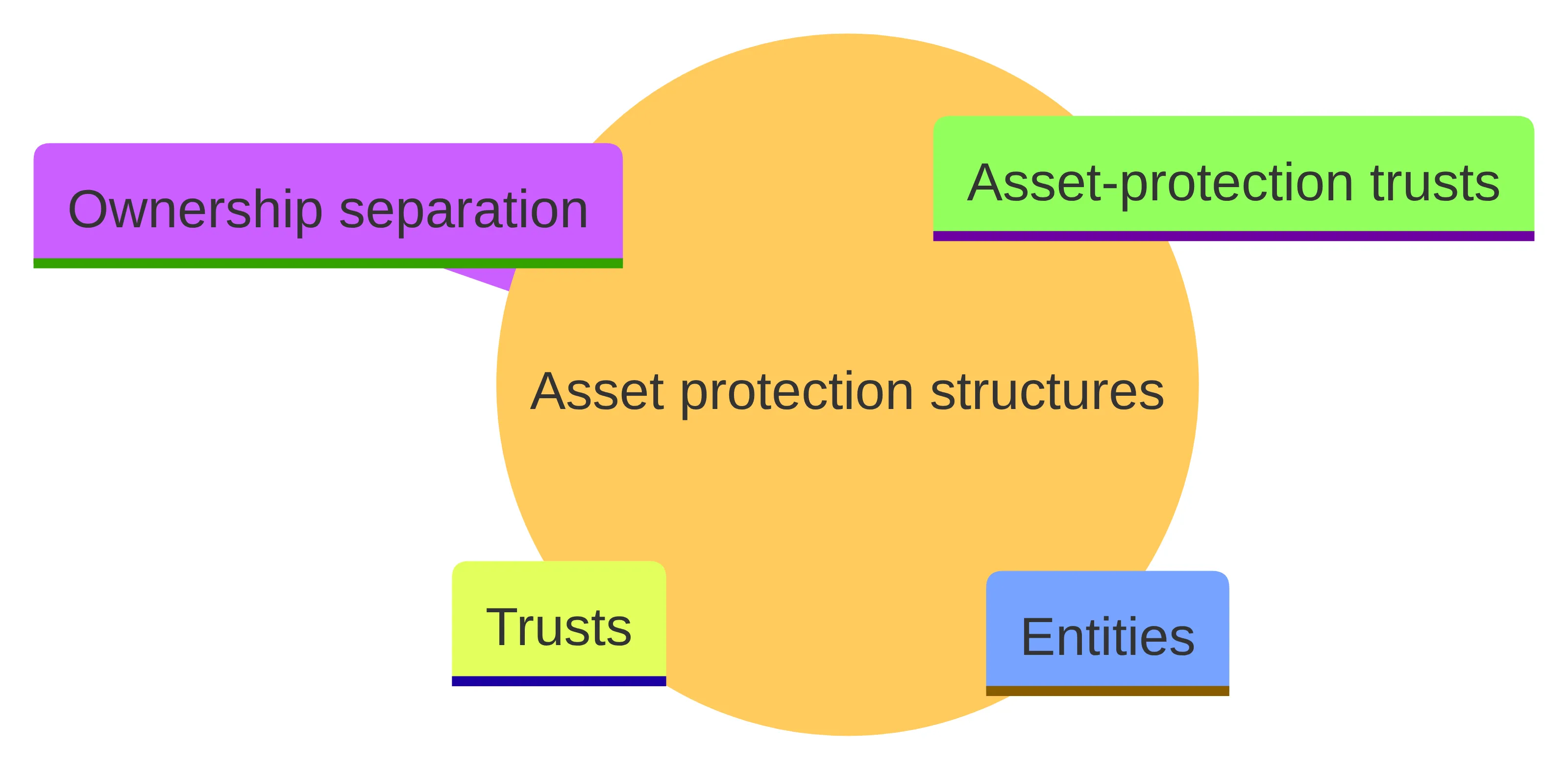
Ownership separation, entities, and trusts should be compared by the function they are intended to serve, not by the appeal of their names. Asset protection planning generally involves transferring assets from a less protected vehicle to a more protected one. That transfer can affect legal title, beneficial enjoyment, control, administration, and access.
| Approach | Function to examine | Questions to ask | Boundary |
|---|---|---|---|
| Ownership separation | Whether legal ownership is separated from your personal ownership position | Who holds legal title, who benefits, and what exposure is the separation intended to address? | A change in title does not by itself establish how a court, creditor, or other authority will treat the arrangement. |
| Entities | Whether an entity forms part of a layered ownership or asset-segregation design | Which asset or exposure is connected to the entity, and what ownership, administration, and jurisdictional obligations follow? | An entity is a layer to evaluate, not a universal answer for every asset or risk. |
| Trusts | Whether legal title and beneficial enjoyment are divided | Who is the trustee, who benefits, what control remains, and what does the trust agreement require? | A trust’s operation depends on its terms and controlling jurisdiction. |
| Asset-protection trusts | How irrevocability changes direct ownership, amendment, revocation, and access | What rights would change, and who would administer the arrangement? | The trust agreement and controlling jurisdiction determine how the trust works. |
A trust can separate beneficial enjoyment from legal ownership, so the person transferring assets may give up legal title while retaining beneficial enjoyment and possibly control. Trusts may remove a debtor from legal title while allowing direct or indirect retention of control over transferred assets. Those features make the exact terms and practical administration central to the analysis.
An asset-protection trust is an irrevocable trust designed to protect assets from potential creditors’ claims. The label does not answer whether the trust fits your circumstances. You need to examine the transfer, the retained rights, the beneficiaries, the trustee’s role, the governing law, and the timing together.
Use the comparison table to make the proposed function visible before you discuss implementation. If the proposal cannot identify the exposure, the asset, the ownership change, and the limitation for each layer, it is not ready for a meaningful review. A layered approach may combine several tools, but adding tools does not remove the need to test each one against the same facts.
Mark control and flexibility changes in the matrix
Control is part of the cost of protection planning. Many asset-protection strategies can reduce the control and flexibility you have over your assets. A proposal that changes title or places property into a trust may also change who can direct, amend, revoke, access, or administer the arrangement.
An asset-protection trust is irrevocable: the settlor gives up direct ownership and cannot independently amend or revoke it. The trust agreement and controlling jurisdiction determine how it works. That means you should examine the rights you would retain rather than treating “control” as a general promise.
Before considering an irrevocable trust, LLC, LP, or another structure, write down the trade-offs you would accept and the limits you would not. Ask:
- Who would hold legal title after the transfer?
- Who could make decisions about the asset?
- Could the arrangement be amended or revoked independently?
- What beneficial enjoyment or access would remain?
- Which decisions would require another person’s consent?
- How would the loss of flexibility affect your business, family, investment, or personal plans?
The purpose of this list is to make the exchange concrete. A structure that reduces exposure but prevents you from handling an asset as expected may not fit your purpose. Before placing assets into a structure, weigh the options with attorneys and tax advisors.
Do not measure a proposal only by the assets it appears to place behind a legal vehicle. Measure it by the rights, responsibilities, and flexibility that move with those assets. If the proposed arrangement changes a decision you consider essential, record that limitation before comparing jurisdictions or adding another layer.
Complete the jurisdiction matrix across borders
Build the jurisdiction matrix before selecting a structure. It should compare the jurisdictions connected to ownership, control, residence, assets, income, creditors, family rights, and enforcement. For each connection, record the country or other jurisdiction involved and the question it creates. Ownership may connect to one jurisdiction, residence to another, an asset to a third, and enforcement to a fourth. Examine the same questions across the matrix instead of assuming that a single structure has a single global effect.
The matrix is a comparison record, not a ranking of jurisdictions. Its purpose is to expose relationships that require coordinated review before relying on diversification or a foreign formation location.
Use this sequence when you have a cross-border connection:
- List where you reside and where you may have residence-related rights or obligations.
- List where each relevant asset, income stream, business interest, and account is located or connected.
- Identify where ownership and control are exercised.
- Identify where a creditor, family claimant, or other party might seek enforcement.
- Record the jurisdictions whose rules could affect title, transfers, beneficial enjoyment, administration, or recognition.
- Compare the questions across the map before choosing a vehicle or location.
This process does not rank jurisdictions or predict an outcome. It tells you which relationships require coordinated review. A foreign formation location cannot, by itself, answer questions created by residence, ownership, income, creditors, family rights, or enforcement elsewhere.
We apply layered ownership, asset segregation, and jurisdictional diversification to reduce exposure to lawsuits, political risk, and financial instability. Those tools still have to be tested against the complete jurisdiction map. Diversification is a design variable, not a guarantee that every connected jurisdiction will recognize or treat the arrangement in the same way.
If your facts cross borders, bring the map into the professional review. Do not choose a jurisdiction first and then search for facts that support it.
Test timing, transparency, and compliance against the matrix
Treat transparency as a design requirement rather than a public-relations preference. Do not rely on secrecy, incomplete disclosure, or a nominal transfer to support a protection conclusion. If the timing or purpose is uncertain, pause the proposed implementation and obtain a review of the relevant facts before transferring assets.
Before implementation, turn each unresolved issue into an explicit review item. For every proposed transfer or layer, record (1) the purpose it is meant to serve, (2) the ownership or control change it would create, (3) the jurisdictions whose rules may affect it, (4) the continuing compliance or administration questions, and (5) the limitation that would remain if the layer were disregarded. Then label each item as established, unknown, or requiring professional determination. Do not treat an unknown as evidence that protection exists. This distinction helps separate a plan that is ready for coordinated legal and tax review from a concept that is only a collection of structure names. It also gives the advisers a focused list of questions without turning the matrix into a prediction about creditor outcomes. The more unresolved items concern timing, transparency, control, or jurisdiction, the more important it is to pause implementation until those issues are addressed.
Bring the matrix and supporting facts to professional review
A useful review begins with a fact file linked to the completed jurisdiction matrix, not a preferred structure. Together, they should show what you own, what you control, where the relevant connections exist, what risks you are addressing, and what trade-offs you can accept.
Prepare these items:
- Exposure list: personal, professional, contractual, family, property, tax, and digital risks that may create liability.
- Asset inventory: cash, securities, business interests, insurance proceeds, personal property, real estate, and other assets within the intended scope.
- Ownership record: current legal title, beneficial enjoyment, control, co-owners, and any existing vehicle.
- Timing record: known claims, creditor relationships, anticipated liabilities, planned transactions, and the date-sensitive facts surrounding them.
- Jurisdiction map: residence, ownership, control, asset location, income, creditors, family rights, and possible enforcement locations.
- Trade-off statement: the control, access, flexibility, and administrative burdens you would accept or reject.
- Purpose statement: the lawful risk-management objective in plain language.
Take these questions into the review:
- Which specific exposure is each proposed layer intended to address?
- Which asset or ownership interest would connect to that layer?
- What legal title, beneficial enjoyment, or control would change?
- What jurisdiction governs each relevant relationship, and where might enforcement occur?
- What timing facts could affect the transfer or its treatment?
- What compliance, administration, tax, or reporting obligations would continue after implementation?
- What risks remain if a layer does not address the intended exposure?
- What flexibility would you lose, and what decisions would require another person’s involvement?
- Which professionals are responsible for the legal, tax, financial, or administrative parts of the analysis?
The questions force the proposal to connect purpose, structure, timing, jurisdiction, and trade-offs. Before placing assets in an irrevocable trust, LLC, LP, or another structure, weigh the options with attorneys and tax advisors.
Use the fact file to organize the conversation and expose unanswered questions. It is a preparation tool, not a conclusion about legal effectiveness, tax treatment, creditor rights, or personal suitability. If the proposed structure cannot be explained against the file’s exposure, timing, ownership, control, and jurisdiction entries, ask for that explanation before considering implementation.
Decide whether a planning consultation is the appropriate next step
We help investors in equity, real estate, crypto, and portfolios protect their wealth, gain second residency or citizenship, and optimize taxes across borders. We provide a Global Wealth Protection Service that builds legal structures to safeguard wealth against risks, creditors, and uncertainty.
We collaborate with lawyers, accountants, tax advisors, bankers, registered agents, realtors, and other professionals based anywhere in the world. Use the framework above to prepare the facts and scope of the discussion before taking the next step.
What should you ask before pursuing an asset protection plan?
What types of assets can be included in an asset protection plan?
Asset protection planning may apply to various assets, including cash, stocks, bonds, business interests, insurance proceeds, jewelry, art, antiques, and real property.
When should asset protection planning be established?
Asset protection planning should be established before any creditors are entitled to remedies under applicable laws.
What are the common threats that an asset protection plan addresses?
Common threats include personal, professional, contractual, family, property, tax, and digital risks that could create liability against an individual’s assets.
Why is individualized legal and tax advice necessary before implementing an asset protection plan?
Individualized legal and tax advice is crucial because asset protection strategies can significantly affect control, flexibility, and compliance with laws.
How does cross-border asset protection differ from domestic strategies?
Cross-border asset protection requires mapping jurisdictions connected to ownership, control, residence, and enforcement. Each jurisdiction may have different rules affecting how assets are treated, making it essential to analyze these connections before implementing a strategy.
What factors should be considered when evaluating an asset protection plan?
Key factors include timing, transparency, compliance with laws, the level of control retained, and the specific risks the plan is designed to address.
Ask the team
Have a question about your own situation?
Tell us where you pay tax today and what you want to achieve. We will review your case and get back to you within 1 business day.