
Asset Protection Plans: How to Evaluate Lawful Wealth Protection Before You Act
What an asset protection plan is—and is not
Asset protection planning is a risk-management approach that addresses legal risks and potential money judgments. It is a way to examine how ownership, legal structures, and other planning choices may affect the exposure of your wealth to claims; it is not a promise that assets cannot be reached. Some circumstances remain outside your control and the control of your advisers, so planning cannot guarantee a particular outcome.
Asset protection is also not a lawful method for cheating existing creditors or hiding assets. Timing and intent matter. A transfer made after a claim-producing event, or made with the intention of hindering, delaying, or defrauding a creditor, may be challenged or invalidated under applicable law.
Do not use the label as a substitute for separate questions about insurance, tax planning, or estate planning. During a review, ask which recommendation addresses legal risk, which addresses tax treatment, which addresses succession or incapacity, and which addresses another need. A proposal may involve more than one area, but the name of a trust, entity, or jurisdiction does not answer those questions by itself.
Readiness gate 1: record the proposed purpose
At the first readiness gate, write the proposed purpose and scope in plain language. Record the legal risks under review, the assets or income streams within scope, the people or entities connected to them, and the point in time when the concern may arise.
A useful starting list includes:
- Lawsuits or other legal claims that could lead to a money judgment.
- Ownership arrangements that connect your assets to another owner’s liabilities or conduct.
- Political risk or financial instability affecting a country, institution, or income stream.
Your objective is not to find a structure that sounds protective in the abstract. Your objective is to determine whether the proposed arrangement addresses the exposure you have identified, under the law that may apply to it, without creating a larger problem elsewhere.
We apply layered ownership, asset segregation, and jurisdictional diversification to reduce exposure to lawsuits, political risk, and financial instability. That description identifies tools used in our approach; it does not mean that every tool fits every asset or eliminates legal risk. Ask for the connection between each proposed layer and the exposure it is meant to address. Risk mapping also helps distinguish a concern from a proposed remedy. Record the event or condition being considered, the asset or income stream connected to it, the other people or entities involved, and the point in time at which the concern could arise. Note uncertainty openly rather than filling it with a preferred structure. The resulting record can show which questions are ready for professional analysis and which facts must be established first.
The planning components that may form the perimeter
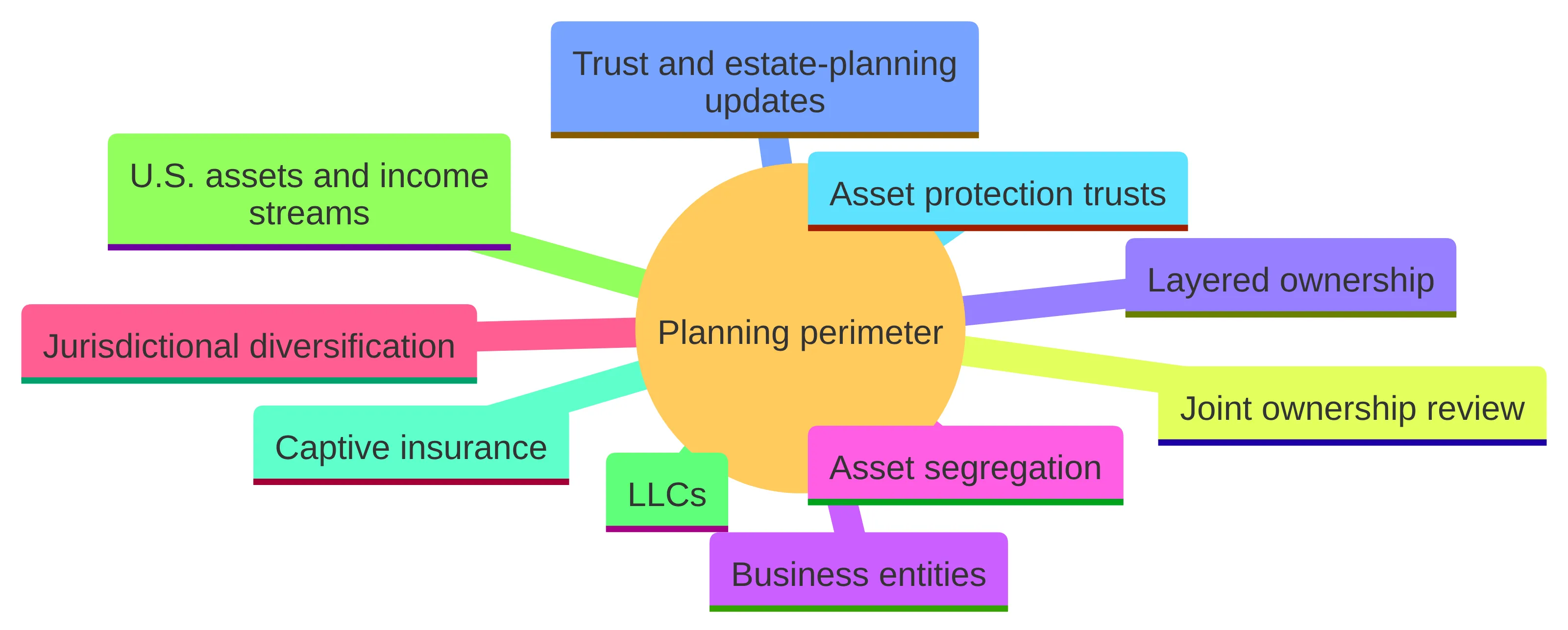
The planning perimeter may combine several components, but no single component is universal. Potential planning components include business entities, trust and estate-planning updates, a review of joint ownership, and attention to U.S. assets and income streams. Each component should have a stated purpose and a defined owner or professional responsible for its design and maintenance.
Depending on the facts, planning discussions may also include LLCs, captive insurance, or asset protection trusts. Asset protection planning may involve LLCs and captive insurance in addition to, or instead of, asset protection trusts; each requires professional review. The relevant question is not whether a tool is familiar or associated with a particular jurisdiction. The relevant questions are what the tool is intended to do, what legal conditions govern it, and what consequences follow from using it.
Our stated approach uses layered ownership, asset segregation, and jurisdictional diversification. Treat those terms as a description of possible design elements rather than as a conclusion about your own situation. For each asset, map the proposed ownership, the account or entity holding it, the related income stream, and the exposure that the arrangement is supposed to address.
A clear perimeter also separates assets that face different risks. That separation should be explained in practical terms: which assets are grouped, which are kept apart, who controls each layer, and what records or continuing actions the arrangement requires. If a proposal cannot answer those questions, pause before evaluating its name or location. To compare components without assuming that more layers are better, create a perimeter map. For every proposed entity, trust, account, ownership layer, or diversification step, record its stated purpose, the assets or income streams it touches, who owns or manages the relevant interest, the country whose rules may matter, and the continuing records or actions it requires. Add a separate line for what the component does not address. The map exposes overlaps and gaps before a recommendation is treated as a complete plan.
Ownership and control determine the practical trade-off
Ownership and control determine much of the practical trade-off. An asset protection trust generally transfers ownership of placed assets to a trustee for management. That change makes the trustee’s role, your retained powers, the beneficiaries, and the governing documents central questions rather than drafting details.
An asset protection trust may add a layer of protection, but it does not create immunity from claims. Ask what authority you retain, what authority the trustee exercises, how decisions are made, and what happens if the relationship, jurisdiction, or family circumstances change. Ask for the conditions under which the intended protection may not apply.
Ownership through a general partnership or joint arrangement can expose assets to problems involving another owner. For that reason, examine every shared title, account, entity, and business interest before adding another layer. The review should identify:
- Who owns the asset under the relevant documents.
- Who can direct, transfer, pledge, or use it.
- Which other person’s conduct or liabilities could affect it.
- What practical access you would have after a transfer or restructuring.
A structure that reduces one exposure while removing control or creating uncertainty about access may be a poor fit. Compare the legal purpose with the ownership consequences before implementation. Control should be assessed through decisions, not only titles. Record who can approve a transfer, pledge an asset, appoint or replace a decision-maker, receive information, and access funds under the governing arrangement. Then note the conditions, delays, or professional coordination those actions involve. This does not decide whether reduced control is acceptable; it makes the trade-off visible. Compare those practical conditions with the access and oversight the reader needs before treating a transfer of ownership as workable.
Timing is a legal boundary, not an implementation detail
Timing is a legal boundary, not an implementation detail. Planning generally needs to occur before an event that may produce a claim; transfers made afterward may be challenged.
Transfers intended to hinder, delay, or defraud creditors may be challenged or invalidated under applicable law. That boundary applies to both the proposed structure and the purpose behind the transaction. A last-minute transfer is therefore not a routine implementation step that can be evaluated apart from an existing dispute, debt, guarantee, accident, or other claim-producing event.
Before acting, ask whether any claim, threatened claim, obligation, guarantee, insolvency concern, or transaction dispute already exists or could reasonably affect the transfer. Provide those facts to the professionals reviewing the arrangement. Do not move, retitle, gift, or place assets into a structure as a response to an existing claim without qualified legal review of the transaction and its purpose.
The practical decision is straightforward: investigate planning while your circumstances can be reviewed prospectively, and stop if the proposed transfer depends on hiding assets or putting them beyond a lawful creditor’s reach.
Cross-border facts can change the analysis
Cross-border planning can change the analysis because more than one country may apply its own rules to the same person, asset, entity, trust, or transfer. A U.S.-connected review may require examining your citizenship, income-tax residency, estate-tax domicile, and assets by country, including their U.S. treatment.
A cross-border fact file should identify:
- Your citizenship and tax residency, along with any change being considered.
- The country where each relevant asset, account, entity, or income stream is located.
- The U.S. treatment of foreign assets and the treatment of U.S. assets in another country.
- Any trust, entity, will, ownership arrangement, or transfer that may be recognized differently across borders.
- The people and professionals responsible for decisions, records, tax work, and legal documents in each country.
Cross-border planning may also require coordination with counsel in other countries on local wills, inheritance rules, governing law, entities, and recognition of trusts. Those questions cannot be answered by choosing a foreign jurisdiction from a list. Ask how the proposed arrangement is expected to operate in each relevant country and what happens if the countries apply different rules.
A foreign connection can also add reporting, coordination, and administration questions. Treat those questions as part of the structure’s cost and risk, not as paperwork to address after formation. If the proposal does not explain the interaction between U.S. rules and the other applicable systems, do not proceed on the basis of the foreign label alone.
What an asset protection plan cannot promise
Asset protection planning cannot promise immunity, certainty, or a result independent of the facts and applicable law. An asset protection trust may add a layer of protection, but the relevant description is that it may make seizure more difficult for creditors or lawsuits, not that it prevents claims.
The limits should be written into your evaluation before you compare providers or structures. Ask:
- What outcome is the arrangement intended to support?
- Which facts could prevent that outcome?
- Which authority, court, creditor, or other party could challenge the arrangement?
- What control, access, cost, administration, or reporting burden would you accept?
- What must be updated if your residence, citizenship, business, ownership, or family circumstances change?
Asset protection planning cannot guarantee a particular outcome because some circumstances remain outside the control of advisers and clients. Ask for the conditions and limitations in plain language.
Administrative work matters as well. Identify who maintains records, coordinates professionals, handles required filings where applicable, and reviews the arrangement after a change in circumstances. A structure that cannot be maintained as designed may not deliver the practical result you expect, even if its documents were completed.
Questions to ask before accepting a proposed structure
A proposed structure deserves a written review before you accept its name or jurisdiction. Use these questions to test the plan and the people responsible for it.
Purpose and fit
- What specific exposure is this arrangement intended to address?
- Which assets, income streams, or ownership relationships are within scope?
- What is outside scope, and what result would show that the arrangement does not fit the stated exposure?
Ownership and control
- Who owns each asset after implementation?
- Who manages it, who can make decisions, and what access do you retain?
- Could another owner’s liabilities or conduct affect an asset held jointly or through a shared arrangement?
Timing and legality
- What legal conditions must be satisfied before implementation?
- Which transactions would need to stop for further review?
Cross-border and tax questions
- Which countries are involved, and how will citizenship, tax residency, estate-tax domicile, and assets by country be reviewed?
- Which local counsel will address wills, inheritance rules, governing law, entities, and trust recognition?
- Who will handle U.S. treatment, foreign treatment, reporting, and coordination?
Provider and cost review
- What does each professional do, and where does that responsibility end?
- If financial advice is part of the engagement, is the adviser subject to a fiduciary duty, and what does that duty cover?
- If an employer plan pays for services, which services are included, are the fees reasonable, and how will fees and expenses be monitored over time?
- What conflicts, referral arrangements, additional charges, and continuing work should you understand before agreeing?
Require answers that connect each recommendation to your facts. A polished diagram is not a substitute for a responsibility map, a limitations list, and a clear account of ongoing work. Keep a written record of what each professional agreed to do, what information that person relied on, and what questions remain for another discipline or country. Compare that scope with the proposed work and note any continuing administration or charges discussed. If an answer depends on another professional, identify the dependency before treating the proposal as complete. A clear record distinguishes an answered question from one that has only been deferred. It also gives you a specific point to revisit when facts change, without assuming that an earlier explanation covers a later transaction or a different asset. When an employer plan pays for services, keep the stated services beside the fees and note how reasonableness and ongoing monitoring will be addressed. This record organizes the review; it does not replace the legal, tax, or financial professionals who assess the relevant questions. Ask each professional to identify the limits of their role and the handoff needed before implementation. To make that review operational, assemble one working file containing the asset and income-stream inventory, ownership and control documents, the cross-border fact file, identified claims or obligations, and each professional’s stated scope. Compare the powers described in the documents with the proposed explanation of who can approve transfers, pledges, use, or access. Mark any mismatch or missing document as an unresolved review item rather than assuming that another layer will correct it. Then list the country-specific and discipline-specific questions still awaiting confirmation, along with the person responsible for answering each one. Create a maintenance calendar for the continuing records, actions, and review points triggered by changes in residence, citizenship, business, ownership, or family circumstances. Treat timing and purpose review, document and control verification, and professional handoffs as approval gates. The file should end with a provisional go, pause, or no-go status for further professional review—not a legal conclusion or guarantee—and should show exactly which unresolved issue controls that status.
Asset protection trust comparison: ownership, control, and professional review
For an investor comparing an asset protection trust with other lawful structures, start by asking whether ownership of placed assets would transfer to a trustee, what control would remain, and how the arrangement would serve intended beneficiaries. Asset protection planning cannot guarantee a particular outcome because circumstances may remain outside your control and the control of your advisers.
A qualified legal and tax professional should assess whether a proposed arrangement fits your individual circumstances, applicable law, existing obligations, and cross-border facts before you implement it. Ask the professionals involved to explain their responsibilities, coordinate where more than one country is involved, and identify the conditions that could change the analysis.
We provide a Global Wealth Protection Service that builds legal structures to safeguard wealth against risks, creditors, and uncertainty. We collaborate with lawyers, accountants, tax advisers, bankers, registered agents, realtors, and other professionals around the world. Use the same review standard for any provider: connect the proposed work to your facts, understand its limits, and proceed only when the legal and tax review supports the next step.
Ask the team
Have a question about your own situation?
Tell us where you pay tax today and what you want to achieve. We will review your case and get back to you within 1 business day.