
Asset Protection Planning: A Cross-Border Decision Guide for Lawful Wealth Protection
Asset protection begins with a lawful planning question
Asset protection planning is a recognized area of practice focused on protecting and conserving accumulated wealth or an asset base. For you, that means starting with the relationship between your assets, ownership arrangements, control, potential liabilities, and the claims that could affect particular assets. It is a planning question before it is a structure question.
The useful opening question is not which trust, entity, account, or foreign location to choose. It is whether a lawful arrangement could address a defined exposure while remaining consistent with your ownership goals, tax responsibilities, reporting duties, and applicable law. That approach keeps the discussion tied to your facts instead of treating a named product as the answer.
You may be considering this work because of business liability, investment exposure, cross-border connections, family considerations, or uncertainty about how assets are held. Each concern can change the questions that need to be examined. A plan designed around a business-related claim may raise different issues from one involving investment assets, real estate, or assets connected to more than one country.
A useful first conversation should therefore clarify four points:
- What exposure are you trying to examine?
- Which assets, owners, controllers, and jurisdictions are connected to it?
- What legal, tax, reporting, and practical responsibilities would accompany a proposed change?
- Are there existing or anticipated claims that could affect the analysis?
Those questions do not predict an outcome. They define the work required before anyone can discuss implementation responsibly.
Lawful asset protection planning can be permissible, but transfers may still raise creditor-recourse and fraudulent-transfer concerns. The distinction matters because moving ownership or control does not erase the legal context surrounding the transfer.
Your objective should be lawful risk planning, not concealment or obstruction. A proposal that depends on hiding assets, evading taxes, defrauding creditors, or obstructing lawful claims is outside that objective. The existence of a cross-border element does not change the boundary.
That is why the first stage should test relevance rather than promise protection. You are assessing whether a coordinated review of purpose, assets, control, jurisdiction, timing, and compliance is warranted. The result of that assessment may be a decision to explore planning, to gather more facts, or to stop before implementation.
Separate protection planning from adjacent financial objectives
Tax reduction, insurance, investment management, and ordinary business risk management can all affect your broader financial risk picture, but they answer different questions. Keeping those purposes separate prevents a tax result, an investment location, or an insurance policy from being treated as automatic protection against a creditor or lawsuit.
| Objective | What the objective examines | Boundary for the protection question |
|---|---|---|
| Tax reduction | How transactions, entities, income, residence, and jurisdictions are taxed and reported | A lower tax result does not by itself establish protection from a creditor or lawsuit. |
| Insurance | Whether part of a defined risk can be transferred under a policy | Coverage operates through limits, exclusions, and conditions and may not cover every exposure. |
| Ordinary business risk management | Contracts, controls, staffing, cybersecurity, continuity planning, and related operating practices | These measures may matter to your risk profile but do not answer every ownership or creditor question. |
The table is a sorting tool, not a statement that any objective is irrelevant. Insurance may be part of a broader response to a defined risk. Investment diversification may address concentration. Tax analysis may affect the cost or reporting consequences of a proposed arrangement. None of those functions should be assigned a different legal function merely because they appear in the same overall plan.
Start by naming the purpose of each proposed step. If the purpose is tax reduction, analyze tax and reporting consequences. If the purpose is investment allocation, analyze the investment decision. If the purpose is to examine ownership and creditor exposure, keep that question distinct and ask what legal rules govern it.
A practical test is to complete this sentence for every proposed component: This step is intended to address ____. Then ask whether the stated function matches the tool being discussed.
For example, locating an investment outside the United States may change the investment geography, but it does not automatically turn the investment into a liability structure. A policy may transfer part of a defined risk, but its conditions determine the scope of that transfer. A lower tax result may change tax economics, but it does not by itself answer whether a creditor can pursue a particular asset.
This separation also improves your questions. Instead of asking whether a plan protects everything, ask which exposure each component addresses, what conditions apply, and which risks remain outside that component. That produces a narrower and more useful review.
Treat legal structures as functions, not promises
Legal structures should be evaluated by the function they are meant to perform for particular assets, not by their names or the jurisdiction attached to them. Asset protection analysis should examine how ownership, control, liability, and legal claims affect particular assets.
That framework gives you a disciplined way to examine a proposed arrangement:
- Ownership: Who legally owns the asset now, and who would own it after a proposed change?
- Control: Who can direct, use, manage, transfer, or otherwise influence the asset?
- Liability: Which business, personal, contractual, or other exposures are connected to the owner or asset?
- Legal claims: Which claims or enforcement questions could affect the asset, and under which legal systems?
These questions are related, but they are not interchangeable. A change in ownership may affect control. A retained power may affect how the arrangement is viewed. A connection to a foreign jurisdiction may add another legal system without eliminating the laws connected to the owner, the asset, the creditor, or the underlying conduct.
The planning task is to trace those relationships rather than assume that a structure produces a universal result. You should be able to explain what each component is intended to do, which asset or exposure it relates to, and what conditions would affect its operation.
The same arrangement can raise several different questions at once. An ownership question may connect to business-entity law. A transfer question may connect to creditor rights or fraudulent-transfer rules. A cross-border connection may add foreign law, reporting, and enforcement issues. A tax objective may create a separate analysis rather than resolve the ownership question.
Treat a proposed structure as a set of legal relationships to examine. Do not treat it as a promise that a particular asset will be unreachable, that a creditor will be unable to pursue a claim, or that the arrangement will produce a particular tax result.
Ask whether diversification changes geography, law, or neither
Geographic diversification and jurisdictional diversification are not the same. An investment outside the United States through a domestic institution may diversify geography while remaining within the U.S. legal framework.
Jurisdictional diversification can involve holding assets in foreign legal systems, but its legal effect depends on the jurisdictions involved; U.S. courts may not have authority over accounts held in other countries. That possibility does not establish a result for your assets. It identifies a question about which courts, laws, custodians, owners, and enforcement procedures may be connected to them.
The distinction is easiest to see through three separate questions:
- Where is the underlying asset located?
- Where is the institution, custodian, owner, or controlling arrangement legally connected?
- Which jurisdiction may govern ownership, enforcement, creditor rights, reporting, or another relevant issue?
An investment can have an international geographic profile while remaining connected to a domestic legal framework. A foreign account can involve both geographic and jurisdictional diversification. An asset can also be connected to several jurisdictions at the same time. The location on a map is only one part of the analysis.
Enforcement against assets held by a foreign custodian may require a creditor to navigate the foreign jurisdiction’s laws, which can be complex and burdensome. That describes an enforcement question; it does not promise that an asset is protected or unavailable to a lawful claimant.
Before treating jurisdictional diversification as part of a protection strategy, ask:
- Which legal systems are connected to the asset and its owner?
- Which law addresses ownership and control?
- Which law addresses creditor rights and enforcement?
- What reporting or compliance responsibilities accompany the connection?
- Does the proposed arrangement change the relevant legal relationship, or only the asset’s geographic location?
Those questions help you distinguish a change in investment geography from a change in the legal framework relevant to ownership or enforcement. They also keep the discussion from assuming that one foreign location has one effect across every connected jurisdiction.
Put timing and existing claims on the compliance side of the decision
Timing belongs in the legal and compliance analysis, not as an implementation detail added at the end.
Before discussing a transfer or change in control, identify whether a creditor issue, dispute, claim, demand, proceeding, or other material event already exists or is anticipated. The relevant question is not simply when an arrangement could be created. It is how the timing and surrounding circumstances affect the legal analysis.
A proposed change should therefore be tested against the following boundaries:
- It must have a lawful planning purpose.
- It must be considered with the creditor and debtor rules that may apply.
- It must account for fraudulent-transfer or conveyance concerns.
- It must not depend on concealing assets, evading taxes, defrauding creditors, or obstructing lawful claims.
- It must be examined alongside the tax and reporting consequences connected to the change.
Do not treat the absence of an immediate dispute as a conclusion about legal effect. Treat timing and surrounding facts as information that must be raised before implementation is discussed.
Compliance also includes conduct after an arrangement is created. Ownership, control, reporting, and tax treatment should remain consistent with the applicable rules and the facts represented in the planning process. A cross-border arrangement can create more than one set of legal and administrative questions.
If your purpose is to respond to an existing or threatened claim by making assets harder to reach, stop and identify that issue before taking action. If your purpose is lawful forward-looking planning, state that purpose precisely and have the timing, transfer, and compliance questions examined together. This boundary protects the integrity of the decision even before a structure is compared.
Trace one cross-border enforcement question
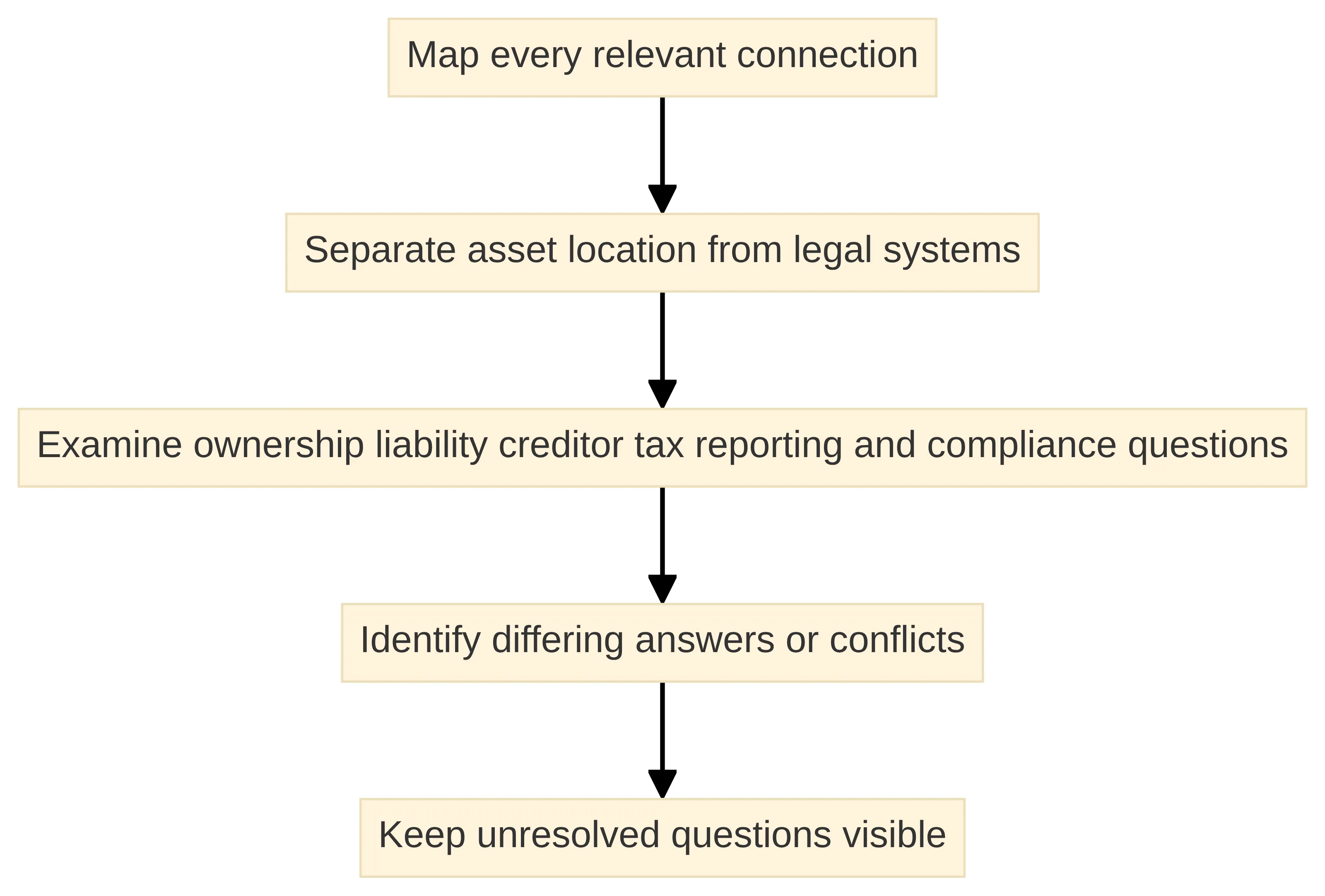
Cross-border asset protection questions are easier to examine when you isolate one potential enforcement issue at a time. Start with the particular asset, ownership arrangement, or claim in question. Then record the connections that bear on that issue instead of treating a foreign location as the answer.
For each issue, record:
- Purpose: What risk or exposure are you examining, and what would you want a lawful arrangement to address?
- Asset and ownership: Which asset or arrangement is involved, where is it located, and who owns or controls it?
- Claim and liability: What business, personal, contractual, creditor, or legal-claim issue is being examined?
- Jurisdictional connections: Which jurisdictions are connected to ownership, control, residence, income, the asset itself, creditors, family rights, or possible enforcement?
- Compliance questions: Which questions involve taxation, business entities, bankruptcy, creditor and debtor law, or fraudulent-transfer and conveyance rules?
This record frames a question for further analysis; it does not determine whether protection exists or whether any arrangement is suitable. Its purpose is to keep the ownership, control, liability, and legal-claim questions tied to the particular issue before a broader strategy is discussed.
With one issue defined, compare the jurisdictions connected to that issue rather than starting with a catalogue of structures. Keep the issue constant and examine what each connection contributes to the question: ownership, control, residence, income, the asset, creditors, family rights, or enforcement.
Ask the relevant question in each connected jurisdiction. If the issue is enforcement, distinguish the asset’s location from the legal systems connected to ownership, control, and the claim. If the issue is ownership or control, do not treat geographic diversification as a substitute for examining the legal connection. The same structure should not be assumed to have one global effect.
This comparison does not resolve the legal issue or establish protection. It identifies the facts and jurisdiction-specific questions to raise in a tailored review.
Triage each asset before evaluating a cross-border structure
Asset-by-asset exposure triage asks a narrower question than whether a structure sounds protective: what ownership, control, liability, and legal-claim issues remain open for this particular asset?
Create one exposure record for each asset. Note its ownership and control, location, and the jurisdictions connected to residence, income, creditors, family rights, and enforcement. Add the liability or legal-claim question that makes the asset relevant to the review. The exposure record is a comparison aid, not a conclusion about the result.
Then assign each unresolved issue a review state:
- Pause implementation discussion: a proposed transfer or arrangement raises creditor-recourse or fraudulent-transfer concerns, or an existing or threatened claim is part of the facts.
- Investigate the governing connections: the answer depends on foreign law, taxation, reporting, compliance, or questions that may differ across jurisdictions. Examine the relevant question in each connected jurisdiction.
- Escalate for professional analysis: ownership, control, creditor, family-rights, or enforcement connections point to conflicting or unresolved legal questions.
The record is useful when it leaves a defined question for further analysis rather than turning an unknown into an assumption. It keeps the review tied to the asset and the facts instead of treating one structure as having one global effect.
Cross-border planning can involve several legal systems at once, and a foreign custodian may require enforcement to proceed under foreign law. Those connections can make the analysis more demanding, but difficulty is not the same as protection.
A coordinated review should end with a clear decision point: either the facts support a defined question for further professional analysis, or the proposed step cannot yet be evaluated responsibly because material connections or compliance issues remain unresolved. Do not replace that decision with a general statement that a foreign location, a diversified portfolio, or a named structure has one automatic effect.
Know what this educational overview cannot decide
That boundary matters most when a proposal is described in absolute terms. No general description can establish that an asset is protected from every creditor, lawsuit, tax obligation, regulatory action, or other claim. If the proposal depends on a result that cannot be stated without your specific facts and applicable law, treat that result as an unresolved question rather than an assurance.
Prepare for a tailored asset protection conversation
Your next step is to bring a defined purpose and an organized fact set to a tailored conversation. Include the assets, ownership and control arrangements, relevant income and residence connections, jurisdictions, creditor concerns, family-rights considerations, and open tax or compliance questions. That preparation lets the discussion begin with the relationships that matter instead of a predetermined structure.
We help investors in equity, real estate, crypto, and portfolios protect their wealth, gain second residency or citizenship, and optimize taxes across borders. We apply layered ownership, asset segregation, and jurisdictional diversification to reduce exposure to lawsuits, political risk, and financial instability. We provide a Global Wealth Protection Service that builds legal structures to safeguard wealth against risks, creditors, and uncertainty.
We also offer Asset Protection Planning, Global Tax Reduction Planning, Exit Tax and Departure Planning, Second Residency Planning, and Second Citizenship Acquisition. A qualified professional must determine whether any proposed approach is suitable for your individual facts under applicable law.
The sound starting point is a lawful question: which exposure are you examining, which assets and jurisdictions are connected to it, and what ownership, control, timing, creditor, tax, and compliance issues must be addressed before implementation? If those questions are relevant to your situation, your organized fact set can give the next discussion a clear starting point.
Frequently asked questions
What is asset protection planning?
Asset protection planning is a recognized area of practice focused on protecting and conserving accumulated wealth or an asset base. It involves assessing the relationship between your assets, ownership arrangements, control, potential liabilities, and claims that could affect those assets.
How do legal structures and diversification contribute to asset protection?
Legal structures and diversification can be components of a protection strategy by helping to manage risks associated with ownership, control, and liability. They should be evaluated based on their intended functions rather than their names or jurisdictions.
What common questions should I consider before pursuing asset protection planning?
Before pursuing asset protection planning, consider questions related to your exposure, the assets involved, ownership and control arrangements, potential liabilities, and the jurisdictions connected to your situation.
Why is timing important in asset protection planning?
Timing is crucial because it can affect the legal analysis of any proposed changes. Existing or anticipated claims must be identified before discussing any transfers or changes in control.
What steps should I take to prepare for a tailored asset protection conversation?
Gather a defined purpose and an organized fact set that includes details about your assets, ownership and control arrangements, relevant income and residence connections, jurisdictions, creditor concerns, and any open tax or compliance questions.
What limitations exist in asset protection planning?
A general overview cannot determine the suitability of a proposed structure for your specific facts, how current law applies, or what outcomes may result. Each situation requires a detailed analysis of the relevant legal relationships and compliance responsibilities.
Disclaimer: The content in this article is simplified for general informational purposes and does not apply to all situations. Readers should not make or refrain from making any decisions based on this information without first consulting a qualified professional. To look at your own situation, send us your details at the bottom of this page or start with our Global Strategy Service.
Ask the team
Have a question about your own situation?
Tell us where you pay tax today and what you want to achieve. We will review your case and get back to you within 1 business day.