
Asset Protection Plans: How to Evaluate Lawful Wealth Protection Before You Act
What an asset protection plan is—and is not
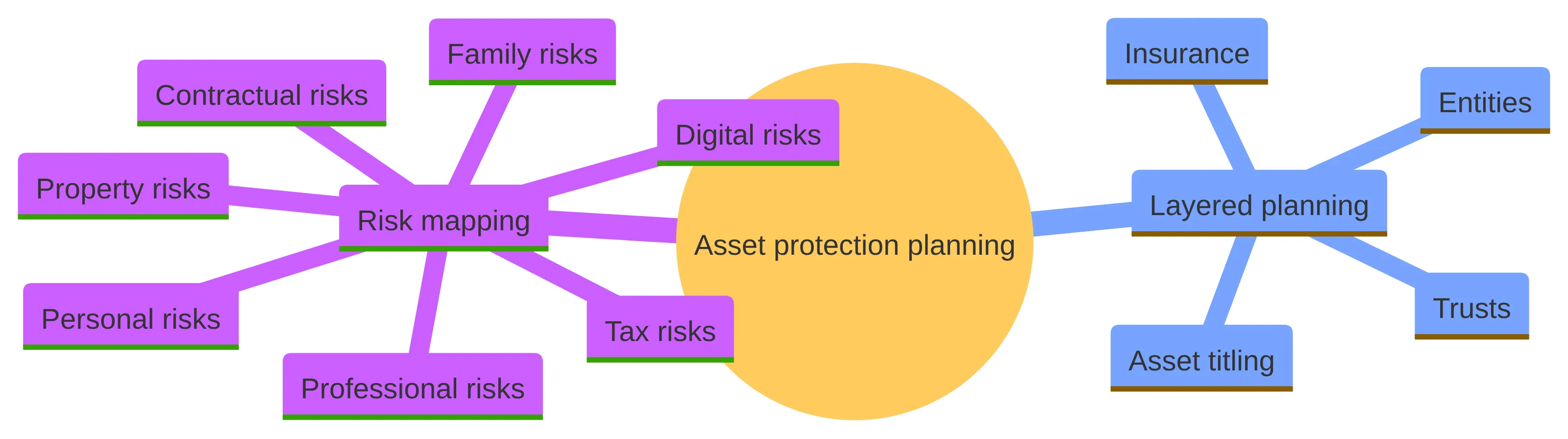
An asset protection plan is a system for safeguarding personal or business wealth from risks such as lawsuits, creditors, and unforeseen financial burdens. The plan may combine insurance, asset titling, legal entities, trusts, and other arrangements selected for the risks and assets under review. The purpose is to reduce exposure, not to promise that every asset will remain beyond the reach of every claimant.
Lawful planning is different from concealing assets or attempting to defraud creditors. Timing therefore belongs in the definition: planning should be established before liability, a claim of liability, or even anticipated liability. A plan begun after liability appears may be too late for the intended purpose.
Start with a pre-transfer fact record
At the outset, the review should organize the facts relevant to the risks, assets, and obligations under review.
Create a fact record for each relevant asset or obligation:
- The personal, professional, contractual, family, property, tax, or digital risk that could create liability.
- The business activities, ownership interests, contracts, and professional responsibilities connected to that risk.
- The real estate, investment assets, business assets, personal assets, and qualified retirement accounts involved.
- The current owner, the person or entity exercising control, and any insurance already in place.
- The jurisdictions connected to residence, business, assets, counterparties, and intended ownership arrangements.
The record gives a professional reviewer the context needed to assess timing and purpose before discussing a structure. The same record also separates the exposure from the asset and from the person or entity controlling it. Liability can arise from personal, professional, contractual, family, property, tax, or digital risks, so relying on a single strategy can leave gaps. This does not mean that every risk calls for a separate structure. It means the reviewer can test whether a proposed arrangement addresses the relevant exposure, whether another layer already applies, and what remains outside its purpose. That distinction matters when an asset has personal and business connections or when a proposed arrangement involves more than one jurisdiction.
With that record in hand, assess proposed arrangements through their purpose and upkeep rather than by counting instruments. For each asset or obligation, connect:
- The exposure the arrangement is meant to address.
- The current and proposed owner and the control each would retain.
- The legal structure, insurance, exemption, or other arrangement being considered.
- The accounts, filings, records, and administration that would have to continue.
- Any residence, business, asset, counterparty, or beneficiary connected to another jurisdiction.
A review may consider state or federal exemptions alongside asset titling, entities, and trusts. Planning can be organized in layers before a claim arises, but not every layer belongs in every plan. The output is a clear account of what each proposed arrangement is intended to address and what ongoing conditions it would require. Layering should be understood as coordination rather than accumulation. Insurance, exemptions, asset titling, entities, and trusts can play different roles, and the plan should show why each layer is being considered. A structure should not be added merely because it is available; its proposed purpose, control consequences, upkeep, and jurisdictional implications should be visible in the record. This approach keeps the review focused on the risks and assets identified at the outset while leaving the selection of any structure to qualified professionals.
Check the protections already available
In a plan review, start with protections already in place: insurance, exemptions, and qualified retirement arrangements may address part of the risk without a new ownership structure. Analyze liability, business, and umbrella insurance as part of the plan so you can assess how the existing coverage relates to potential legal claims. Keep the coverage review alongside the ownership review; insurance does not replace ownership planning, but its scope remains part of the same assessment. The coverage review should identify which legal claims the policies are intended to address and what questions remain for professional review, while the ownership review considers who holds the asset and bears the relevant liability. These reviews answer different questions and should not be collapsed into a promise that one layer addresses every risk. Insurance can remain one part of a layered approach alongside exemptions, asset titling, entities, and trusts. The purpose is to identify what protection is already available, what exposure remains for review, and whether any added complexity has a defined reason.
State and federal exemptions can apply to certain assets, but the assets and amounts protected vary greatly from state to state. The relevant question is not whether an exemption exists in the abstract; it is which exemption rules apply to your facts and which assets fall within them. ERISA covers 401(k) and 403(b) plan accounts, pensions, and profit-sharing plans. Creating and funding qualified retirement plans can provide shelters against creditors’ claims, subject to applicable rules. Review these areas before assuming that a trust, entity, or foreign arrangement is necessary.
Verify that ownership boundaries remain real
For an existing arrangement, compare the assets held, the accounts used, and the liabilities assigned with the boundary the arrangement is intended to maintain. An LLC’s name on paper is not the same as evidence that the arrangement is being used as documented. Check whether an LLC holding an asset is being treated as a personal account; that mismatch can weaken the boundary under review.
Maintenance is a continuing review item for an LLC’s liability protection. Keep a separate bank account, file tax returns, and adhere to corporate formalities. In the plan review, treat these requirements as part of the protection decision rather than paperwork that starts after formation. Record who maintains the accounts, filings, records, and required formalities over time. That record should be compared with actual use over time. An ownership boundary has practical meaning only when the accounts, records, tax filings, and conduct reflect it. Compare the documented owner with the account used, the liability assigned, and the formalities actually observed. If those facts do not match, identify the maintenance issue before treating the entity as a complete answer. Asset segregation is therefore a continuing operating question, not only a formation decision.
Review control, administration, and creditor access in trusts
Review a trust by tracing the relationship between you, the assets, and the person or institution controlling them. An irrevocable trust requires the creator to give up control of the assets and can offer significant protection from future creditors. A revocable living trust generally does not protect assets from the creator’s creditors because the creator retains control. For the audit, record the control arrangement and the conditions affecting creditor access rather than treating the trust label as the answer.
An asset protection trust is a lawful estate planning vehicle designed to address unknown future creditor claims, lawsuits, or judgments through trust ownership and enforceable spendthrift protections. Available structures include offshore trusts and Domestic Asset Protection Trusts, which are legal in certain states. Domestic Asset Protection Trusts may help address future creditor claims and support estate tax planning and multigenerational wealth management when properly structured and administered.
Keep a trust review record that covers what control must be retained, which beneficiaries or purposes matter, where the trust is governed, and how it will be administered. Do not treat a revocable trust as equivalent to an irrevocable trust for creditor protection, or a domestic option as interchangeable with an offshore option across jurisdictions. The professional review should address the ownership effect, creditor-access conditions, and administration required for the specific structure under consideration.
Recheck cross-border diversification when circumstances change
During a plan review, assess the current spread of assets, markets, and locations as a separate risk-management consideration. A cross-border review should ask what legal rules govern ownership, how creditors could pursue a claim, how administration would work, and which tax questions require specialist advice. Geographic spread may change the risks under review; it does not remove the need to test each arrangement against its purpose, timing, and compliance obligations.
We apply layered ownership, asset segregation, and jurisdictional diversification as risk-mitigation tools to reduce exposure to lawsuits, political risk, and financial instability. For a cross-border review, compare how each relevant jurisdiction treats ownership, creditor claims, taxation, administration, and enforcement. Keep geographic diversification separate from any assumption that location alone resolves a protection question.
Test control and administration before changing ownership
After the timing issue has been identified for professional review, the decision also turns on the control and flexibility that a proposed change would affect. Note whether the arrangement limits the ability to sell, pledge, redirect, or otherwise manage property on preferred terms. Before placing assets in an irrevocable trust, LLC, LP, or another structure, record the protection objective, the control that would be surrendered, and the decisions that may need to be made later.
This record makes the trade-off visible alongside the proposed purpose, so professional advice can address both the intended protection and the change in control. Asset protection strategies can reduce the control and flexibility owners have over their assets. Weigh that loss with attorneys and tax advisors before placing assets in an irrevocable trust, LLC, LP, or another structure. The comparison should also identify which decisions remain possible, which require another person or institution, and what administration continues after the change.
Each proposed structure needs to be traced from its purpose to the obligations it creates. An irrevocable trust may shield assets from certain creditor claims, while an LLC or family limited partnership may isolate business and investment assets from personal liability and, in many states, provide charging-order protection limited to distributions. An LLC also requires continuing separation and formalities to preserve its intended liability protection.
Use the same factual questions for each option:
- What asset or liability is the structure meant to address?
- Who controls the asset after the change?
- What flexibility is reduced?
- What accounts, filings, records, and administration must continue?
- What happens if your residence, business, assets, beneficiaries, or counterparties involve another jurisdiction?
That comparison ties the professional discussion to purpose, control, and administration rather than to a structure’s label alone.
Review timing and new liability before any change
Timing is an audit item: record when the planning was established and whether it preceded liability, a claim of liability, or even anticipated liability. Planning initiated after liability appears may be too late. Do not transfer assets after a claim-related event with the intention of hindering, delaying, or defrauding a creditor; that transfer may be treated as fraudulent.
Jurisdiction changes the timing analysis, so do not carry one state’s transfer rule into another state or country without review. Arizona illustrates why the record must remain jurisdiction-specific: a creditor may challenge a transfer if a claim arises within a certain number of years after the transfer, and Arizona’s statute of limitations is generally four years. Treat that figure as an Arizona-specific point, not as a universal deadline. Disclose existing disputes, debts, claims, and anticipated liability before any transfer or restructuring is considered.
Use the fact record to frame professional review
Use the fact record to prepare for professional review instead of beginning with a preferred structure. The file can include:
- A current inventory of personal, business, investment, real estate, and retirement assets, with the present owner and person or entity exercising control over each asset.
- The location of each asset and entity, your tax residence, the jurisdictions connected to your business, and any intended relocation or cross-border activity.
- Existing, threatened, or reasonably anticipated claims, disputes, creditor issues, and events that could create liability.
- The control, beneficiary, governance, filing, account-separation, and administration requirements attached to each existing arrangement.
- The proposed purpose and timing of any ownership change that needs review.
Organized this way, the file lets the discussion address the actual asset, exposure, timing, and continuing obligations. It also gives the professionals a way to separate known facts from assumptions that need confirmation. For each proposed change, the discussion can connect the asset and liability to the intended legal purpose, note the control that would remain or be surrendered, and identify the records, accounts, filings, and administration that would continue. If more than one jurisdiction is involved, keep those questions visible rather than treating a foreign location as an answer by itself. The file is a preparation aid for professional review, not an individualized conclusion about whether a structure is available or suitable.
Questions for qualified legal and tax professionals should resolve the decision in sequence:
- Does an existing, threatened, or reasonably anticipated claim affect whether a proposed transfer can be pursued lawfully?
- Which assets may already receive protection through insurance, state or federal exemptions, or qualified retirement arrangements?
- Which risk and asset is each proposed arrangement intended to address, and which risks remain outside that purpose?
- What control, flexibility, tax treatment, filings, administration, and costs change if ownership changes?
- How would the arrangement operate if your residence, business, beneficiaries, assets, or creditors involve more than one jurisdiction?
- What facts or future events could make a transfer unlawful, challengeable, or ineffective?
- Who is responsible for formation, maintenance, tax compliance, records, and later review?
Consult a legal professional experienced in creditor protection about a tailored asset-protection plan. We collaborate with lawyers, accountants, tax advisors, bankers, registered agents, realtors, and other professionals based anywhere in the world.
Build a pre-transfer fact record before professional review
Start with a pre-transfer fact record rather than with a preferred structure. Record the assets and business interests under review, how each is currently owned, relevant liabilities or potential claims, existing insurance, possible state or federal exemptions, and the jurisdictions whose rules may affect ownership or enforcement. For business assets, note whether an entity has a separate bank account, files tax returns, and follows corporate formalities, because those practices can affect an LLC’s liability protection. For trusts, record the control that would be retained or given up: an irrevocable trust and a revocable living trust have different creditor implications. For cross-border diversification, identify the jurisdictions, assets, markets, and locations under consideration, then treat diversification as one risk-management consideration rather than a stand-alone answer. Take this record to qualified legal and tax professionals to examine timing, creditor access, administration, compliance, and the control and flexibility trade-offs of any proposed structure. Asset protection planning should be established before liability, a claim of liability, or even anticipated liability. Transfers intended to hinder, delay, or defraud a creditor may be treated as fraudulent, so the stated purpose of any proposed transfer belongs in professional review. The record does not choose a structure or provide an individualized conclusion; it gives that review a concrete factual starting point.
We provide a Global Wealth Protection Service that builds legal structures to safeguard wealth against risks, creditors, and uncertainty. A fact-based review can help you examine lawful protection options before treating any structure as a promise.
Ask the team
Have a question about your own situation?
Tell us where you pay tax today and what you want to achieve. We will review your case and get back to you within 1 business day.