
Does Puerto Rico Pay Taxes? A Decision Guide for U.S. Entrepreneurs
Puerto Rico is not a tax-free answer
Puerto Rico is not a completely tax-free answer for a U.S. entrepreneur. Your potential obligations depend on whether you are a bona fide resident, where each item of income is sourced, what business activity takes place, and whether Puerto Rico or U.S. federal filing rules apply. A relocation decision therefore has to separate Puerto Rico income-tax questions from U.S. federal questions instead of treating the move itself as the conclusion.
A bona fide resident with income from outside Puerto Rico, including U.S.-source income, must file a U.S. federal income tax return if that income exceeds the U.S. filing threshold. The distinction is the source of the income and the filing threshold, not merely the fact that you moved.
For your planning, the useful question is not simply whether Puerto Rico pays taxes. Ask which government can tax or require a return for each income item, which facts establish your residence status, and how your business activity affects sourcing. The sections below follow that order so you can identify the questions that deserve tailored review before changing your residence, structure, or filing position.
Start with two separate tax systems
Puerto Rico and the United States create separate questions about income tax and filing. A Puerto Rico resident may need to consider a Puerto Rico income tax return even when the U.S. federal filing result is different. Conversely, a U.S. federal filing obligation can arise from income outside Puerto Rico even when Puerto Rico-source income receives different treatment under the federal rules.
For Puerto Rico residents, the applicable Puerto Rico return guidance covers gross income from any source. The guidance describes when a return obligation is triggered for the filing categories it covers; it does not establish your total tax due.
The U.S. federal question begins with bona fide residence and income source. If your only income is from Puerto Rico sources, you generally do not have to file a U.S. federal income tax return. If you have income from outside Puerto Rico, including U.S.-source income, you must file when that income exceeds the U.S. filing threshold. Under IRC § 933, Puerto Rico-source income is excluded from U.S. income tax for bona fide residents, while U.S.-source and other non-Puerto Rico-source income remains within the federal analysis.
A U.S. filing, when required, does not mean that every item belongs on that return. If a bona fide resident has a U.S. filing obligation, Puerto Rican-source income is not reported on the U.S. income tax return under the cited IRS guidance. You therefore need an income-by-income classification before deciding what belongs in a Puerto Rico filing, a U.S. filing, both analyses, or neither.
Start your review with two columns: Puerto Rico obligations and U.S. federal obligations. Then place each income item into the analysis that its source and your status require. Do not use the existence or absence of one return as proof that the other jurisdiction has no claim.
Classify each income item before assessing the obligation
Income source is the organizing question because residence alone does not classify every payment. Under IRC § 933, a bona fide resident excludes Puerto Rico-source income from U.S. income tax, but U.S.-source and other non-Puerto Rico-source income can remain subject to U.S. income tax and IRS filing. The sourcing analysis also determines whether income is Puerto Rico-source income or effectively connected with a Puerto Rico trade or business.
A Puerto Rico trade or business does not automatically turn every related payment into Puerto Rico-source income. U.S.-source income remains excluded from Puerto Rico-source income even when earned through a Puerto Rico trade or business. That boundary matters if your company serves U.S. customers, owns intellectual property, receives investment income, sells goods, or performs work across jurisdictions.
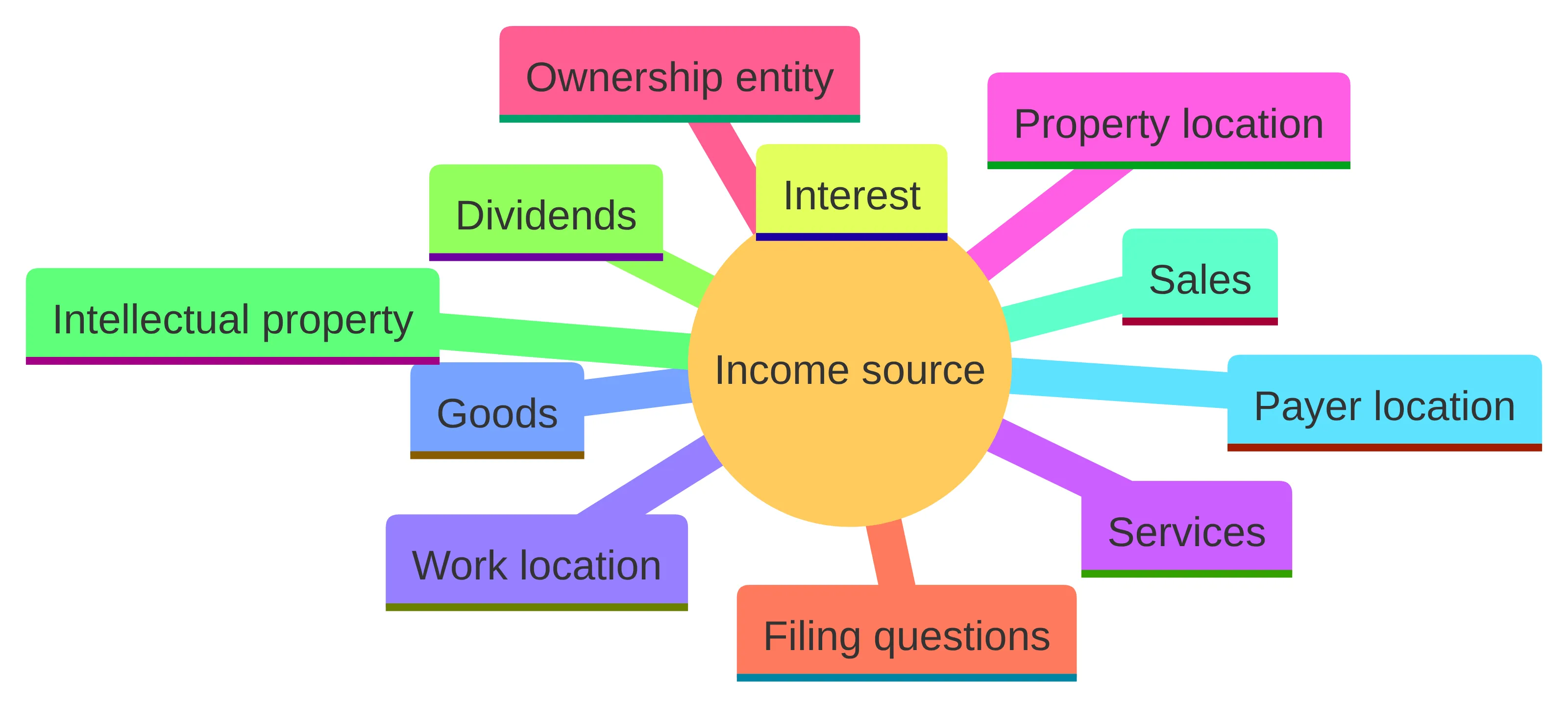
Different income categories can use different sourcing rules. Interest and dividend income is sourced to the payer’s residence. Sales of goods have traditionally followed the title-passage rule. Patents and other intellectual property are sourced according to where the intellectual property is used. These examples show why describing your company as Puerto Rico-based is not enough to resolve the source of every receipt.
Create an income map before drawing a tax conclusion. Use the map in two passes. First, list each receipt without deciding whether it is Puerto Rico-source or non-Puerto-Rico-source. Second, connect the receipt to the facts that support its classification: the activity that produced it, the relevant payer or customer, the location of performance or use, the movement and title terms for goods, and the entity or person that earned it. This prevents a broad label such as Puerto Rico business income from hiding several different source questions.
Add a status field to every line: documented, provisionally classified, or unresolved. A documented line can be supported by a contract, payment record, ownership record, or other ordinary business record. A provisionally classified line is one where the basic facts are available but the sourcing rule still needs professional confirmation. An unresolved line is a decision boundary; do not include it in a projected result merely to complete the worksheet. This makes the map useful for review even when it does not yet produce a final tax answer. For each item, record:
- What produced the income: services, goods, interest, dividends, intellectual property, a sale, or another activity.
- Who paid it and where that payer was located.
- Where the work, sale, property, or intellectual property use occurred.
- Whether the item belongs to you personally, to a partnership, or to a corporation.
- Which Puerto Rico and U.S. filing questions the item may create.
This map is a classification tool, not a determination of your liability. Use it to expose the items that require jurisdiction-specific analysis.
Use the map to separate three kinds of uncertainty. A source question asks what rule and facts classify the receipt. A filing question asks whether that classification creates a Puerto Rico or U.S. reporting obligation. A relief question asks whether a credit or other treatment can follow after the first two questions are answered. Keeping those questions in separate columns prevents a possible credit from being used to justify a source classification, or a filing obligation from being mistaken for a calculation of tax due. It also lets you explain why one unresolved receipt matters: it may affect the return review, the allocation of taxes paid elsewhere, or both. Mark the affected jurisdiction and tax period beside the unresolved item so the professional can test the issue without rebuilding the entire income schedule. An item can be fully recorded yet still provisionally classified; completeness of the file is not proof of the conclusion. Conversely, an unresolved item should remain visible rather than being forced into a favorable category.
Outside-Puerto-Rico income is a separate category in the corporate-return calculation. The calculation uses the return’s gross income and subtracts qualifying Puerto Rico-source income that is not taxable in the United States, its possessions, or foreign countries.
What Puerto Rico residents may need to file
Puerto Rico residents with gross income from any source may have a Puerto Rico income tax return obligation when gross income exceeds the applicable filing threshold. The applicable threshold is only a filing criterion; it does not by itself establish that tax is owed at a particular rate or that no other rule applies.
Pension income has its own reporting point. An eligible federal government pensioner residing in Puerto Rico may claim a credit, subject to limitations, for U.S. income taxes paid on service-related income from outside Puerto Rico. The credit is conditional and does not remove the underlying Puerto Rico reporting requirement.
A U.S. citizen who is a nonresident of Puerto Rico and whose gross income has not been subject to withholding may also have a Puerto Rico filing obligation. If you are considering a move but have not established Puerto Rico residence for tax purposes, do not use the resident thresholds without reviewing the nonresident branch.
Separate three questions in your records: whether you are treated as a Puerto Rico resident, whether your gross income crosses the applicable threshold, and whether a particular item has withholding or another treatment. That separation gives you a more reliable starting point than asking only whether you live on the island. Apply the same three-part check for each relevant tax period rather than carrying a prior year’s status forward without review. Record the facts supporting residence first, then identify the filing category and threshold that appear relevant, and only then note withholding or other treatment for particular items.
Keep the threshold worksheet separate from the tax calculation. A filing trigger does not, by itself, establish the amount of tax due, the treatment of every income item, or the effect of a credit. It also does not resolve the U.S. federal question. Those conclusions require the income-source classification and residence analysis to be placed alongside the Puerto Rico filing review.
When a U.S. federal return can still matter
For an entrepreneur, outside-Puerto-Rico income may appear through several business connections: customers or operations in the United States, investment payments from U.S. payers, sales governed by a title-passage rule, or intellectual property used outside Puerto Rico. The category and source of each item matter separately. A company address or incorporation location cannot replace that classification.
Before assuming that a move removes your federal filing question, list every connection that may produce non-Puerto-Rico income. Include personal investments, business receipts, compensation, property transactions, and intellectual property. Then ask which items exceed the applicable U.S. filing threshold and which items are Puerto Rico-source. Take those questions to a qualified professional rather than using the move itself as the answer.
A useful federal-review inventory has four fields for each item: what produced the income, where the relevant activity or property connection was located, who received the income, and what source classification remains to be confirmed. Add the amount and tax period so the threshold question can be considered for the correct period. Do not use the presence of a U.S. customer, payer, or asset as a substitute for the full sourcing analysis; the applicable rule can differ by income category. The inventory should also show whether the item is personal or earned through an entity, because that distinction affects which records and returns must be examined.
The result is not a prediction of federal liability. It is a way to identify whether the federal review is limited to a filing question, requires classification of particular receipts, or also needs coordination with the Puerto Rico analysis.
A Puerto Rico business does not automatically determine income source
Your business review should connect each receipt to the activity that produced it. Identify the payer, the customer or market, the location of performance, the location of property or intellectual property use, and the entity that earned the item. Puerto Rico’s corporate return instructions also address qualifying taxes paid outside Puerto Rico when relevant outside-Puerto-Rico income is included in the Puerto Rico return and evidence of the tax paid is submitted.
Do not treat incorporation, registration, an office address, or a Puerto Rico bank account as a substitute for income-source analysis. Those facts may belong in the review, but they do not answer the separate question of where a particular item is sourced. Keep the owner-level and company-level analyses separate, then connect them only after each income stream has been classified.
For the company, build a receipt schedule that identifies the activity, payer, customer or market, performance location, property or intellectual-property connection, earning entity, and relevant tax period. For the owner, build a separate schedule for compensation, investments, property transactions, and other personal items. Compare the schedules only after the underlying items have been classified. This avoids allowing an entity description to answer an owner-level question or allowing an owner’s residence to answer a company-level sourcing question.
The same business may therefore require more than one review path. A services receipt, a goods sale, an investment payment, and an intellectual-property receipt should not be grouped simply because they pass through the same organization. Where outside-Puerto-Rico income is included in a Puerto Rico corporate return, retain the calculation and evidence of taxes paid outside Puerto Rico so the professional can test whether the applicable credit conditions are met. The record should show the income and the tax together, not just a general statement that tax was paid elsewhere.
Residence is a factual status, not a relocation label
Tax residency is determined by facts such as how long you spend in a country, where your primary residence is, and where you have significant personal or financial ties. A new address or residence permit does not, by itself, answer every tax-residency question. Your dates, homes, relationships, work pattern, and financial connections may all need to be reviewed together.
Build a dated residence record before relying on Puerto Rico treatment. Note when you arrived, where you lived, where you maintained another home, where your close personal ties remained, and where your business and financial relationships were centered. The purpose is to give a professional enough factual detail to analyze residence rather than forcing the conclusion from a single document or travel day.
Turn the residence record into a timeline rather than a narrative. For each relevant period, record the location where you spent time, the home available to you, the primary residence you treated as your base, and the personal or financial ties that remained elsewhere. Link each entry to ordinary records and note any change in work or business location. Then identify the exact tax period for which the status is being reviewed. This format does not decide bona fide residence, but it makes competing facts visible and keeps a later-period conclusion from being assumed for an earlier period. It also helps separate a residence question from an income-source question: where you lived is one part of the review, while what produced each receipt and where the relevant activity or use occurred is another. Where facts changed during a period, show the change as a separate line rather than smoothing it into a single description. This gives the reviewer a clearer basis for asking which facts apply to which period.
Relocation can change your facts without automatically producing the tax result you expect. A person who spends time in Puerto Rico but keeps substantial ties elsewhere may need a more detailed review than the phrase moved to Puerto Rico suggests. Treat residence as a factual status to establish and document, not as a label that follows from announcing a move.
Incentive language does not replace compliance analysis
The IRS passage describes Puerto Rico Act 22 as having provided an exemption from Puerto Rican income tax for certain Puerto Rico-source interest and dividends and reduced income tax rates for individuals who newly established residence in Puerto Rico. That historical description is limited to the provisions and conditions it identifies. It does not support treating every form of income, every new resident, or every present-day move as covered by a blanket exemption.
Even when an incentive is part of a planning discussion, residence status and income source still control the surrounding analysis. IRC § 933 addresses Puerto Rico-source income for bona fide residents, while income from outside Puerto Rico can create U.S. federal filing obligations when it exceeds the U.S. filing threshold. An incentive reference cannot replace those two classifications.
The IRS has identified improper exclusions of income subject to U.S. tax, failures to file or report such income, and incorrect treatment of certain gains on property acquired while a taxpayer was a U.S. resident. Those examples show why a proposed benefit should be tested against the income’s source, the timing of the move, the residence facts, and the reporting position.
Use incentive language as a prompt for questions, not as the final answer. Ask which provision applies, to which income, for which period, after which residence facts, and with what filing conditions. If those questions have not been resolved, you are not ready to rely on an incentive when deciding whether to move or restructure.
Treat credits as conditional relief, not an automatic answer
For U.S. foreign tax credit purposes, taxes paid to Puerto Rico on Puerto Rican-source income reported on a U.S. income tax return may qualify for a credit. Taxes allocable to excluded Puerto Rican-source income must be subtracted. The potential credit therefore depends on what income is reported, what income is excluded, and how the tax is allocated.
A credit changes the calculation only if its conditions are met; it does not erase the need to identify the underlying income or filing obligation. Keep the income classification, the tax paid, the return on which the income appears, and the supporting documentation together. A headline statement that taxes are credited is too broad to guide a relocation decision.
When you see a proposed credit in a plan, ask four questions: What income does it relate to? Which jurisdiction received the tax? Which return includes the income? What allocation limits or proof requirements apply? Resolve those questions before using the credit to estimate the financial effect of a Puerto Rico move.
Run the decision through five fact checks
Use five fact checks to turn the general rules into a focused question list. The checks are not an individualized determination. They organize the facts that can change whether Puerto Rico filing, U.S. federal filing, or both require further analysis.
1. Residence status. Record how long you spend in Puerto Rico and elsewhere, where your primary residence is, and where your significant personal or financial ties remain. Those are among the factors used to determine tax residency. If the facts do not point clearly in one direction, pause before relying on bona fide-resident treatment.
2. Income source. List each income item separately and classify its source. A bona fide resident’s Puerto Rico-source income is treated differently from U.S.-source or other non-Puerto Rico-source income under IRC § 933. Interest, dividends, goods sales, and intellectual property can use different sourcing rules, so do not group them under a single business label.
3. Business activity. Describe what the business does, where services are performed, where goods move and title passes, where intellectual property is used, who pays the business, and which entity earns each receipt. A Puerto Rico trade or business does not automatically convert U.S.-source income into Puerto Rico-source income. Keep records of outside-Puerto-Rico income and any taxes paid on it.
**4. Include pension income in the Puerto Rico income tax return when it applies. If you are a U.S. citizen who is not a Puerto Rico resident and your income was not subject to withholding, review whether the applicable nonresident filing rules require a Puerto Rico return.
5. U.S. federal filing exposure. Ask whether you are a bona fide resident and whether you have income from outside Puerto Rico. Only Puerto Rico-source income generally does not require a U.S. federal income tax return for a bona fide resident. Outside-Puerto-Rico income, including U.S.-source income, can require a federal return when it exceeds the U.S. filing threshold. If a return is required, Puerto Rican-source income is not reported on that U.S. return under the cited IRS guidance.
After the five checks, sort your questions into three groups: facts that are documented, classifications that still need analysis, and filing or credit consequences that depend on those classifications. That result is more useful than a yes-or-no label because it shows exactly what must be resolved before a move, restructuring, or changed filing position.
Use the groups as a decision gate. Documented residence facts can support the residence discussion, but they do not classify an income item. A classified income item can inform the Puerto Rico and U.S. filing discussion, but it does not by itself establish a credit. A possible credit should be reviewed only after the related income, tax paid, return treatment, allocation, and evidence are identified. This order keeps an unresolved conclusion from becoming the premise for the next conclusion.
For each unresolved item, write the narrow question that would resolve it and the record needed to answer it. For example, the question may concern where an activity occurred, which entity earned a receipt, how title passed, where intellectual property was used, or whether a residence tie continued during the relevant period. This turns the five checks into a review agenda rather than a general checklist that ends with an unsupported yes or no.
Identify what the available evidence cannot decide
A general framework cannot determine your current effective tax rate. That result may depend on the income type, deductions, credits, entity, filing category, residence status, source rules, and the law applicable to the relevant tax period. Do not turn the filing thresholds described above into an estimate of tax due.
Historical incentive language cannot determine whether a present or proposed Puerto Rico incentive applies to your facts. You need the governing provision, its effective period, the qualifying income, the residence conditions, and the filing requirements. The existence of a past incentive does not establish present eligibility or a particular result.
The examples of interest, dividends, goods, and intellectual property do not resolve every sourcing question. A detailed review may need to examine the contract, the parties, the performance location, the payer, title passage, the use of intellectual property, the entity involved, and the relevant tax period. Do not classify a complex receipt from its label alone.
A move can also raise questions about the period before the move, property acquired while you lived in the United States, existing business arrangements, and filing positions already taken. The general framework does not decide those facts for you. Put each pre-move asset, income stream, and filing position on the review list before you change residence or restructure the business.
Treat unresolved rates, incentives, sourcing details, pre-move items, and other obligations as decision boundaries. If a proposed move depends on an unresolved point, do not treat the expected tax result as established. Carry that point into a jurisdiction-specific professional review.
Use a simple triage before committing to a move or restructuring. If the unresolved issue is residence, the review should focus on dates, primary residence, and personal or financial ties. If it is source, the review should focus on the receipt’s category, payer or customer, activity, property, or intellectual-property connection. If it is filing, the review should test the relevant Puerto Rico threshold and any U.S. filing threshold for the correct period. If it is relief, the review should match the tax paid and income to the return and test allocation and evidence conditions. A decision that depends on more than one unresolved category should be treated as a planning question, not a settled tax result. This triage helps the professional begin with the fact that controls the next question instead of starting with the hoped-for benefit. It also shows whether the next step is to gather a record, classify an item, or analyze a consequence. Do not let a readily available document, such as an address or entity registration, stand in for the unresolved analysis.
Prepare the facts for professional review before changing position
Prepare a review packet before changing your residence, business structure, or filing position. The goal is to give a qualified cross-border tax professional a complete factual map rather than a short description such as moving to Puerto Rico for lower taxes.
Start with residence facts: arrival and departure dates, time spent in Puerto Rico and elsewhere, primary residence, other available homes, close personal ties, and significant financial ties. Tax residency is determined by factors that include time spent in a country, primary residence, and personal or financial ties, so each fact should be dated and supported by ordinary records.
Then assemble the income and filing facts:
- A list of personal and business income items by category and tax period.
- The payer, customer, property, activity, or intellectual property connection for each item.
- Puerto Rico returns, U.S. federal returns, withholding records, and notices already received.
- The filing status you expect to use and the gross income relevant to the applicable Puerto Rico threshold.
- Any U.S.-source or other non-Puerto Rico-source income that could affect federal filing.
This set lets the professional separate Puerto Rico filing exposure from U.S. federal filing exposure instead of treating them as one question.
For the business, document each entity, ownership relationship, operating location, service location, customer and payer location, goods movement, title-passage terms, intellectual property use, and outside-Puerto-Rico taxes paid. Include contracts and records that show what produced each receipt. This is especially useful where a Puerto Rico trade or business has income that may still be U.S.-source.
We help businesses expand abroad with corporate structures, tax planning, and compliance with international regulations. Bring the facts and unresolved questions into that conversation rather than asking for a conclusion based only on the destination.
Write the questions you want answered before the meeting:
- Do the residence facts support bona fide residence for the relevant period?
- Which income items are Puerto Rico-source, U.S.-source, or otherwise outside Puerto Rico?
- Does the business activity change the sourcing analysis for any receipt?
- Which Puerto Rico return and U.S. federal return questions apply?
- Could a credit apply, and what income allocation and documentation conditions govern it?
- Which pre-move assets, gains, or existing filings need separate treatment?
A written question list keeps the review tied to the facts that can change the result. Organize the meeting in the same order as the analysis: establish the residence facts and relevant period, classify personal and business income item by item, examine the business activity and earning entity, then review Puerto Rico and U.S. filing exposure. Discuss credits only after the underlying income and tax records have been matched to the relevant returns. This sequence reduces the risk that an expected benefit is considered before the facts supporting residence or source have been tested.
Mark each question as one of three types before the meeting: a fact that needs confirmation, a classification that requires technical analysis, or a consequence that follows only after the first two are resolved. Bring the record that corresponds to each question rather than relying on a destination-based summary. If a proposed move or restructuring depends on an unresolved item, identify that dependency explicitly and ask whether the decision should wait for the item to be resolved.
The professional review should leave you with a written list of conclusions, assumptions, open issues, and records still needed. That format preserves the distinction between what the available facts establish and what remains dependent on current Puerto Rico and U.S. rules or a more detailed analysis of the transaction.
Decide whether tailored Puerto Rico planning is warranted
Puerto Rico should be evaluated as a jurisdiction with potentially applicable Puerto Rico and U.S.-related tax obligations, not as a tax-free shortcut. Your next decision should rest on documented residence facts, an income-by-income source analysis, business activity, Puerto Rico filing exposure, and U.S. federal filing exposure. Before changing residence, business structure, or filing position, have a qualified cross-border tax professional decide how the rules apply to your individual facts.
Ask the team
Have a question about your own situation?
Tell us where you pay tax today and what you want to achieve. We will review your case and get back to you within 1 business day.