
Exit Tax and Departure Planning: A Pre-Departure Decision Guide for U.S. Entrepreneurs
Start with the departure decision gate
A planned departure from the United States is a decision gate, not a tax conclusion. Moving abroad does not, by itself, tell you whether federal expatriation rules apply, whether a state considers your residency ended, or whether another country considers you tax resident.
Tax residency analysis can consider how long you spend in a country, where your primary residence is, and where you maintain significant personal or financial ties. A residence permit is a separate fact to record rather than a substitute for a residency analysis. Each country has different rules for tax residency and residence permits, so your intended destination needs its own review.
A pre-departure review should therefore answer a sequence of questions before you commit to the move:
- What citizenship, immigration, and U.S. residency facts describe your position at the relevant time?
- Are you considering an international departure, an interstate move, a citizenship relinquishment, or more than one change?
- Which assets, liabilities, business interests, trusts, accounts, and ownership rights need valuation or reporting review?
- Which prior filings and continuing international reporting obligations need to be examined?
- Which facts belong in a separate state or Canadian analysis?
The practical action is to build the fact file before treating relocation as a tax strategy.
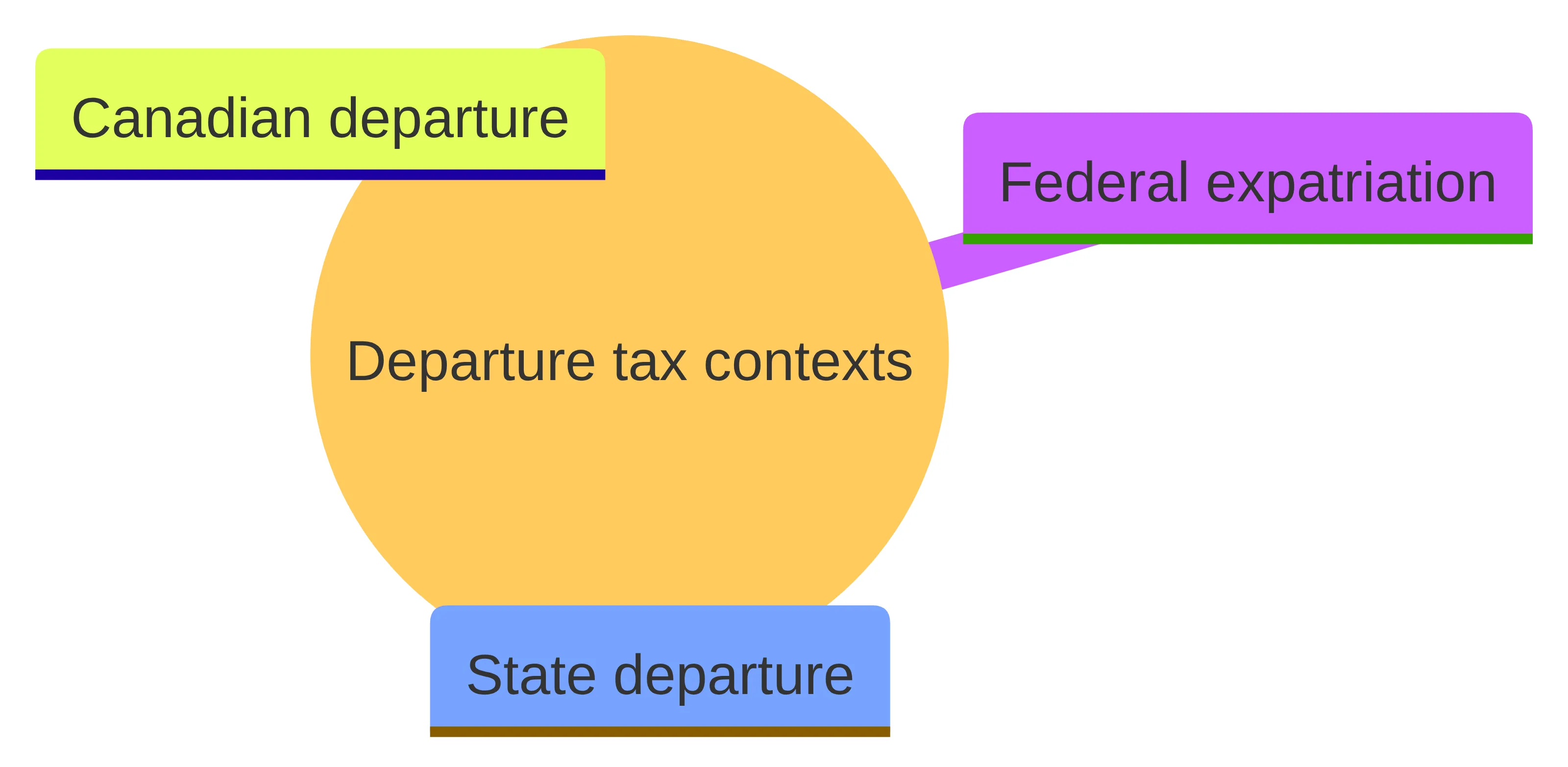
Separate the three departure-tax contexts
Three departure contexts should be kept separate because they ask different legal and factual questions. A single move can touch more than one context, but one label should not be used to answer all three.
The separation also prevents a category error when several changes occur together. Leaving a state, ending or changing a U.S. status, and establishing a connection with another country are not interchangeable descriptions. For each branch, record the status or connection being examined, the event or intended change, the relevant date, and the records supporting the description. This turns a broad relocation plan into separate review questions and makes it easier to identify where a conclusion is still missing rather than assuming that one answer carries across every branch.
Federal expatriation concerns the status and facts associated with leaving the U.S. tax and citizenship framework. The applicable result depends on your status and facts. A move from one U.S. state to another is an interstate residency question, not automatically a federal expatriation event.
State-level departure questions concern the state connection you are ending or changing. Your review may need to consider domicile, time spent in the state, homes, family and financial ties, business activity, and the date of each change, but the applicable state rules must be applied to your facts separately.
Canada-related departure tax is a third workstream. If Canada is part of your history, destination, ownership structure, or planned departure, place the Canadian question in a separate current-law review. Do not carry a U.S. federal conclusion into a Canadian analysis, and do not treat a state residency conclusion as an answer to a Canadian departure-tax question.
Use this separation as your first decision rule:
- Federal expatriation: establish citizenship, immigration status, U.S. residency, and the relevant expatriation facts.
- State departure: establish the state connection, the intended change, and the facts supporting that change.
- Canadian departure: identify the Canada connection and obtain a separate analysis of the applicable Canadian rules.
If two or three branches apply, keep their timelines and conclusions distinct.
Establish the status that makes federal review relevant
U.S. status determines which federal questions deserve attention first. For U.S. residency analysis, the relevant framework can consider whether you are a U.S. citizen or a resident alien under the lawful permanent resident, physical presence, or first-year election tests. Your citizenship, immigration documents, residence history, and election history should therefore be assembled before you draw a conclusion about federal consequences.
Relinquishing U.S. citizenship abroad is a Department of State process governed by applicable citizenship law. That process is not the same event as deciding to live abroad, obtaining residence in another country, or ending a state connection.
An oath-based renunciation requires voluntary intent to relinquish citizenship, an in-person appearance before a U.S. diplomatic or consular officer, and the prescribed oath. Those conditions make the timing and nature of any citizenship action material to the review. Do not describe a planned move as a renunciation unless the relevant legal process and facts support that description.
Prepare a status timeline with these items:
- Current and prior citizenships, including any citizenship obtained by birth, naturalization, or another route.
- Green card or other immigration records, including dates and changes in status.
- U.S. residence history and the dates you entered or left particular jurisdictions.
- Any planned citizenship relinquishment, renunciation, or other expatriating action.
- The date on which each status change is expected to occur.
The direct action is to resolve the status branch before estimating a tax result.
For each entry, distinguish a documented fact from a planned action and from an unresolved question. Keep the underlying record with the timeline rather than relying on a label such as “resident” or “expatriate” without showing what supports it. If dates conflict, preserve both dates and flag the conflict for review. That approach gives the professional a usable sequence while avoiding a premature conclusion about which federal analysis applies.
Residency can also involve more than one country. If you are resident in both the United States and a treaty country, treaty residence tie-breaker rules may determine a single treaty residence for treaty purposes. That possibility does not erase the need to document your domestic-law status in each country.
Examine federal expatriation through the applicable facts
The described federal framework treats a covered expatriate as having sold worldwide assets at fair value on the day before expatriation, with tax on deemed gain and a dedicated final form. That description identifies a framework to test; it does not establish that you are a covered expatriate, that a deemed sale applies to you, or that tax is due.
The asset side of the review can be broad. A Form 8854 inventory can include trusts, beneficial interests in trusts, U.S. and foreign intangibles, loans to U.S. and foreign persons, U.S. and foreign real property, U.S. and foreign business property, other assets, liabilities, and net worth. Business ownership should not be reduced to the cash in a bank account; ownership interests, rights, property, and related obligations need to be identified.
Ask for a fact-specific federal review of four linked questions:
- What status do you hold, and what event are you planning?
- What date makes the planned event relevant?
- Which assets, liabilities, and business interests must be measured or valued?
- Which form, report, or continuing obligation may relate to the event?
The fourth question is not a filing instruction. It is a prompt to identify the correct review path before you act.
These questions work as a sequence rather than as four independent checkboxes. Status determines which branch deserves attention; the planned event and its date define the point being reviewed; the asset and liability inventory identifies the information that may need measurement; and the reporting question identifies records or obligations that require further examination. If any link is missing, a general description of an exit tax cannot supply the answer. Mark the missing link explicitly so the consultation can focus on the unresolved fact instead of treating an incomplete file as a completed analysis.
A form name or a general description of deemed-sale treatment cannot answer the eligibility question. The status, event, valuation, and reporting facts must be tested together under the law applicable on the relevant date.
Keep state residency questions separate from expatriation
State residency review is a separate branch from federal expatriation. An interstate move and an international expatriation event involve different questions, while tax residency can depend on time spent in a place, primary residence, and significant personal or financial ties.
Your state review should create a dated record of the connection you are changing. Include the home you used, time spent there, family and financial ties, business activity, property, mailing and administrative connections, and the actions you took to establish a new base. These facts are inputs for the applicable state analysis; they are not a conclusion by themselves.
Do not assume that leaving California or another state creates, avoids, or changes an exit tax. The question is whether a state-level departure or residency issue requires review under that state’s law and your particular facts. A current state analysis should stand on its own rather than being inferred from a federal expatriation discussion.
Use a separate state worksheet with three headings:
- Connection before the move.
- Dates and actions associated with the move.
- Connection after the move.
If the planned relocation also involves citizenship relinquishment, keep the state worksheet beside—not inside—the federal expatriation file.
After completing the worksheet, compare the three sections for changes that need explanation: what ended, what continued, and what began. Attach dates and supporting records to each change, and identify facts that remain uncertain. The worksheet is a way to organize the state question, not a test that produces a state conclusion by itself; the applicable state rules still need to be applied to the documented circumstances. Keeping that limitation visible helps prevent a state worksheet from being mistaken for a federal expatriation analysis.
Review Canadian departure tax as a separate regime
Canadian departure tax belongs in a separate analysis from U.S. federal expatriation and state residency. A person with U.S. and Canadian connections should not assume that a U.S. status conclusion answers the Canadian question or that a state residency conclusion answers either country’s departure-tax question.
Start the Canadian branch by identifying the connection that brings Canada into the review. That may include citizenship, prior residence, current residence, property, a business, an ownership interest, family ties, or a planned move involving Canada. Record the dates and the role of each connection without labeling the result in advance.
Ask for a distinct Canadian analysis of the relevant departure event, assets, valuation dates, residence position, and reporting responsibilities. Keep any Canadian conclusions in a separate section of your consultation file so that U.S. federal, state, and Canadian assumptions cannot silently replace one another.
The practical boundary is simple: a move involving Canada needs Canadian review. Do not use general U.S. expatriation language as a shortcut for that work.
Build the pre-departure fact inventory
Record your personal and residency facts in a format that another professional can follow:
- Citizenship and immigration status in every relevant country.
- Residence permits, visas, green card records, and other status documents.
- Travel dates and time spent in each country and U.S. state.
- Primary homes, leased homes, family location, and meaningful personal ties.
- Business locations, management activity, offices, employees, and operating connections.
- Planned departure, arrival, status-change, sale, transfer, or restructuring dates.
Add four labels to each material fact: the person or entity it concerns, the country or state connected to it, the date or period involved, and the document that supports it. For a business interest or trust connection, keep the ownership or control record with the related personal facts rather than listing it only as an asset. Also mark whether a date is confirmed, expected, or unknown. This makes the inventory useful for comparing personal, residency, and business timelines without turning an assumption into a stated fact.
Record assets and liabilities by owner, location, type, acquisition date, cost information, current value, and related debt.
Foreign accounts and other foreign financial assets need their own records. For a foreign financial account, maximum value may be based on periodic account statements unless there is reason to know that the statements do not reasonably estimate the maximum value during the tax year. For a specified foreign financial asset outside an account, reliable public or other verifiable information may support a fair-market-value estimate, and a third-party appraisal is not automatically required.
Track business interests separately from personal assets. Include shares, partnership interests, membership interests, options, loans, intellectual property, real property, operating entities, and rights to receive distributions when those items exist in your structure. Accidental tax residence in multiple countries could result in double taxation, so the inventory should also show where each business is managed and where you perform relevant work.
A useful inventory does not need to predict the answer. It needs to make the decision-changing facts visible, tie each item to a date, and identify records that still need to be obtained.
Test timing and overlapping obligations with a professional
Timing review should connect each planned action to the date on which it occurs. Put the intended departure date, last day in each jurisdiction, status-change date, asset transfer or sale date, business restructuring date, and expected arrival date on one timeline. The timeline should show whether events overlap rather than treating the move as one undifferentiated day.
Use the timeline as a dependency map. Mark which dates are already documented and which are only proposed, then place a note beside each event identifying the branch it may affect: federal status, state connection, Canadian review, asset valuation, business activity, or reporting history. Where two events overlap, leave them as separate entries rather than combining them into a single “move” date. This gives the professional a way to test sequence and overlap and helps the reader see which planned action should not be treated as proof that another event has already occurred.
Treaty residence can add another timing question. If you are resident in both the United States and a treaty country, treaty tie-breaker rules may determine a single treaty residence for treaty purposes. Ask which facts make the treaty analysis relevant, which date controls, and how the treaty result relates to domestic-law residency in each country.
Bring account records, ownership records, and correspondence relevant to the planned move.
Use these consultation questions to test timing and overlap:
- Which event starts the relevant federal review, and which date controls the analysis?
- Which state residency facts need to be established before and after the move?
- Does Canada require a separate departure-tax and residence review?
- Which assets require a value, basis, ownership, or liability record?
- Which business actions occur before departure, on departure, or after arrival?
- Which prior filings or foreign reporting records should be checked?
The action is to give the professional a dated sequence, not only a destination and a proposed moving date.
Do not assume that a future departure eliminates the need to examine earlier periods.
Prepare the consultation file before relocating
A consultation file should let an international tax professional reconstruct your status, movement, ownership, valuation, and reporting position without relying on memory. Arrange the material by topic and date, and label open questions instead of filling gaps with assumptions.
Create an index that names each section, gives the relevant date or period, identifies the supporting record, and states any unresolved issue. Keep estimates visibly separate from documents and note the source of each estimate. Use the same date format throughout the file so that a departure date, status-change date, valuation date, and filing period are not confused with one another. This organization does not decide the tax result; it reduces the risk that an important fact, missing record, or conflict between timelines will be overlooked during the review.
Prepare personal, immigration, and residency records:
- Passports, citizenship documents, naturalization records, and immigration documents.
- Green card records, residence permits, visas, and any planned relinquishment documents.
- A travel calendar showing days in the United States, each state, Canada, and the proposed destination.
- Home ownership or lease records and a summary of personal and financial ties.
- The planned departure, arrival, and status-change dates.
These records establish the timeline that the federal, state, treaty, and Canadian branches will use.
Prepare asset, liability, and ownership records:
- Statements for bank, brokerage, retirement, and other financial accounts.
- Real property records in the United States and abroad.
- Business property, entity documents, capitalization records, partnership or membership interests, and related-party arrangements.
- Intangible assets, intellectual property, options, and other rights.
- Mortgages, installment obligations, other liabilities, and a net-worth schedule.
These categories align with the broad asset and liability inventory reflected in Form 8854.
Prepare valuation support for the relevant date. Include periodic account statements for foreign financial accounts and reliable public or other verifiable information for specified foreign financial assets outside accounts. A third-party appraisal is not automatically required merely because public information is unavailable when the maximum value can otherwise be reasonably estimated, but the basis for each estimate should be recorded.
Prepare prior tax and reporting records:
- Federal and state returns for the periods relevant to the move.
- International reporting forms and supporting schedules.
- Foreign account and asset records.
- Entity, trust, ownership, and distribution filings.
- Notices, correspondence, extensions, amended filings, and unresolved questions.
Finish the file with a one-page decision brief. State where you live now, where you plan to go, what status change you are considering, when each event may occur, what you own, what businesses you operate or control, which records are missing, and which questions must be answered before you relocate.
Separate the brief into confirmed facts, proposed actions, and questions for review. Include the three branches that may need separate treatment—federal expatriation, state residency, and Canadian departure tax—and identify which branch each question belongs to. End with the decisions that are still open, such as whether a status action is actually being contemplated, whether an asset or business interest needs further valuation work, and whether prior reporting records are complete. The result should be a handoff document that frames the consultation without presenting the reader’s preliminary assumptions as legal or tax conclusions.
Decide whether formal departure planning should begin
Formal departure planning should begin before you commit to a move when your facts raise a federal expatriation, state residency, Canadian departure-tax, valuation, business, or international reporting question. Federal expatriation and an interstate move involve different questions, tax residency depends on facts such as time, primary residence, and personal or financial ties, and every country applies its own rules to tax residency and residence permits.
Bring the status timeline, fact inventory, valuation records, business and ownership documents, and prior reporting history to the review. A qualified international tax professional must determine how the applicable rules apply to your individual circumstances before you act. Use the decision gate to obtain that review while the relevant records and choices are still available.
Questions to raise before leaving the United States
How should I prepare for a consultation with an international tax professional regarding departure planning?
Prepare a fact inventory that includes your citizenship and immigration status, residency history, assets, liabilities, business interests, and any planned changes. This will help the professional assess your situation accurately.
What should I include in my pre-departure fact inventory?
Your pre-departure fact inventory should include details about your citizenship, immigration status, travel history, primary residences, business interests, and a list of assets and liabilities, along with their values.
How can I avoid double taxation when relocating internationally?
To avoid double taxation, ensure you understand the tax residency rules of each country involved and maintain clear records of your residency status, time spent in each location, and any applicable tax treaties.
Ask the team
Have a question about your own situation?
Tell us where you pay tax today and what you want to achieve. We will review your case and get back to you within 1 business day.