
How Mexico-Connected Businesses Can Evaluate Lawful Tax-Reduction Strategies
Build a transaction diagnostic from one value flow
Begin the working record with one material flow of value: a customer receipt, a payment for the owner’s services, retained profit, or a dividend. Build a transaction diagnostic for that flow. Record the business activity, payer and recipient, entity, work and management locations, jurisdictions touched, and owner-level event. The diagnostic organizes facts for current-rule review; it is not a calculation or a promised result.
Keep the individual and company tests separate within the same trace. The individual lane asks which personal residence, income-source, filing, and reporting questions require review, while the company lane asks which entity, activities, and Mexican-source or permanent-establishment connections are relevant. A conclusion in one lane does not answer the other.
Treat the tax-connection trace as a dated record of the links that connect an activity to a taxpayer and then to an owner-level event. For each link, mark an established fact, a rule requiring current verification, or an unresolved dependency. A proposed residence, entity, or payment change should identify the link it is intended to affect and the links that remain open; a new label does not by itself establish a changed tax result.
An unresolved link should remain visible instead of being filled with an assumption. That makes the trace useful when the business has several entities, owners, payment routes, or countries in the same value flow.
The 2026 Mexican figures commonly used in this discussion are a 30% corporate income-tax rate and a 35% top individual rate. Those figures do not tell you what your effective result will be, because the relevant income category, entity, residence position, dividend treatment, deductions, timing, and foreign obligations still have to be tested.
A lawful plan therefore begins with a map rather than a promise. Use this order:
- identify the people and entities connected to the business;
- locate the work, management, customers, assets, and income-producing activity;
- separate company-level tax from owner-level tax;
- identify every country that may have a residence, source, reporting, or entity connection; and
- test the proposed result against current rules before changing operations.
That sequence keeps a lower advertised rate from becoming the sole reason for a decision.
Classify the proposed change before estimating a reduction
Lawful tax planning means arranging genuine business, ownership, residence, and investment facts within the rules that apply to them, while reporting the resulting position accurately. Tax evasion or concealment is a different objective. A plan that depends on hiding income, misrepresenting where work occurs, disguising related-party dealings, or placing profits in a jurisdiction without addressing the governing rules is not a sound tax-reduction strategy.
Mexico’s anti-tax-haven provisions are described as preventing Mexican taxpayers from deferring Mexican income tax through preferential tax regimes or tax havens. Mexican transfer-pricing rules also address related-party sales, services, intangibles, and loans through an arm’s-length analysis. These rules matter because a structure can be formally documented and still require a substantive review of the income, transaction, and relationship involved.
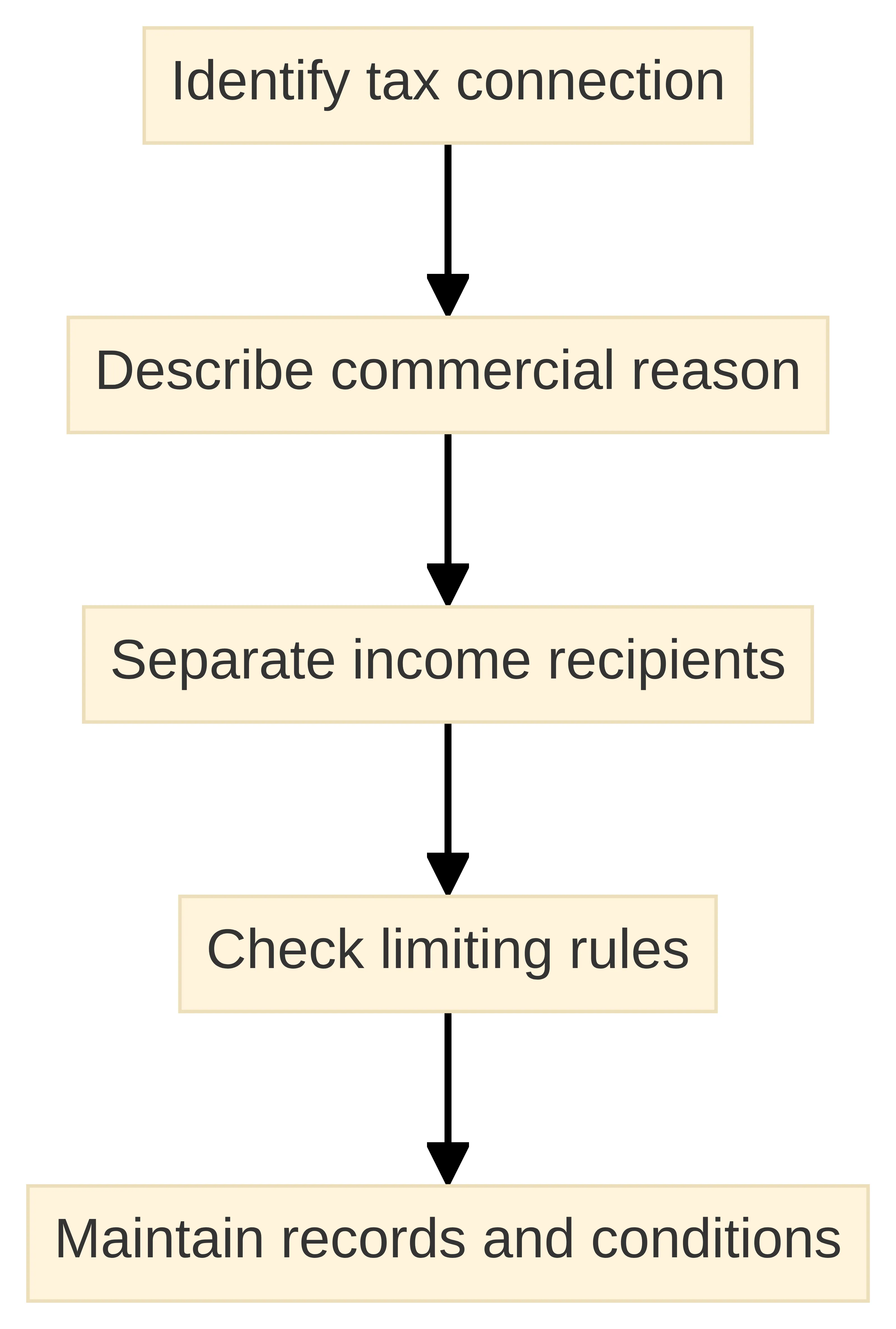
A lawful planning screen should answer five questions before you calculate a projected saving:
- What fact creates the tax connection? Identify residence, source, permanent establishment, ownership, management, or activity rather than relying on incorporation alone.
- What commercial reason supports the arrangement? Describe the actual service, investment, expansion, financing, or operating purpose.
- Who earns each item of income? Separate the company, its owners, related entities, and service providers.
- What rule limits the intended result? Check residence rules, source rules, anti-tax-haven provisions, transfer pricing, treaty provisions, and reporting duties.
- What must be maintained after implementation? Include records, contracts, filings, operational substance, and any continuing eligibility conditions.
If the proposed reduction cannot survive those questions, stop treating it as a rate comparison. Rework the facts and obtain a jurisdiction-specific review before taking action.
Keep company and owner records separate
Run every selected flow in two columns. In the company column, record the entity that earns the revenue, its operating and management locations, relevant people and functions, and any Mexican-source or permanent-establishment question. In the owner column, record personal residence, services performed, compensation, dividends, investments, and foreign income or reporting questions. The columns meet at the payment or distribution; they should not be collapsed into one rate.
This format also exposes a missing fact. A company can have a Mexican connection even when its owner does not, and an owner can have an individual exposure that the company analysis does not settle. Treat those as points to test, not conclusions about the reader’s position.
The owner’s extraction of value is a separate question from the company’s profit. List each route by which money or benefits can reach you, then identify the rule that governs that route. Dividends illustrate why the two levels cannot be collapsed: Mexican-resident individuals must account for dividends from Mexican corporations under the treatment described in the applicable rules, including the stated gross-up and credit mechanism.
Prepare two workpapers rather than one:
- Company position: entity residence, revenue sources, operating locations, related parties, permanent-establishment questions, and company-level tax.
- Owner position: personal residence, services performed, compensation, dividends, investments, foreign income, and individual filing or reporting questions.
Do not describe a company-level rate as your personal tax result. Do not assume that moving ownership, changing an entity, or retaining profits answers the owner-level analysis without testing the applicable rules.
Test residence and source at the relevant link
Mexico tax residence determines the reach of individual income taxation, but residence is a fact-sensitive legal status rather than a label you can select for convenience. The residence classification is material to whether the individual-income analysis includes income outside Mexico or focuses on Mexican-source income. You therefore need to document the facts that support the status you intend to use, not merely the country where you keep a home, company, or bank account.
For services, the physical location where you provide the service can matter to the source analysis. A payment from a foreign customer and a foreign bank account do not, by themselves, answer where the service income arises. Record where you perform the work, where management decisions occur, where personnel operate, and where the business maintains the functions that generate revenue.
A person who meets Mexico’s domestic residence rule may still need to apply the U.S.-Mexico treaty tie-breaker analysis. That analysis can include the center of vital economic interests, along with the treaty’s other residence tests. U.S.-Mexico cases can also involve different residence, sourcing, filing, and reporting rules, so a domestic conclusion in one country may not settle the cross-border position.
Use a residence file that records:
- days and locations of physical presence;
- homes, family, business management, and economic relationships;
- where services are performed and decisions are made;
- citizenship, immigration status, and residence rights; and
- the domestic rules and treaty provisions that may apply.
A residence permit is an immigration status, not an automatic answer to tax residence. If the facts point to more than one country, analyze the domestic rules and any applicable treaty together before changing your living or operating arrangements.
Complete the transaction diagnostic
Business profit and personal income meet through specific transactions, and each transaction can carry a different tax question. Start by drawing the path from customer payment to company profit and then to your personal balance sheet. Mark compensation, dividends, investment income, retained amounts, benefits, and any payments involving a related entity. The map should show the payer, recipient, service or right exchanged, jurisdiction, currency, timing, and supporting record.
Dividend treatment shows why this exercise matters. The applicable treatment for Mexican-resident individuals includes the dividend in taxable income, a gross-up for corporate income tax paid by the Mexican corporation, and a possible credit for that underlying corporate tax under the described rules. That is not the same as saying the company’s corporate tax rate is the owner’s final rate.
Ask the following questions for every route from the business to you:
- Is the payment compensation for work, a dividend, a return of capital, investment income, or another category?
- Which entity makes the payment, and where is that entity resident?
- Which country treats the amount as sourced there?
- Does the payment create a second layer of tax, a credit, a withholding question, or a reporting obligation?
- What records establish the amount, timing, commercial purpose, and recipient?
Keep the owner-flow map separate from the company’s profit calculation. A structure that reduces tax at one level may create a different obligation at another level, and a tax result that looks favorable before distribution may change when money reaches you. Treat the owner’s cash need, reinvestment plan, and residence position as facts to analyze, not assumptions that justify a preferred structure.
For a more reliable result, turn this map into a transaction diagnostic and complete it in the same order for each material flow. Start with the current transaction, not the proposed structure. Name the payer, recipient, entity, service or right exchanged, amount, timing, currency, and supporting record. Then write one sentence describing the commercial event in ordinary terms. “The owner performs services for the business” is a different starting point from “the company distributes accumulated profit,” even if the cash ultimately reaches the same person. Do not combine those events merely because they have a common beneficiary.
Next, identify the people and functions behind the event. Record who performs the work, who directs it, where management decisions are made, which entity contracts with the customer or supplier, and which personnel, assets, or contractors support the income. This does not decide the tax result by itself. It gives the adviser a fact pattern against which residence, source, permanent-establishment, transfer-pricing, and reporting questions can be tested. If a function, location, or relationship is unknown, mark it as open rather than filling the gap with the proposed structure’s description.
Then produce two outputs for the same transaction. The company output should state which entity earns or pays the amount, what activity supports it, which company-level connections require review, and what records establish the transaction. The owner output should state whether the individual receives compensation, a dividend, an investment return, retained value, or another benefit, together with the owner’s residence and service-location questions. This side-by-side output prevents a company conclusion from being silently reused as an owner conclusion.
After that, list every jurisdiction touched by the event and assign each one a question. A country may be relevant because of the owner’s residence, the entity’s residence, the place where services are performed, management activity, the source of income, a related-party transaction, or a filing and reporting obligation. The list is not a conclusion that each country taxes the amount. It is a control against overlooking a country whose rules or treaty relationship could change the analysis.
Only once the current flow is described should you compare a proposed change. Change one material fact at a time in the worksheet: the owner’s work location, management location, entity used, payment category, timing, or distribution route. For each change, record which link it is intended to affect and which links remain unchanged. If a proposed entity change leaves the work and management facts unchanged, those facts remain open questions. If a proposed residence change leaves the company’s operations in place, the company-side analysis remains open. This makes the claimed mechanism visible without assuming that the change succeeds.
Finish the diagnostic with three labels for each issue: established fact, rule requiring current verification, and unresolved dependency. The unresolved dependency should state what evidence or professional conclusion is missing, such as a residence analysis, an arm’s-length review, a treaty question, or confirmation of a regime’s eligibility and effective date. The result is not a promised saving. It is a transaction-level record showing what is known, what may change, and what must be reviewed before the flow is altered.
Repeat the diagnostic for customer receipts, owner service payments, retained profit, distributions, and material related-party transfers when those flows exist. Compare the completed sheets only after each sheet identifies its own unresolved links. This keeps the planning discussion attached to actual value movements and gives a qualified adviser a precise starting point instead of a preferred rate or an entity name.
Attach entity and related-party facts
A foreign entity does not erase the Mexico connection. Start the entity test with residence, then identify any Mexican-source or permanent-establishment income relevant to a foreign resident; the applicable corporate rules determine whether income beyond Mexico enters the analysis. The entity review should therefore ask where the entity is resident, where it has people and functions, where management takes place, where contracts are performed, and whether its activities create a Mexican connection.
A cross-border structure also brings the other country into the analysis. U.S.-Mexico cases can involve different residence, income-source, filing, and reporting rules. If the owner, company, customers, personnel, assets, or management are connected to another jurisdiction, identify that jurisdiction before selecting an entity or moving an activity.
Related-party transactions need their own review. Mexican transfer-pricing rules address sales, services, intangibles, and loans between related parties and require the applicable arm’s-length analysis described in the governing material. The purpose is to prevent artificial profit shifting and to align the tax result with the transaction that independent parties would have negotiated.
A foreign low-tax entity can also raise a preferential-tax-regime question. The described Mexican test is tied to tax effectively paid on foreign income and includes a 75% comparison with the Mexican tax that would have applied, subject to specified qualifications. Do not apply that percentage mechanically. Test the transaction, income category, entity, timing, statutory conditions, and available exceptions.
Before using a cross-border entity, prepare:
- an ownership chart;
- a functions-and-people chart;
- contracts and intercompany arrangements;
- an income and expense flow by jurisdiction;
- transfer-pricing support; and
- a list of residence, permanent-establishment, anti-tax-haven, and filing questions.
If you cannot explain the commercial activity and pricing in ordinary business terms, pause the structure review.
Read the diagnostic through rule checkpoints
Read the completed diagnostic through rule checkpoints rather than ranking structures. Each row identifies the facts that must be established, the question that requires current application, and the point at which the comparison should pause.
| Rule checkpoint | Record in the diagnostic | Question before a change | Stop condition |
|---|---|---|---|
| Company income scope | entity residence, income-producing activity, Mexican-source activity, management, and permanent-establishment facts | Which corporate residence, source, and permanent-establishment rules apply to this entity and activity? | A tax connection is inferred from incorporation or a label alone |
| Owner income scope | personal residence, service location, compensation, dividends, investments, and foreign income | Which owner-level residence, source, filing, reporting, or treaty questions attach to the flow? | The company result is being used as the owner result |
| Dividend route | distributing entity, recipient residence, timing, gross-up, and credit information | Does the applicable dividend treatment, including the described gross-up and credit mechanism, require review? | The owner-level treatment is untested |
| Related-party route | parties, functions, service or asset, price, and terms | What arm’s-length analysis and records apply to the transaction? | The price cannot be tied to the actual functions and terms |
| Foreign low-tax route | ownership, management, income category, foreign tax effectively paid, timing, and qualifications | Does the described preferential-tax-regime test and its 75% comparison apply to this flow? | The percentage is used without testing its qualifications |
| Proposed repatriation route | lawful-fund status, eligible taxpayer, timing, deductions, and three-year investment condition | Is the described 7.5% regime enacted and in force, and do its conditions fit the facts? | A proposal is treated as current law |
The table is a checkpoint map, not a scorecard. Follow the flow from activity to entity to owner, stop at the first untested link, and record the review needed for that link. A residence question stays attached to residence facts; a distribution question stays attached to owner-level treatment; and a cross-border entity question stays attached to functions, management, source, related-party terms, and foreign tax treatment.
This method also keeps conditions visible. A proposed change may alter one link while leaving earlier or later links unchanged. Record those unchanged links instead of treating the proposed change as a completed result. If the current rule, eligibility condition, or supporting fact is not established, the diagnostic has identified the next review question rather than a strategy to implement.
A comparison becomes useful when you state the action attached to each branch. If the issue is a related-party service, document the service, price, functions, and arm’s-length basis. If the issue is owner residence, build the domestic and treaty residence analysis. If the issue is a foreign entity, map management, operations, income source, and permanent-establishment exposure before forming or moving anything.
Use the category that matches the fact pattern, not the category with the most attractive advertised percentage. If two categories interact, keep both in the review. A residence change can affect personal income while the company remains exposed through its operations, and an entity change can alter company-level analysis without settling your personal position.
Separate special-regime proposals from current-law analysis
In the diagnostic, a lower-tax jurisdiction is one fact in a Mexico-connected flow, not a planning conclusion. The relevant question is not whether foreign tax is low in the abstract, but how the foreign income, entity, owner, transaction, and Mexican connection are treated together. The described preferential-tax-regime test compares foreign tax effectively paid with the Mexican tax that would have applied, subject to specified qualifications. Mexico’s anti-tax-haven provisions are described as addressing tax deferral through preferential regimes or tax havens and covering direct and indirect investments by Mexican residents.
That means a foreign structure can require more analysis rather than less. Review the income category, the taxpayer, the foreign entity’s tax treatment, the transaction basis, the timing of income and deductions, and the records that support the result. Do not promise that incorporating abroad, invoicing from abroad, or keeping funds abroad will produce a particular Mexican tax outcome.
A special regime must also be separated from ordinary corporate, individual, and repatriation analysis. A proposal published on October 9, 2026 described a possible 7.5% income-tax regime for specified lawful foreign funds repatriated by eligible taxpayers, with no deductions and conditions involving timing and a three-year investment period. That proposal is not a substitute for confirmed current law, and it would not be comparable to an ordinary business tax rate without testing the eligibility and investment conditions.
Use a special-regime checklist:
- Who may use it?
- What income, funds, activity, or taxpayer does it cover?
- Is it enacted and in force on the date of action?
- What timing, investment, documentation, or retention conditions apply?
- Does it change company tax, owner tax, withholding, reporting, or only one part of the result?
- What happens if a condition is missed?
If the answer depends on a proposal, an unconfirmed threshold, or an untested eligibility condition, label it as a review item and do not build the operating plan around it.
Treat relocation as a change to test, not a tax answer
Treat relocation or a second residence as a possible change to the trace, not as a tax conclusion. A residence permit grants immigration status; it does not automatically establish or end tax residence. To see whether the move changes a relevant link, compare physical presence, homes, family and economic relationships, work location, management, income source, and any treaty analysis before and after the proposed change.
A person who meets Mexico’s domestic residence rule may still need the U.S.-Mexico treaty tie-breaker analysis, including center-of-vital-interests considerations. Keep that analysis beside the domestic residence question. A passport, permit, lease, or stated intention to move is one fact in the file, not a substitute for tracing where the person works, where management occurs, and which income is being tested.
Test a proposed move or second residence against the operating plan:
- Will you actually perform services from a different place?
- Where will management decisions be made?
- Where will employees, contractors, customers, and assets remain?
- Does the company keep a Mexican residence or permanent-establishment connection?
- Which country’s rules apply to your personal income and reporting?
- Does the move create dual-residence or treaty questions?
If the objective is a backup residence, assess immigration continuity, personal use, and business coordination separately from tax. If the objective is tax reduction, identify the specific tax connection that changes and the rule that recognizes the change. If no material fact changes, treat the residence option as a personal contingency plan rather than a tax conclusion.
Verify each link in the flow against current law
Tax rates, thresholds, tests, proposals, and filing obligations can change, so every projected result needs a date and jurisdiction. For 2026, the cited Mexican figures are a 30% corporate income-tax rate and a 35% top individual rate. The preferential-tax-regime discussion uses a 75% comparison subject to qualifications, while the 7.5% repatriation measure was described as a proposal with stated conditions. Do not carry any of those figures into a later plan without checking whether the rule, population, income, and effective date still match your facts.
Current-law verification should happen before you sign contracts, move management, form an entity, change residence, distribute profits, or repatriate funds. A calculation prepared under an old rule is not made current by changing the spreadsheet date.
Record the following for each material conclusion:
- the rule’s effective date and jurisdiction;
- the taxpayer and income category covered;
- residence, source, and permanent-establishment conditions;
- eligibility thresholds and required records;
- treatment of related-party transactions;
- treaty provisions if more than one country is involved; and
- the consequence if a condition changes or is missed.
Use authoritative Mexican materials and the relevant treaty or foreign-law materials for the final check. Ask for the conclusion to be tied to the facts and date in your file. If a proposed incentive has not been confirmed as current law, keep it in the “possible option” column and do not use it to justify an irreversible move.
Build the consultation file around decision-changing facts
A useful consultation file lets the analysis begin with facts rather than a preferred structure. Prepare a short written business profile and attach records that show who operates the business, where it operates, how it earns income, and how profits reach you. Mark each fact with its date and jurisdiction because residence and operational facts can change.
Include these categories:
- People and residence: citizenship, immigration status, physical-presence history, homes, family ties, economic ties, and intended moves.
- Business activity: products or services, customers, personnel, contractors, assets, management locations, and places where work is performed.
- Entities: ownership chart, formation jurisdictions, tax residences, permanent-establishment questions, and intercompany relationships.
- Money flows: revenue by customer and country, expenses, compensation, dividends, retained profits, investments, and transfers among related parties.
- Compliance history: returns, registrations, reports, notices, elections, and open questions in each relevant jurisdiction.
- Objectives and limits: cash needs, reinvestment plans, backup-residence goals, timing, acceptable administration, and changes you are unwilling to make.
Bring questions that can change the decision:
- Which facts establish the company’s Mexican connection?
- Which facts establish or challenge your individual residence position?
- Where is each service performed, and where does each income item arise?
- Could a foreign entity create a Mexican permanent-establishment or anti-tax-haven issue?
- Which related-party transactions need an arm’s-length analysis?
- Does a treaty apply, and which tie-breaker questions must be answered?
- How would compensation, dividends, retained profits, or investments be treated at both levels?
- Which rules and rates must be confirmed on the date of implementation?
- What records must be maintained after the plan is adopted?
A concise file with these answers lets you compare options on facts, conditions, and continuing work rather than on a promotional rate.
Ask the adviser to test interactions, not validate a preferred structure
A cross-border review should test how the rules interact. Ask for a written analysis that connects the owner, company, income, transactions, jurisdictions, dates, and continuing conditions. A conclusion about one item is incomplete if it ignores the rule that applies at another level.
Use interaction questions such as:
- If the owner changes residence, what happens to company management, service location, and income source?
- If the company forms a foreign entity, what happens to Mexican residence, permanent-establishment, anti-tax-haven, and transfer-pricing analysis?
- If profits are distributed, how do company-level tax and owner-level dividend treatment interact?
- If a treaty may apply, which domestic residence conclusions must be made first?
- If a special regime is available, what happens when the threshold, timing, investment, or documentation condition changes?
Require each answer to identify its assumptions. A conclusion that depends on a future move, a stated management location, or a proposed regime should say so plainly.
Coordinated advice becomes necessary when facts cross jurisdictions or when the same payment is relevant to more than one taxpayer. U.S.-Mexico cases can involve different residence, sourcing, filing, and reporting rules, and dual-residence cases may require treaty analysis. The same coordination concern applies when another country is connected through ownership, operations, investment, personnel, or relocation.
Ask how the professionals will divide responsibility, reconcile different conclusions, and document the final position. Give each participant the same fact file and require a shared list of assumptions, open questions, implementation steps, and ongoing records. If advice addresses only the entity or only your personal residence, keep the other lane open before you act.
A transaction-level review comes before structural change
Begin with the Mexico-connected transactions that move value among the business, related parties, and its owners. For each related-party sale, service, intangible, or loan, identify the jurisdictions involved and the arm’s-length question; then assess how the transaction fits the company’s Mexican-source, worldwide-source, or permanent-establishment position. This keeps transfer-pricing, preferential-tax-regime, and anti-tax-haven questions tied to actual transactions rather than treating a new entity or location as the answer.
Review the owner separately for residence, worldwide income, dividends, and any U.S.-Mexico dual-residence issue that may require treaty analysis. A second residence does not by itself settle tax residence, and the 7.5% repatriation measure is described as a proposal with conditions, not confirmed current law. Bring those transaction, entity, residence, and jurisdiction facts to a qualified cross-border tax professional before changing operations, distributions, or structure.
We offer a Global Tax Reduction Service that includes cross-border planning, entity structuring, and tax strategies. We help businesses expand abroad with corporate structures, tax planning, and compliance with international regulations.
Ask the team
Have a question about your own situation?
Tell us where you pay tax today and what you want to achieve. We will review your case and get back to you within 1 business day.