
Taxes in Mexico for Expats: How Residence, Income Source, and Cross-Border Rules Shape Your Obligations
Build a filing-readiness record before relocation
For an entrepreneur considering life or work in Mexico while retaining a home or business connection elsewhere, begin with a filing-readiness triage sheet rather than a tax conclusion. Its purpose is to record the facts that determine which Mexican filing branch requires review and to connect that branch to the relevant income and foreign-tax information. For a Mexican resident, the applicable rule calls for an annual return reporting worldwide income. For a non-resident, the rule described here concerns Mexican-source income and monthly returns. A foreign-tax credit, where available, is limited and does not apply to foreign tax imposed on income exempt from Mexican taxation.
A permit is one entry on the sheet, not its answer. Keep these fields separate:
- Immigration status: the permission or residence documentation held in Mexico.
- Mexican tax residence: the facts that may cause Mexico to treat the individual as a resident for tax purposes, including a home in Mexico or, when another home exists, a center of vital interest connected to Mexican-source income or professional activity.
- Income and filing route: each income stream, its connection to Mexico, the person or entity receiving it, and whether the resident worldwide-income or non-resident Mexican-source-income rule requires review.
- Foreign-tax record: foreign income tax paid and whether the related income is taxable or exempt in Mexico, because any available credit is subject to limits.
- Continuing country connection: citizenship, former residence, business activity, or other facts that may keep another country in the review.
This triage does not determine liability. It places residence facts, income scope, filing rules, and foreign-tax details together so unresolved questions can be taken to a qualified international tax professional before a move, work arrangement, filing position, or business restructuring is treated as settled.
Triage 1: Locate the residence trigger
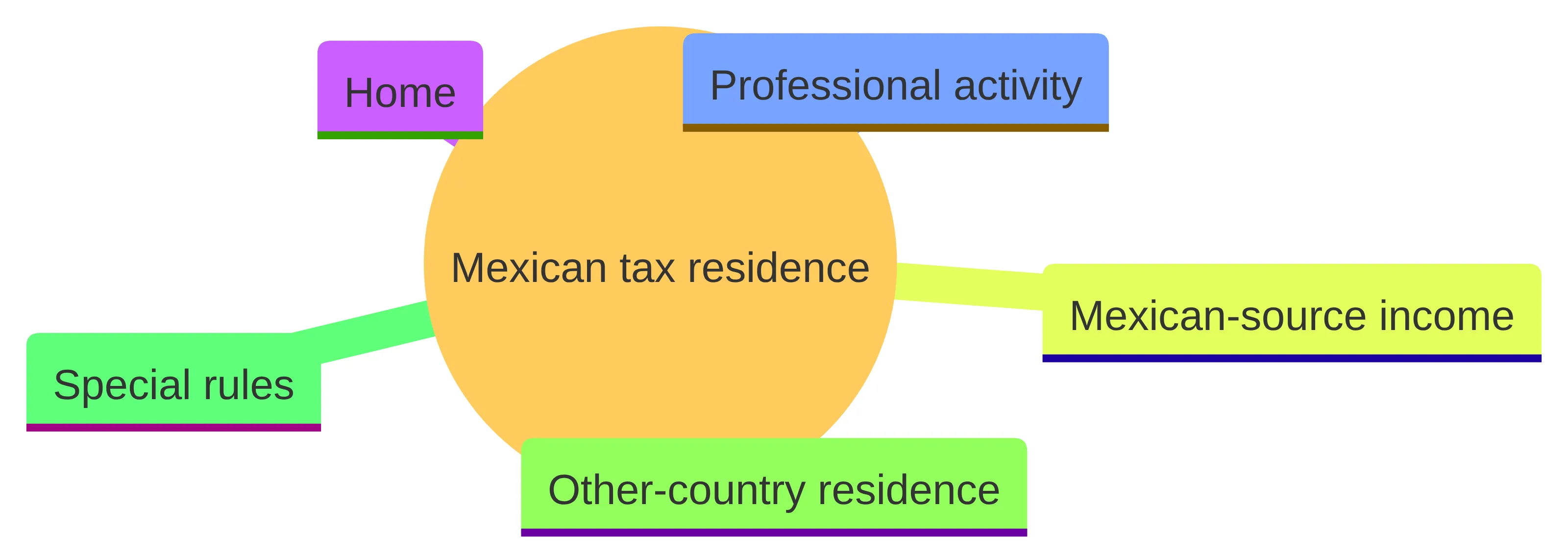
The first triage row is the possible Mexican-residence trigger. An individual is considered a resident of Mexico when they establish a home in Mexico. A permit, hotel stay, or travel plan does not replace examination of the home and the surrounding facts.
When a home also exists in another country, Mexico may consider the individual a resident when the center of vital interest is in Mexico and more than 50% of total income earned in the calendar year is from Mexican sources. Mexico may also deem the center of vital interest to be in Mexico when Mexico is the main location for professional activities.
Place these facts beside one another rather than treating any single item as decisive:
- The homes maintained and how each property is used.
- The main location of professional activity.
- The income streams that may be from Mexican sources.
- Whether another country continues to regard the individual as resident under its own rules.
The sheet should also flag the stated special situations. Temporarily using Mexican real estate for touristic purposes does not, for this analysis, mean a permanent home has been established there. Mexico deems government officials or employees to be residents even when their center of vital interest is abroad. The resulting branch is a question for professional verification, not a permit-based or day-count conclusion.
Triage 2: Route income by status
The second triage row is the income scope attached to the residence branch. If you are a Mexican resident, you must file an annual Mexican income tax return reporting worldwide income during April of the following year. Foreign earnings can therefore remain inside the Mexican review even when the payment or payer is outside Mexico.
The described non-resident treatment is narrower but still depends on classification. If you are a non-resident of Mexico, you are taxable only on Mexican-source income earned in a twelve-month period. A Mexican non-resident subject to this filing rule must file individual monthly income tax returns no later than the 17th day of the following month. The Mexican non-resident tax described here is considered final, with no obligation to file an annual Mexican income tax return.
Use the residence result to route the next question:
- Resident branch: examine worldwide income and the annual return requirement.
- Non-resident branch: examine Mexican-source income and whether the described monthly filing rule applies.
- Unresolved branch: leave the filing pattern open until the residence facts are reviewed.
These branches do not establish that you personally qualify for either status or that a particular item is Mexican-source income. They identify the scope a professional needs to test before a relocation, filing position, or business arrangement is treated as settled.
Build the income-and-entity map
The third part of the triage sheet is an income-and-entity map. An income total does not resolve every tax question, so the map should also flag facts that may require review outside the personal-income analysis. Give each stream its own line:
- Employment compensation or work performed for an employer.
- Fees for services or independent professional activity.
- Revenue from an operating business.
- Interest, dividends, gains, or other investment income.
- Rent and other property-related receipts.
- Payments from a foreign business, partnership, trust, or related entity.
For each line, note the payer, the location of the activity producing the income, the recipient entity or account, the payment period, and the country where tax was paid or reported. These entries do not decide the result. They give the reviewer a way to test residence, source, reporting scope, entity effects, and possible foreign-tax relief against the same income item.
Separate personal and business pages. A change in personal residence does not by itself answer a company’s tax questions, and a company’s location does not by itself answer the owner’s residence question. Where work, ownership, or management crosses borders, keep both paths visible in the triage sheet.
Test the continuing home-country connection
The home-country row prevents the Mexico branch from being read as a replacement for another country’s rules. U.S. and Mexican systems use different residence, income-source, filing, and reporting rules. A connection to Mexico does not automatically replace the rules of a country where you are a citizen, resident, business owner, or former resident.
For a U.S.-connected entrepreneur, mark the continuing connection next to the Mexican residence and income rows. The US–Mexico treaty’s saving clause provides that each country may tax its residents, citizens, and certain former citizens under domestic law without regard to the convention. The treaty technical explanation also states that Mexico does not now tax income on the basis of citizenship, while taxation of former US citizens is limited to a period of ten years under section 877 of the Code.
The saving clause does not answer every dual-country issue. Its application depends on the person, the domestic rules, the treaty provision, and the facts surrounding residence or citizenship. The open questions are therefore:
- Does the home-country system still treat the individual as resident?
- Do citizenship or former-citizenship rules continue to matter?
- Which income and accounts require reporting in each country?
- Does the proposed move affect the individual without changing the business position?
The same row can identify continuing connections with countries other than the United States. Mexico should remain one branch of the review rather than the only jurisdiction considered.
Check foreign-tax relief against each income item
The credit row tests coordination only after an income item has been classified. A Mexican-resident individual may credit foreign income tax paid against Mexican income tax on foreign-source income taxable in Mexico. The credit is limited to the lesser of the foreign tax paid on that income and the Mexican tax corresponding to that income.
Mexico does not allow a foreign-tax credit for foreign taxes imposed on income that is exempt from Mexican taxation. Payment of tax abroad and Mexican taxation of the same item therefore need to be shown separately on the sheet.
For each foreign-taxed stream, place these entries together:
- The income item and whether it is treated as foreign-source.
- The foreign tax paid and the country that imposed it.
- The Mexican income-tax treatment of the same item.
- The amount of Mexican tax corresponding to that income.
- Any exemption or other condition that could affect the credit.
If dual residence or cross-border income is present, the applicable US–Mexico treaty rules belong beside the domestic-law analysis. The treaty may affect coordination, but it does not turn an unclassified income stream into a settled result.
Identify the cascade risks before acting
Cross-border tax risk can build through several connected decisions rather than one isolated mistake. A home in another country, Mexican-source income, or professional activity mainly located in Mexico can affect the center-of-vital-interest analysis. Each fact deserves a place in your review before you relocate or restructure.
The main cascade risks are:
- Accidental multi-country residence: Mexico may consider you a resident when the stated center-of-vital-interest conditions are met, even if you continue to maintain a home elsewhere.
- Overlapping obligations: Mexican and home-country rules can use different residence, source, filing, and reporting concepts.
- Misaligned personal and business planning: your personal move may be evaluated separately from the company’s income, ownership, management, and operating facts.
- Unexamined foreign taxes: tax paid abroad may not produce a Mexican credit if the income is exempt in Mexico or the credit exceeds the applicable limit.
- Premature restructuring: changing residence, ownership, payment flows, or business activity before the facts are mapped can make the intended result harder to evaluate.
We warn that accidentally becoming a tax resident in multiple countries could result in double taxation. Treat that possibility as a reason to coordinate the analysis, not as a prediction that double taxation will occur in your case. Before acting, prepare a timeline showing where you lived, worked, earned income, owned assets, and managed business activity during the relevant period.
Assemble the triage sheet for professional review
The completed triage sheet should let a professional test the connected branches without relying on a relocation label. Use one page or file with these fields:
- Homes and movement: Each home, how it is used, occupancy dates, and the relevant travel calendar. Include the home expected in Mexico and any home retained elsewhere.
- Immigration position: The permit or immigration status, application dates, and intended length and purpose of stay. Keep this field separate from tax residence.
- Professional location: Where services are performed, operations are managed, key business decisions are made, and principal professional activity occurs.
- Income lines: Employment, services, business, investment, rental, and other receipts, with the payer, recipient entity, payment country, and connected activity.
- Ownership and filing history: Companies, partnerships, trusts, accounts, property, ownership percentages, Mexican and home-country returns, information reports, notices, and tax paid abroad.
- Continuing connections and planned changes: Citizenship, former citizenship, prior residences, business connections, the proposed move, work arrangement, ownership or payment change, restructuring, and intended timing.
The sheet’s final column is for unresolved questions: Which facts support or weaken Mexican tax residence? Which income is treated as Mexican-source? What worldwide income must be reported if resident? Which home-country obligations continue? Which treaty provisions apply? Is a foreign-tax credit available for each relevant item, and what limits apply? Each question should point back to a recorded fact.
Convert unresolved branches into verification questions
The last triage step is to convert each unresolved branch into a verification question. A current, jurisdiction-specific review is needed for points that can change a filing position or a relocation decision. A cross-border tax professional can test the sheet against the rules in force when you act.
The written issue list should address:
- Mexican tax residence, including the home and center-of-vital-interest analysis.
- The source and reporting treatment of each income stream.
- Mexican filing scope for the proposed residence position.
- Continuing filing and reporting obligations in the home country.
- US–Mexico treaty provisions if dual residence or cross-border income is present.
- Saving-clause implications of citizenship, residence, or former citizenship where relevant.
- Foreign-tax credit eligibility, the limit for each item, and the effect of any exemption.
- Whether current Mexican rules create separate obligations tied to transactions, property, employment, or the business entity, alongside the personal income-tax analysis, and what personal, entity, ownership, and management consequences the proposed structure may have.
Assumptions should appear separately from conclusions. A conclusion based on Mexican residence has a different scope from one based on non-resident treatment, and a conclusion about personal income does not automatically settle the company’s position. Treat the filing and treaty rules in this article as review points for applying current law to the recorded facts.
Request a written review output that preserves these branches rather than collapsing them into a single yes-or-no label. It should identify:
- The facts accepted and the facts still needing confirmation.
- The residence position being tested and any alternative position.
- Each income stream whose source or reporting treatment remains unresolved.
- The Mexican and home-country filing questions connected to each branch.
- The foreign-tax-credit assumptions and limits for each relevant item.
- The changed fact or future event that would require the analysis to be revisited.
This format makes it easier to distinguish a professional conclusion from an assumption and an unresolved issue. It also separates a personal answer from a business answer: a residence conclusion may be usable while entity-level questions remain open. Do not treat one clear answer as resolving every connected issue. The record should show the review date and identify conclusions that depend on facts or rules that may change before implementation. That gives the entrepreneur a controlled basis for deciding whether to proceed, gather more information, or delay a relocation, filing position, or restructuring decision.
Use the completed review to choose the next action
Your next decision should follow the facts, not the label attached to a permit or relocation plan. Separate immigration status from tax residence, map each income stream, keep home-country obligations visible, and test foreign-tax relief within its limits. A qualified international tax professional must assess your individual suitability, filing position, and proposed restructuring before you rely on a cross-border plan.
Prepare the fact file before the discussion so the review can focus on the connections that change the result: your homes, professional location, income sources, ownership structure, citizenship and continuing ties, foreign taxes, and intended timing. Use that review to decide which questions require an answer before relocating, establishing residence, earning income, or changing a business structure.
What should an expat know before seeking Mexico tax advice?
How does residency status affect tax obligations in Mexico?
Residency status significantly impacts tax obligations. Mexican residents must report worldwide income and file annual tax returns, while non-residents are only taxed on Mexican-source income and have different filing requirements.
What is the difference between tax residency and immigration residency in Mexico?
Tax residency in Mexico is determined by factors such as establishing a home in Mexico or having a center of vital interest there, while immigration residency pertains to the legal permission to reside in the country. These concepts are distinct and can lead to different tax obligations.
What should expats consider regarding cross-border tax issues?
Expats should be aware of potential double taxation and the need to review tax obligations in both Mexico and their home country. Understanding the US–Mexico tax treaty and its implications is crucial for managing cross-border income.
What are the risks of accidentally becoming a tax resident in multiple countries?
Accidentally becoming a tax resident in multiple countries can lead to double taxation, where an individual may be liable for taxes in both jurisdictions. It’s important to carefully analyze residency factors to avoid this situation.
What information should expats gather before consulting a tax professional?
Expats should compile details about their homes, income sources, immigration status, and any relevant tax filings. This information will help a tax professional assess their situation and provide tailored advice.
How can foreign tax credits affect tax obligations in Mexico?
Mexican residents may claim foreign tax credits for taxes paid on foreign-source income, but the credit is limited to the lesser of the foreign tax paid or the Mexican tax due on that income. Understanding these limits is essential for effective tax planning.
Ask the team
Have a question about your own situation?
Tell us where you pay tax today and what you want to achieve. We will review your case and get back to you within 1 business day.