
Global Tax Reduction Planning: A U.S. Entrepreneur’s Decision Guide Before Relocating
Use a relocation triage before choosing a country
Relocation triage is the first step when you are considering an international move to reduce your tax burden. A new address, residence permit, or foreign company does not by itself produce a tax result. Cross-border planning accounts for tax laws in more than one country, including potentially relevant tax treaties, residency rules, and reporting requirements. Tax residence is determined under each jurisdiction’s domestic tax laws, and you may qualify as a tax resident in more than one jurisdiction.
Start by asking whether your proposed move changes the facts that matter, rather than asking which destination advertises the lowest rate. Identify where you live now, where you expect to live, where you will manage the business, where income arises, and which connections remain in the United States. That first pass helps you decide whether a tailored assessment is warranted before you spend money on a new entity, residence application, or relocation plan.
Treat those statuses as separate questions from the beginning.
Use this short triage:
- Personal move: What date do you expect to leave, and where will you spend time afterward?
- U.S. connection: Will you retain citizenship, a green card, a home, family ties, investments, or business activity in the United States?
- Business change: Will the company move, form a foreign entity, change management location, or continue operating from the United States?
- Jurisdiction scope: Which countries’ domestic rules, treaty provisions, and reporting systems could affect the plan?
- Decision point: Are you seeking a personal move, a business restructuring, or both?
If these answers cross more than one legal or tax system, treat professional analysis as a planning step before implementation.
Separate immigration status, residence permits, tax residency, citizenship, and entity structure
Immigration status, a residence permit, tax residency, citizenship, and entity structure answer different questions. Immigration status concerns your permission to enter or remain. A residence permit records an authorization under a country’s immigration system. Tax residency concerns the domestic rules that determine where you may be treated as resident for tax purposes. Citizenship is a legal nationality status. Entity structure concerns the company or other organization that owns assets, earns income, signs contracts, or conducts activity.
The distinction matters because a person can hold a residence permit without becoming tax resident there, while a former jurisdiction may continue to treat that person as resident. The OECD explains that tax residence is determined under domestic law and that a person may qualify in more than one jurisdiction. We assess factors such as time spent in a country, primary residence, and significant personal or financial ties when considering tax residency. We also recognize that every country has different rules for tax residency and residence permits.
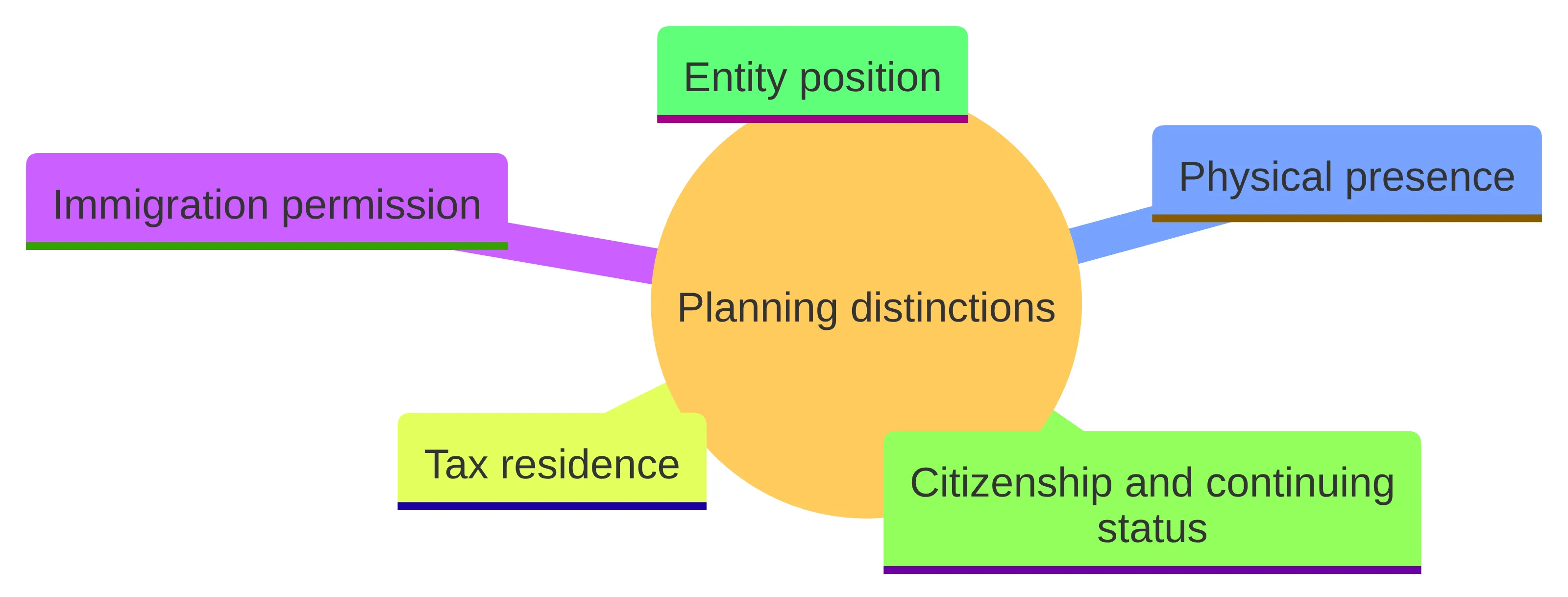
Use five separate lines in your planning file:
- Immigration permission: Record the visa, permit, or status you intend to hold and its conditions.
- Physical presence: Record expected travel and the places where you will actually spend time.
- Tax residence: Identify the domestic tests that each potentially relevant jurisdiction may apply.
- Citizenship and continuing status: Record citizenships, green-card status, and any proposed change to them.
- Entity position: List existing companies, proposed entities, ownership, management, and operating activity.
A green-card holder living outside the United States may still be treated as a U.S. resident alien for tax purposes unless a stated legal exception applies. That rule illustrates why leaving physically or obtaining a foreign permit cannot substitute for a review of the status that remains in force. Keep the five lines separate until the relevant professionals analyze how they interact.
Build the personal and business fact inventory before estimating any reduction
Your fact inventory is the foundation for any cross-border tax analysis. Cross-border planning accounts for laws in more than one country, so a professional needs more than a preferred destination and an expected tax rate. Before U.S. tax residency begins, assets, entities, and family structures deserve review because foreign corporations, trusts, pensions, insurance products, expected inheritances, and family wealth structures may create U.S. tax and reporting consequences.
Prepare the information in five groups:
- Personal status: Citizenship, green-card status, current domicile, primary home, family location, expected move date, travel pattern, and ties you expect to retain.
- Residence history: Countries where you have lived, permits you hold or plan to request, days spent in each place, and prior tax-residence positions.
- Assets and income: Real estate, securities, private investments, deferred compensation, trusts, insurance, loans, distributions, employment income, business income, and expected transfers.
- Business activity: Companies, ownership percentages, business lines, customers, contracts, employees, contractors, management location, bank accounts, intellectual property, and planned changes.
- Compliance record: U.S. and foreign returns, information reports, elections, notices, open examinations, and filing positions that may carry forward.
A fact inventory is useful because it lets you distinguish a personal relocation from an entity change and an income-source change. It also gives a professional a way to test the plan asset by asset and entity by entity instead of treating the move as a single event.
Mark each item as known, estimated, or unknown. Add the date attached to each fact: the planned departure date, the expected first day in a new country, the date of an entity formation, the timing of a sale, or the start of a management change. Keep supporting records with the corresponding item, including prior filings, ownership documents, organizational records, account statements, contracts, and residence documents. Do not estimate savings until the inventory identifies which facts are changing and which facts remain connected to the United States.
Test whether U.S. obligations actually end
U.S. obligations require a separate exit analysis. A foreign residence right or citizenship does not automatically end tax residence in a former jurisdiction. For a green-card holder, living outside the United States may still leave U.S. resident-alien treatment in place unless a stated legal exception applies. A company’s foreign incorporation also does not answer the owner’s personal tax-residence question.
Test the proposed move against the status you hold today and the status you expect to hold after the move. Record whether you will keep a green card, whether you plan to change citizenship, whether a home or family connection remains in the United States, and whether business management or income-producing activity continues there. Each fact can change the questions that require analysis, but none should be treated as a complete answer without jurisdiction-specific review.
Citizenship changes require their own U.S. tax review. Certain former U.S. citizens must comply with federal tax requirements for the year of expatriation and the five tax years before expatriation. Under IRC 877A, covered expatriates may be treated as disposing of worldwide assets and may face a mark-to-market exit tax, subject to the statute’s conditions and exclusion amount.
Use an exit checklist before treating expatriation as part of a plan:
- Identify the proposed status change and its intended effective date.
- Assemble the prior five years of federal tax records and related information reports.
- Inventory worldwide assets, deferred compensation, trusts, and other items that may require review.
- Separate the question of whether expatriation is legally available from the question of what tax consequences it may create.
- Obtain analysis before making an irreversible filing, transfer, or status change.
The checklist organizes the questions. It does not determine whether the statutory conditions apply to you.
Map overlapping residence, tax, and reporting exposure
Overlapping exposure is a normal planning question when more than one jurisdiction may treat you as resident. Tax residence is determined under each jurisdiction’s domestic laws, and you may qualify as a tax resident in more than one jurisdiction. Tax treaties, residency rules, and reporting requirements can affect how income, gains, and assets are taxed, but a treaty analysis depends on its conditions and the facts.
Build a jurisdiction map with one row for each country connected to you or your business. For every row, record the residence test, relevant dates, income and asset connections, filing duties, information-reporting duties, treaty questions, and the professional responsible for resolving the point. Then add a second map for the business: entity location, management activity, customers, employees, contracts, bank accounts, and the place where decisions are made. This structure keeps your personal position from being treated as the company’s position.
Reporting exposure can continue even when your main planning objective is relocation. Under CRS self-certification, account holders or controlling persons must disclose all of their tax residences.
Treat those thresholds as questions to test under the applicable filing rules, not as a complete reporting analysis. Add foreign corporations, trusts, pensions, insurance products, expected inheritances, and family wealth structures to the review because each may create U.S. tax or reporting consequences. Record the forms already filed, the forms under consideration, the relevant asset values, and the tax residence positions reported to financial institutions.
Screen jurisdictions for more than headline tax rates
Jurisdiction screening should test the complete planning fit rather than a headline rate. Cross-border tax planning may involve domestic tax rules, tax treaties, residency rules, and reporting requirements in more than one country. Tax residence is determined under each jurisdiction’s domestic laws, so the country that appears attractive on one measure may create a different result once your personal facts, business activity, and continuing U.S. connections are considered.
Screen each candidate using the same questions:
- Personal residence: What domestic rules could treat you as resident, and what facts would trigger or avoid that result?
- Business position: Where would the company be incorporated, managed, staffed, contracted, and operated?
- Income and assets: How could the country treat salary, dividends, gains, intellectual property, real estate, and foreign accounts?
- Treaty position: Which treaty provisions might be relevant, and what conditions would have to be met before relying on them?
- Reporting: What returns, self-certifications, disclosures, and records would the plan require?
- Operating practicality: Can your proposed travel, family arrangements, management pattern, banking, customers, and staff fit the structure?
- Exit exposure: What happens if you later leave, sell the business, change status, or return to the United States?
Multinational business groups need an additional screen for applicable international reporting frameworks. The OECD GloBE Information Return is a standardized return used to support tax-administration risk assessment and evaluation of a Constituent Entity’s Top-up Tax liability. It includes transitional simplified reporting at a jurisdictional level and coordinated filing and exchange mechanisms that can allow multinational enterprises to report on a single return.
Do not assume that a framework applies merely because your company operates internationally. Ask whether the group, entities, revenue profile, ownership, and jurisdictions place the business within the relevant rules, and identify which calculations and filings require current professional review. Put the answer in the jurisdiction matrix beside the ordinary residence, income, entity, and reporting questions. A lower nominal rate is only one input; administrative obligations and the consequences of a later exit belong in the same decision.
Stress-test the proposed business change and compliance perimeter
Business restructuring needs its own stress test because the owner’s move does not settle the company’s tax position. Review the existing and proposed entities, ownership, management, employees, customers, contracts, intellectual property, bank accounts, and places where business decisions occur. Before U.S. tax residency begins, foreign corporations and other family or wealth structures may create U.S. tax and reporting consequences, so the review should cover more than the entity being formed.
Run the proposed change through these checkpoints:
- Owner and entity: Separate your personal residence and filing position from each company’s position.
- Activity and control: Describe what the business actually does, who makes decisions, and where work is performed.
- Money flow: Trace revenue, expenses, compensation, dividends, loans, transfers, and gains from source to recipient.
- Records: Match contracts, invoices, payroll, bank records, ownership documents, and board or management records to the activity described.
- Reporting perimeter: List every country that may require a return, disclosure, self-certification, or exchange of information.
- Change sequence: Set out what happens first, what depends on it, and what must be completed before the next step.
Compliance screening also includes the character of the proposed transaction. The IRS describes listed transactions as transactions that are the same as, or substantially similar to, tax-avoidance transactions identified in published guidance. Under applicable U.S. rules, organizers, sellers, and material advisors involved with listed transactions generally must maintain and furnish certain investor or advisee information.
Ask the professional reviewing the plan to identify whether any proposed step resembles a transaction identified in published guidance, what disclosure or recordkeeping rules could follow, and whether the commercial purpose and documents match the proposed structure. Do not rely on labels such as “international,” “offshore,” or “tax efficient” to characterize a transaction. Describe the actual steps, parties, assets, payments, control, timing, and expected result. If a proposed arrangement depends on secrecy, incomplete records, or a promise that no filing will be needed, stop implementation until the issue is resolved.
Prepare a consultation-ready review request
A consultation-ready review request turns your fact inventory into a decision brief. Cross-border tax planning accounts for laws in more than one country, while pre-residency planning may require an asset-by-asset, entity-by-entity, and family-by-family review. Send a concise summary that allows the professional to see the intended move, the business change, the jurisdictions involved, and the questions that remain open.
Include these sections:
- Objective: Explain whether you want to relocate personally, restructure a business, change citizenship or residence status, protect family assets, or examine more than one objective.
- Timeline: Give the proposed departure, arrival, formation, sale, transfer, and implementation dates, marking estimates separately from fixed dates.
- Personal profile: List citizenship, green-card status, current residence, family location, homes, travel pattern, and continuing U.S. connections.
- Business profile: Describe each entity, ownership, activity, management location, employees, contractors, customers, contracts, intellectual property, accounts, and expected changes.
- Financial profile: Summarize income sources, assets, liabilities, gains, distributions, trusts, pensions, insurance, and expected inheritances.
- Compliance profile: List returns, information reports, prior advice, notices, examinations, and unresolved filing questions.
- Jurisdiction shortlist: Name the countries you are considering and explain the reason for each without assuming that any is suitable.
Attach documents that support the facts: prior tax returns and information reports, passports and residence documents, green-card records, ownership charts, formation documents, financial statements, account records, contracts, payroll records, property records, trust and insurance documents, and schedules of expected transactions. Organize each document under the fact it supports and note the period it covers.
Ask focused questions rather than requesting a general promise of savings:
- Which countries’ residence rules could apply to me, my family, and each entity?
- Which U.S. obligations could continue after the proposed move or status change?
- How could the proposed management, ownership, income, and asset arrangements be treated in each jurisdiction?
- Which reporting, disclosure, treaty, and information-exchange questions need current-law review?
- What facts would make the proposed route unsuitable, too burdensome, or unavailable?
- Which step must be analyzed or completed before another step can begin?
Use a complete brief so the engagement can address the actual facts rather than a headline destination.
Choose assessment before implementation
A tailored assessment is the appropriate next step when your proposed move or international business change creates questions about personal status, entity structure, tax residence, reporting, or overlapping jurisdictions. Relocation is not a tax result. Your outcome depends on the facts, the jurisdictions involved, the sequence of actions, and the rules that apply when you act.
We help entrepreneurs grow internationally by reducing taxes, protecting assets, and securing residency or citizenship to support global mobility. A qualified professional must determine your individual suitability, eligibility, liability, and implementation requirements under the applicable jurisdictions and current law.
Bring the fact inventory, jurisdiction map, document set, and decision questions to that assessment. That preparation gives the review a clear starting point and keeps a proposed country, permit, citizenship path, or entity from being treated as the answer before its consequences have been tested.
If your plan crosses borders, use the assessment to clarify what can change, what may continue, and what must be addressed before implementation.
What should you verify before relocating or restructuring internationally?
What factors determine tax residency in different jurisdictions?
Tax residency is determined by each jurisdiction’s domestic laws, which may consider factors such as time spent in the country, primary residence, and significant personal or financial ties.
What should I include in my fact inventory for cross-border tax planning?
Your fact inventory should include personal status, residence history, assets and income, business activity, and compliance record to provide a comprehensive overview for tax analysis.
What is the significance of the OECD GloBE Information Return?
The OECD GloBE Information Return is a standardized document that helps tax administrations assess compliance with global minimum tax rules and evaluate a company’s Top-up Tax liability.
What steps should I take before expatriating from the U.S.?
Before expatriating, you should review your tax obligations for the year of expatriation and the five years prior, inventory your worldwide assets, and understand the potential tax consequences under IRC 877A.
What questions should I prepare for a professional global tax reduction consultation?
Prepare questions about applicable residence rules, continuing U.S. obligations, treatment of proposed management and ownership structures, and any reporting or treaty issues that need current-law review.
Ask the team
Have a question about your own situation?
Tell us where you pay tax today and what you want to achieve. We will review your case and get back to you within 1 business day.