
U.S. Exit Tax and Departure Planning: A Pre-Departure Decision Guide
Relocation triggers a tax review, not an automatic tax result
Moving abroad is a reason to start a tax review, not a tax result. A new country, residence permit, or overseas business address does not by itself answer whether federal expatriation rules, state tax rules, destination-country rules, or continuing business connections affect you.
Your first decision is therefore not whether relocation is attractive. It is whether you need a coordinated review before you change citizenship or expatriation status, leave your state, move assets, alter ownership, or begin operating from another country.
The review should keep four questions separate:
- Federal: What citizenship, expatriation, compliance, asset, income, and timing facts must be tested under the rules in force when you act?
- State: Has your domicile changed, and could income still be connected to a state after you leave?
- Destination: What immigration status and tax-residency position will you have in the country where you plan to live or operate?
- Structure: How will your personal move interact with your company, ownership, management, contracts, accounts, and records?
A relocation plan can involve all four tracks at once. Treating one track as a substitute for the others is how a simple move becomes an incomplete tax analysis. Use the sections below to identify the questions, records, and decision points that need review before you take an irreversible step.
Overview
International departure planning is a sequence of questions rather than a single calculation. You need to establish what is changing, which jurisdiction is asking the question, and which facts must be documented before an answer can be reached.
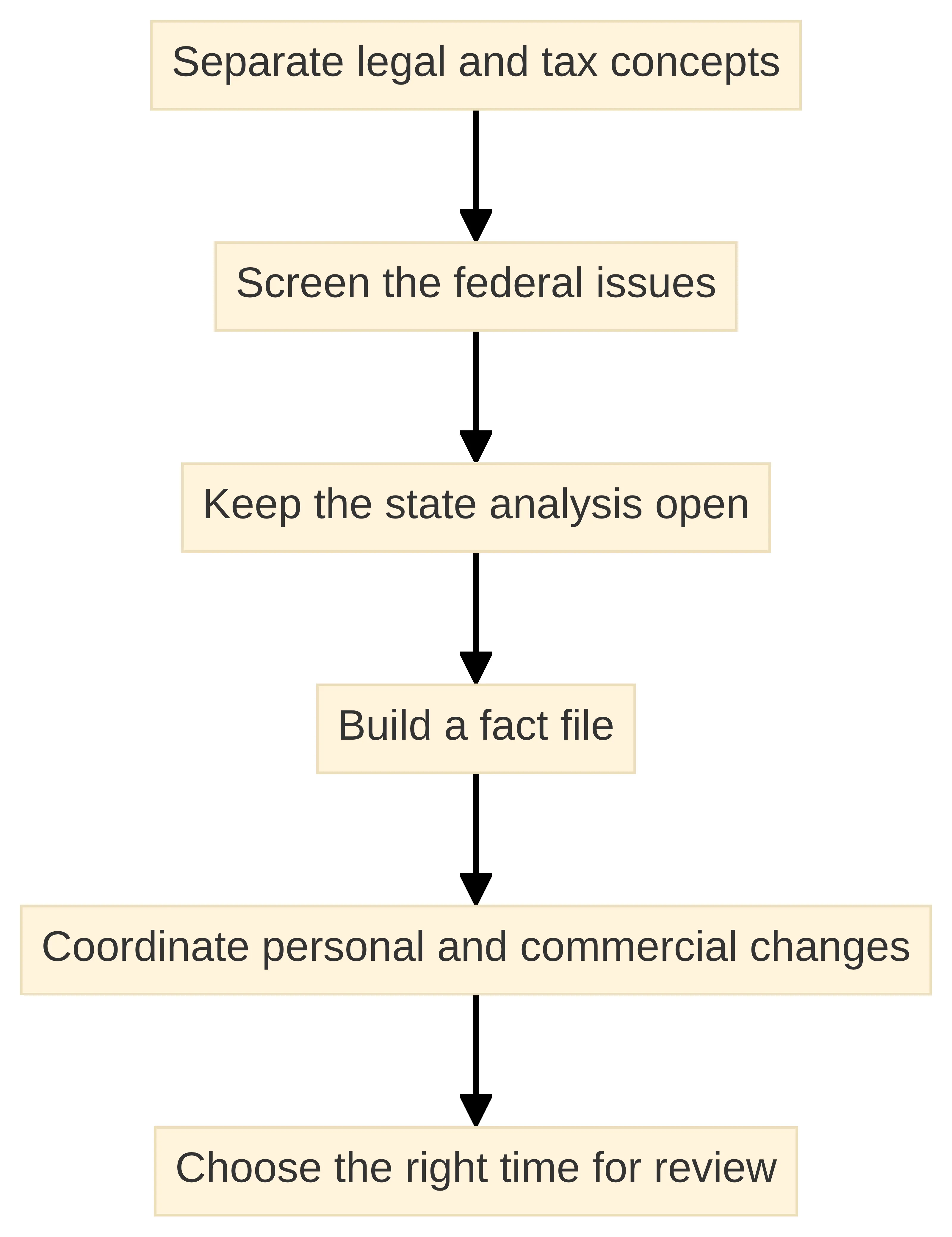
This guide addresses the following decisions:
- Separate legal and tax concepts. Federal expatriation, state domicile, destination-country tax residency, and immigration status are different lines of analysis.
- Screen the federal issues. Citizenship or expatriation status, prior compliance, assets, income, and timing belong in the federal review, while thresholds, rates, exceptions, and filing rules require current verification.
- Keep the state analysis open. Leaving the country does not answer whether a state still considers you resident or whether income remains sourced there.
- Build a fact file. Your citizenship, residency history, assets, liabilities, business interests, income, ownership, intended destination, and planned dates give advisers the material needed to analyze the move.
- Coordinate personal and commercial changes. Moving yourself, moving management, changing an entity, and opening a foreign operation can create separate questions that should be examined together.
- Choose the right time for review. Obtain the analysis before you surrender status, sell or transfer assets, change ownership, close accounts, or make other changes that may be difficult to reverse.
The practical outcome is a decision file, not an assumed answer. If the facts are incomplete, the responsible next step is to identify what is missing and obtain current federal, state, and destination-country analysis before acting.
Separate federal expatriation, state departure, and residence status
Federal expatriation, state departure, tax residency, and immigration status should appear as separate headings in your review file. They can interact, but they do not answer the same question.
Federal expatriation concerns the federal consequences of a change in the status that brings you within the relevant expatriation rules. The analysis is not answered by the country where you intend to live alone. Citizenship or other relevant status, compliance history, assets, income, and timing may all need to be examined under current rules.
State departure concerns your relationship with the state you are leaving and any income or activity that remains connected with it. A change of country does not eliminate the need to analyze domicile, continuing connections, and state-source income.
Tax residency concerns the country or countries that may treat you as resident for tax purposes. Tax residency is determined by factors such as how long you spend in a country, where your primary residence is, and where you have significant personal or financial ties. Country-specific rules can differ.
Immigration or residence-permit status answers an immigration question; it does not, by itself, complete the tax-residency analysis. Global entrepreneurs can hold multiple residence permits while maintaining a single, tax-friendly residency.
That distinction matters when your plan includes a visa, a residence card, a second home, or several countries. Record each permit separately from the tax-residency position you expect to claim, the days you expect to spend in each country, your primary home, and your personal and financial ties. A permit may help you live in a country while leaving the tax question open for separate analysis.
Start with the federal expatriation questions that require current verification
The federal screen should begin with your status and timeline, not with a headline rate or a generic internet checklist. Put these questions at the front of the review:
- What citizenship or other status do you hold now, and what status change are you considering?
- What date would the change take effect, and what actions would happen before and after that date?
- Which federal returns, statements, or other compliance records cover the relevant prior years?
- What assets, liabilities, income streams, trusts, interests, and business holdings would need to be valued, classified, or traced?
- Which facts connect your personal plan to a company, partnership, investment, employer, or controlled operation?
- Which federal thresholds, rates, exceptions, valuation rules, and filing obligations must be checked against authoritative guidance in force when you act?
These are screening questions, not an eligibility test. A relocation decision alone cannot tell you whether a federal expatriation rule applies, what amount might be involved, or which filing obligations follow. Keep those conclusions for a current, fact-specific analysis.
The IRS states that, in its relief procedures for certain former citizens, meeting the certification test requires filing Form 8854 with the tax return for the year of expatriation and certifying compliance for the prior five tax years.
That statement is limited to the relief procedures and population it describes. It does not establish that you qualify for those procedures, determine your status, or answer every federal filing question connected with a move. If your plan involves a former-citizen relief pathway, place the relevant returns and compliance records in the review file and have the current requirements tested before relying on the pathway.
Do not treat an old threshold, a rate copied from a secondary article, or a broad statement about an expatriation tax as your personal result. Federal rules can turn on status, dates, valuation, prior compliance, and the interaction between personal and business facts. Your action point is to list those facts and obtain current authority for each rule that could change the decision.
Analyze state domicile and continuing source income separately
State analysis has at least two paths: your residency or domicile and the source of particular income. States with personal income taxes generally consider both residency or domicile and nonresident source income when determining what income they may tax.
That means an international move should prompt a state-by-state review rather than a single statement that you have left the United States. Identify the state you are leaving, the date and facts surrounding the change, any property or business activity that remains there, and any income connected with work, services, property, or operations in that state.
As a general principle, a state taxes its residents on income from whatever sources it is derived, typically with a credit mechanism for some or all tax paid to another state on the same income.
Use that principle as a reason to examine your facts, not as a conclusion about your status. Your file should show where you lived, where your primary home and personal connections were located, how your work and business activity were conducted, and when each relevant change occurred. The state-specific rules determine how those facts are treated.
Regardless of residency or physical presence, a state may tax a nonresident on income sourced to that state.
After you leave, list any continuing state connection that could affect the source of income. A foreign home or a new residence permit does not erase a state-source question. Separate the question of whether you remain a resident from the question of whether a particular payment, activity, property, or business connection remains attributable to the state.
For practical review, create a short state schedule with four columns: state, connection, income or activity, and date of change. Include former residences, property, offices, operating activity, customers or services tied to the state, ownership interests, and continuing records. Then ask for the state-specific domicile and source analysis before treating the departure as complete.
Key Highlights
The central decisions are these:
- Relocation is a trigger for review, not an automatic tax escape. A move can change future relationships with jurisdictions, but it does not answer prior obligations, federal expatriation questions, state domicile, source income, or business connections on its own.
- Federal and state questions are different. Federal expatriation analysis should not replace a state review of domicile and continuing source income.
- A residence permit is not the same as tax residency. Tax residency turns on factors such as time spent in the country, the location of your primary residence, and significant personal or financial ties.
- Personal and business facts belong together. Moving yourself may affect how you manage, own, or operate a business, while changing a company may create a separate review of structure, compliance, and income.
- Multiple tax residencies create a separate concern. Accidentally becoming a tax resident in multiple countries could result in double taxation.
- Current verification is part of the plan. Thresholds, rates, exceptions, forms, state treatment, destination-country rules, and treaty effects must be checked against the rules in force when you act.
The useful question is not whether relocation sounds tax-efficient in the abstract. Ask which facts change, which jurisdiction can still assert a connection, and which records support the position you intend to take.
Assemble the personal and business facts behind the move
Your departure analysis should follow the facts that move with you, remain behind, or change during the transition. Start with a timeline, then attach the relevant records to each stage.
Status and residence history
Record every citizenship, relevant immigration or expatriation status, country of residence, state domicile, primary home, and material change in residence. Add the dates that matter rather than relying on a general statement such as moving abroad in a particular year.
Personal connections
List family location, homes, recurring travel, personal property, banking relationships, professional activity, and other ties that may help explain where you lived or where you continued to operate. The purpose is not to label a connection as decisive. It is to give the analysis a complete factual record.
Assets and income
Separate liquid assets, investments, real property, deferred compensation, privately held interests, intellectual property, loans, trusts, and other holdings. For each item, record ownership, acquisition date, cost or valuation records, expected income, location, and any planned sale, transfer, or restructuring.
Business interests
Identify every entity, your ownership percentage, voting or management rights, role in operations, place of management, employees, contracts, customers, accounts, intellectual property, and related-party arrangements. Note whether the business will remain in the United States, expand abroad, change its management, or create another entity.
Destination plan
Record the intended country, expected arrival and departure dates, housing, permit or visa route, work location, business activity, and expected time in each country. Keep intended facts separate from facts that have already occurred.
This organization turns a broad relocation idea into a set of questions that can be tested. It also helps you spot missing dates, unclear ownership, and personal or business changes that were being planned separately but need to be reviewed together.
Build a pre-departure information file
Build one dated information file before requesting the departure review. The file records what you hold, where you live, what you own or control, what will change, and when each change is expected. It is a working record for analysis, not a substitute for the analysis itself.
Use these sections:
- Identity and status: citizenship records, passports, relevant status documents, prior countries of residence, state residences, and the status change you are considering.
- Residence timeline: dates for homes, travel, work locations, state moves, intended departure, intended arrival, and any planned return or continuing presence.
- Federal and state records: tax returns, notices, elections, statements, prior professional advice, state filings, and records that show compliance or an unresolved issue.
-
- Income: employment or service income, distributions, investment income, property income, deferred amounts, sale plans, and the entity or activity connected with each stream.
- Business ownership and control: entity charts, governing documents, ownership registers, management roles, contracts, payroll or service arrangements, accounts, intellectual property, and related-party transactions.
- Destination plan: intended country, immigration route, housing, work location, expected days, family arrangements, local activities, and any other planned personal or commercial tie.
- Decision calendar: every proposed sale, transfer, resignation, status change, account closure, entity change, arrival, departure, and filing milestone.
Label assumptions as assumptions. If a valuation, date, ownership percentage, or residence fact is uncertain, mark it for confirmation instead of silently filling the gap. The file becomes more useful when it distinguishes what has happened from what you intend to do.
If your review concerns the IRS relief procedures for certain former citizens, create a clearly marked section for the prior five tax years. The IRS states that the certification test in those procedures requires certification of compliance for that period and filing Form 8854 with the tax return for the year of expatriation.
Do not assume that this narrow procedure applies to your situation. Use the records section to support a current determination of whether it applies and what other records or filings may be relevant.
Use timing, records, and compliance history as planning controls
Timing should control the order of your decisions. Begin the review before a status change, asset transfer, sale, entity restructuring, account closure, or move that would make the facts harder to reconstruct. Early review gives you a chance to identify missing records and distinguish a proposed action from one that has already occurred.
Use this sequence:
- Set the proposed timeline. List the intended departure date and every personal, federal, state, destination, and business change around it.
- Capture the current position. Save returns, statements, ownership records, valuations, agreements, and residence records before transactions change the picture.
- Separate planned from completed actions. A proposed transfer should not be presented as though it has already happened, and a completed change should not be treated as reversible merely because the move is not finished.
- Test interactions. Ask how a personal status change, state departure, destination-country position, and business change affect one another.
- Record the decision basis. Keep the rule version, assumptions, dates, professional conclusions, and documents used for each material decision.
- Revisit the review after a material change. A changed departure date, sale, valuation, ownership arrangement, or destination can alter the questions that need to be answered.
This process does not determine a tax outcome. It gives you a controlled way to see which facts are known, which remain uncertain, and which action should wait for review.
Use the timeline as a comparison tool, not merely a list of dates. For each proposed change, record what is changing, who controls it, where it is located, which person or entity is involved, whether it is planned or completed, and which document supports the entry. This approach lets the review distinguish a change to your personal residence from a change to management, ownership, an account, a contract, or an entity, even when the changes are scheduled close together.
Keep a separate note for the reason a fact matters. A return, statement, ownership register, agreement, permit document, travel record, valuation, or residence record can document a reported fact, event, or relationship. It does not, on its own, supply the conclusion about how a federal, state, or destination-country rule treats that fact. Mark conclusions as questions for current review rather than blending them into the factual record.
Use a before-and-after comparison for each material event. The pre-change column can show the status, residence, ownership, management, income connection, and intended date before action. The post-change column can show what actually changed, what remained in place, and which details are still unknown. If the event has not happened, leave the post-change column open rather than filling it with an expectation. If it has happened differently from the plan, preserve both the original plan and the actual record.
Personal and business calendars should be read together. Place the intended departure, changes in home or work location, management decisions, ownership transfers, sales, new entities, account changes, contract changes, and destination-country steps on one timeline. The purpose is not to assume that one event determines another. It is to reveal where the same date, asset, person, or entity appears in more than one part of the plan and where separate professional questions may need to be coordinated.
For assets and interests that may change, identify the relevant point in time and the record available at that point. Note ownership, control, acquisition or transfer date, valuation material, income connection, debt or other recorded obligation, and any planned disposition. Where a value, date, or ownership detail is uncertain, label the uncertainty and identify the document or professional input needed to resolve it. Do not replace an unknown figure with an estimate simply to make the timeline look complete.
For residence and travel facts, preserve actual dates separately from intended days. Note the location of each home, work activity, family or other personal connection, permit or visa status, and expected time in each country. If the plan changes, add the new date and reason for the change without deleting the earlier plan. A dated history gives reviewers a way to distinguish an intention from an event and to identify which country or state connections require separate analysis.
Where more than one sequence is possible, do not choose between them based on an assumed tax result. List the factual changes each sequence would create, the records available before each step, and the point at which qualified professional review is needed. This comparison can clarify whether timing, order, or coordination changes the information available without promising a particular outcome. If the approved facts do not support a preference, leave the choice open for current analysis.
Finally, end the file with open questions and a decision boundary for each proposed action. An open question might concern status, compliance history, asset treatment, state domicile, source income, destination-country residence, business management, or the coordination of professional roles. Beside it, identify the missing fact, the jurisdiction involved, the relevant date, and whether the question should be addressed by a tax, legal, accounting, immigration, banking, or other qualified professional. This keeps the review focused on facts and current analysis rather than on a general assumption about the tax effect of moving.
The completed file should make three things easy to see: what is known, what is intended, and what still requires qualified review. That clarity supports a structured departure decision without turning a planning record into an eligibility conclusion.
Compliance history deserves its own review rather than a passing reference. The IRS states that, for the certification test in its relief procedures for certain former citizens, the individual must file Form 8854 with the tax return for the year of expatriation and certify that the prior five tax years were properly filed, complete, and accurate.
This is a specific statement about those relief procedures, not a universal instruction for every person leaving the United States. Use it as a prompt to organize the relevant records and identify unresolved returns, amendments, notices, or omissions for current analysis. Do not treat a clean-looking file as proof that every federal condition has been met.
Confirm destination-country status without confusing permits with tax residency
Your destination plan should contain two separate columns: immigration status and tax residency. Tax residency is determined by factors such as time spent in a country, the location of your primary residence, and significant personal or financial ties.
For each destination, record:
- the permit, visa, or other immigration route you expect to use;
- the date you expect to enter and the time you expect to spend there;
- where you will maintain your primary home;
- where your family, work, management activity, and financial ties will be located;
- whether you will work, provide services, own property, operate a business, or receive income there; and
- which other countries may still treat you as resident or connected to local income.
Conversely, your tax position may require review even when your immigration plan seems straightforward.
Record each residence permit separately from the tax-residency position you intend to establish. Note the relevant country and dates, then test the position against your time spent, primary home, and personal or financial ties; permit count alone cannot settle the tax question.
Accidentally becoming a tax resident in multiple countries could result in double taxation. Before you move, map your expected days, homes, personal ties, business activity, and income connections across all relevant countries. If two countries could treat you as resident, identify the rules, treaty conditions, documentation, and professional review needed to analyze the overlap rather than assuming that one permit or one address resolves it.
Coordinate the owner’s departure with the business structure
Your personal departure and your company’s position should be reviewed on the same timeline. Moving your home, changing where you manage the business, transferring ownership, forming a foreign entity, shifting contracts, or opening an overseas account are separate actions. The fact that they are planned together does not make their tax, legal, or compliance treatment identical.
Prepare a simple business map showing:
- each entity and its owners;
- who controls and manages it;
- where employees, contractors, customers, assets, and accounts are located;
- where services are performed and decisions are made;
- which contracts, intellectual property, loans, and related-party arrangements connect entities; and
- which personal or business changes are planned, completed, or still under discussion.
Use the map to identify questions for corporate, tax, accounting, banking, and legal review. Do not assume that moving the owner moves the company, and do not assume that forming a foreign entity settles the owner’s federal, state, or destination-country position.
We help businesses expand abroad with corporate structures, tax planning, and compliance with international regulations. For a departure review, that means the business questions can be placed alongside the owner’s residence, status, income, and timing questions instead of being handled as an isolated company-formation task.
We collaborate with lawyers, accountants, tax advisors, bankers, registered agents, realtors, and other professionals based anywhere in the world. Your information file should identify which specialist needs to answer each question and where responsibilities overlap. Tax treatment, entity administration, immigration status, banking, property, and contracts should not be treated as one person’s conclusion when the move affects several professional areas.
Recognize when general information is not enough
General information stops being sufficient when a decision depends on a fact that is personal, time-sensitive, jurisdiction-specific, or difficult to reverse. Arrange a current cross-border review before acting if any of these conditions applies:
- you are changing citizenship or another status connected with federal expatriation rules;
- your prior federal or state compliance is incomplete, disputed, amended, or difficult to document;
- you own appreciated, illiquid, leveraged, deferred, or privately held assets;
- you own, manage, or control a company, partnership, trust, investment vehicle, or intellectual property;
- you are leaving more than one state connection behind or expect continuing state-source income;
- your destination plan involves more than one country, permit, home, or possible tax residency;
- you intend to transfer assets, change ownership, move management, sell a business, or form a new entity; or
- your departure date is close enough that the sequence of actions may be set before the analysis is complete.
These indicators do not determine whether a tax applies. They identify circumstances in which a general explanation is not a sufficient basis for action.
Do not rely on a fixed threshold, rate, exception, form, state rule, destination-country rule, or treaty conclusion without checking the authority in force when your action occurs. Federal expatriation questions may depend on status, compliance, valuation, and dates. State questions may depend on domicile and source. Destination questions may depend on residence, presence, ties, and local rules.
The right boundary is clear: a move alone cannot determine your eligibility, exposure, filing position, or outcome. Those conclusions require a current review of your facts under the applicable federal, state, and destination-country rules.
Bring these questions to the review:
- Which status and dates control the federal analysis?
- Which prior returns and records need to be assembled or corrected?
- Which assets, income streams, and business interests require separate treatment?
- What state domicile and source-income questions remain after departure?
- What destination-country residence and tax questions arise from the intended schedule and ties?
- Which personal and business actions must be sequenced, documented, or delayed?
- What facts would change the analysis if your destination, timing, ownership, or management plan changes?
A clear question list is more useful than asking for a broad assurance that relocation will eliminate tax.
Decide whether your move warrants a structured departure-tax review
Your move warrants a structured departure-tax review when it involves a change in status, a state departure, a new country of residence, significant assets, business ownership or management, continuing income connections, or a sequence of changes that could affect more than one jurisdiction.
Before you relocate or change a structure, assemble the information file, set out the timeline, separate federal, state, destination, and business questions, and mark every assumption that still needs confirmation. A qualified cross-border tax and legal professional must determine individual suitability, applicable obligations, and the order in which you should act.
The objective is not to presume an exit-tax result or to assume that relocation removes existing obligations. It is to make the relevant facts visible early enough for current rules and coordinated advice to guide the decision.
Once your file and question list are ready, take the next step before making an irreversible change to your status, assets, residence, ownership, or business operations.
What should you gather before discussing an international departure?
What factors determine tax residency when moving abroad?
Tax residency is determined by factors such as the duration of stay in a country, the location of the primary residence, and significant personal or financial ties to that country.
How can I prepare for a structured departure-tax review?
To prepare for a structured departure-tax review, gather information on your citizenship, residency history, assets, business interests, income, and intended destination, and create a timeline of relevant changes.
What should I consider regarding state tax residency when leaving the U.S.?
When leaving the U.S., consider whether your domicile has changed and if any income remains connected to the state you are departing from, as states may tax residents on all income and nonresidents on income sourced within the state.
What are the risks of accidentally becoming a tax resident in multiple countries?
Accidentally becoming a tax resident in multiple countries can lead to double taxation, where an individual may be taxed on the same income by more than one jurisdiction.
When should I seek professional advice for exit tax and departure planning?
Seek professional advice when your situation involves complex factors such as changing citizenship, incomplete compliance history, ownership of significant assets, or multiple state connections.
Ask the team
Have a question about your own situation?
Tell us where you pay tax today and what you want to achieve. We will review your case and get back to you within 1 business day.