
Global Tax Reduction Planning: A Decision Guide Before You Relocate or Restructure
Is Your Relocation or Restructuring Ready for a Lawful Assessment?
Global Tax Reduction Planning begins with a documented picture of your current position, not with a promised rate in a destination country. If you are considering moving yourself, moving an eligible business, incorporating abroad, acquiring foreign assets, entering a new market, or changing how your company is managed, the first question is whether the proposed change can be analyzed across every affected jurisdiction.
Your timing matters because a transaction can alter several parts of your tax position at once. Review your international tax position before incorporating abroad, relocating, restructuring, acquiring foreign assets, expanding into a new market, or changing how your company is managed. That sequence gives you a chance to identify filing duties, tax connections, and operational requirements before a move becomes difficult to reverse.
A practical opening file should answer four questions:
- What personal change are you considering?
- What business change are you considering?
- Which countries are connected to you, your business, your income, and your assets?
- Which assumptions would make the proposed structure fail if they proved wrong?
A low headline tax rate alone can create risk when management, substance, banking, accounting, and compliance are not aligned with the structure. A destination may look attractive on a rate comparison while the wider arrangement creates additional obligations or leaves the intended result unsupported by the way you actually live and operate. Treat the rate as an input to test, not as the conclusion. The assessment is ready to begin when you can describe the proposed personal and business changes clearly enough for each interaction to be examined.
Separate the Five Decisions That Relocation Can Combine
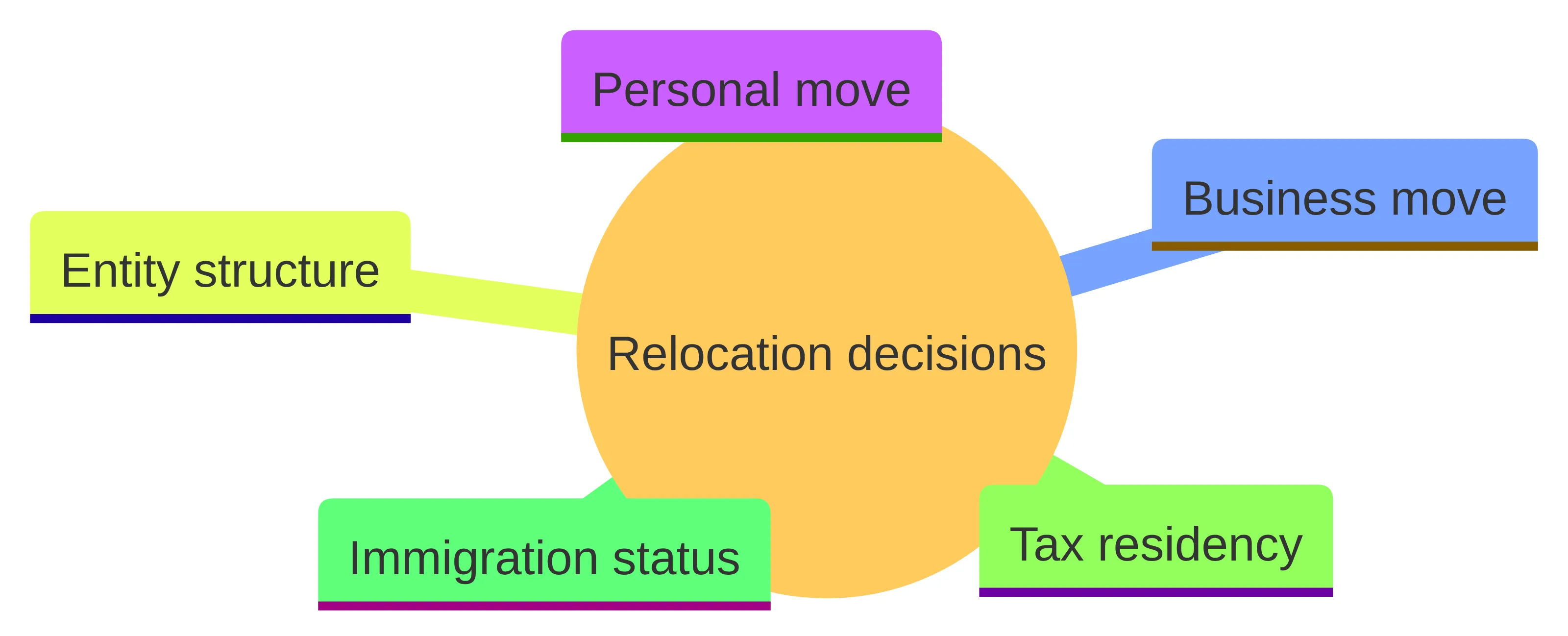
Use a separate line in your planning file for each decision, then record the proposed change and the question it creates:
- Personal move: What changes in your home, presence, and daily activity?
- Business move: What changes in management, personnel, customers, suppliers, and operations?
- Entity structure: Which entity owns assets, signs contracts, earns income, and bears obligations?
- Tax residency: Which domestic-law tests could apply to you and the company?
- Immigration status: What permission would allow you to live or work there, and what does that permission leave unresolved?
We offer a Global Tax Reduction Service that includes cross-border planning, entity structuring, and tax strategies. That service category does not turn the five questions into one answer; it gives you a framework for having them examined together.
Map the Entrepreneur’s Current Personal Position
Your personal map should distinguish facts from assumptions. Record the following for the period before the proposed move and for each planned stage after it:
- Citizenship and current tax-residence positions.
- Residence history, intended homes, physical presence, and travel patterns.
- Family ties and other connections that may matter under a jurisdiction’s rules.
- Employment, business, investment, property, trust, pension, and other income sources.
- Assets, liabilities, ownership interests, and expected transfers.
- The countries connected to your clients, employers, companies, banks, property, and investments.
- Existing returns, information reports, tax elections, and unresolved notices or positions.
A personal map therefore needs more than a proposed address.
Use a separate classification for each income stream instead of placing all foreign income into one total. Record whether the item is compensation for services, business income, dividends, interest, pensions, capital gains, or another category; identify its source, recipient, ownership, and relevant year. The foreign earned income exclusion, where applicable, concerns earned income rather than dividends, pensions, or capital gains. Labeling the income this way helps a professional determine which relief, treaty, reporting, and recordkeeping questions are actually relevant. It also prevents a projected benefit for one type of income from being silently applied to another.
Tax-residence disclosure is a separate preparation issue. That means your file should identify each residence position that may apply rather than assuming that a new residence permit replaces the previous position. Mark every conclusion as a question for jurisdiction-specific review when the underlying facts or domestic-law test remain unsettled.
Map the Business Before Moving Its Owner or Operations
Document the business facts that could change the analysis:
- Every entity, branch, partnership, trust, or other vehicle connected to the activity.
- Ownership percentages, voting rights, control arrangements, and related parties.
- Directors, managers, employees, contractors, and the places where they perform their work.
- Where contracts are negotiated, signed, performed, and stored.
- Customers, suppliers, inventory, intellectual property, equipment, property, and bank accounts.
- Revenue by source, payment route, currency, customer location, and type of income.
- Intercompany services, loans, licensing, distributions, and other related-party flows.
- Existing accounting records, returns, registrations, payroll, indirect-tax filings, and information reports.
This inventory lets you distinguish an owner’s personal move from a change in business management, activity, ownership, or income source.
Make a second pass that compares an owner-only relocation with a business relocation. If the owner changes location while management, contracts, personnel, and operations do not, record that as a different model from one in which the company’s management or activity also changes. For each model, identify the facts that move, the facts that stay, and the facts that become shared across jurisdictions. Then ask which entity earns each receipt, who performs the relevant function, where decisions are made, and which records demonstrate those answers. This comparison prevents an entity chart from standing in for an operating map and gives professional advisers a defined alternative to test.
An international tax planning review should consider personal and company tax residency, permanent establishment risk, treaties, withholding tax, substance, transfer pricing, VAT, accounting, and reporting obligations. The list is a perimeter for investigation, not a conclusion that every item applies to your business. Use it to identify which facts must be tested before you move operations, appoint new managers, sign contracts from another country, or place assets into a new entity.
Use business records to flag ownership, control, payment, or management links that connect the company and the owner. Keep the company map and personal map separate, then connect them where ownership, control, payments, or management create a cross-border link.
Treat Immigration Permission and Tax Residency as Separate Tests
Use two columns when you evaluate a proposed destination:
- Immigration column: What status would permit you to enter, live, work, or conduct the proposed activity?
- Tax column: Which domestic-law rules could make you resident, keep you resident elsewhere, or create more than one residence position?
Then add a third line for reporting. Keep reporting separate from the immigration and tax columns. A permit may solve a mobility question while leaving the tax and disclosure questions open.
Do not use a residence card, visa, or citizenship certificate as proof of a tax result. Record the document as evidence of an immigration status only, then analyze the domestic-law residence tests, presence, connections, income, and continuing obligations that apply to you. If more than one jurisdiction may treat you as resident, keep both positions visible until the relevant rules and any treaty provisions have been examined.
Label each document according to the question it can answer. A permit or visa can document an immigration status; it does not establish the tax conclusion. A domestic-law residence analysis addresses a tax position; it does not by itself prove that the person may live or work in the jurisdiction. A required self-certification records the tax residences being reported for the applicable framework; it is not a substitute for testing whether another jurisdiction also treats the person as resident. Citizenship should likewise remain a separate data point. Keeping these documents in separate columns makes it easier to identify an unresolved position rather than allowing one document to be treated as proof of all three.
Test the Proposed Structure Against the Cross-Border Tax Perimeter
Turn each category into a question tied to your facts:
- Entity choice: What does each entity own, earn, control, and report?
- Residence: Where could you and each company be resident under domestic law?
- Permanent establishment: Could the way you work, contract, or manage create a taxable business presence elsewhere?
- Treaties and withholding: Which income payments cross borders, and what conditions govern relief?
- Substance and management: Does the proposed structure match where decisions, people, functions, and resources actually sit?
- Transfer pricing: Which related-party services, loans, licenses, or sales need pricing and records?
- VAT and accounting: Which registrations, invoices, books, and filings could follow from the activity?
- Reporting: Which returns, disclosures, self-certifications, and information reports are connected to the structure?
- Repatriation and credits: How would money, profits, losses, and foreign taxes move between you and the entities?
The proposed structure should be explainable through the actual business rather than through a label. Ask for each proposed step to be connected to a real activity, a defined owner, a recordkeeping requirement, and a tax question. If a step depends on an assumption about residence, income source, management, or treaty relief, place that assumption beside the step instead of hiding it in the projected result.
Create an assumption register for the proposed structure. For each assumption, record whether it is documented, disputed, or unverified; identify the fact that would confirm or contradict it; and note which jurisdiction-specific rule must be checked. Examples include the expected place of management, the source of an income stream, the residence position of an owner, the availability of treaty relief, or the existence of sufficient records for a related-party transaction. Then link each assumption to the step that depends on it. A model with a favorable projected result but several unverified assumptions should be treated as a conditional scenario, not as a settled comparison with the current position. This gives the consultation a practical order: resolve the assumptions that could change the structure before refining the estimate.
An estimate becomes more useful when it shows the conditions that support it. Separate expected tax treatment from implementation costs, filing duties, administration, operational changes, and consequences if a condition fails. This prevents a single projected figure from standing in for the entity, personal, treaty, anti-deferral, and reporting analysis that produced it.
Check U.S. Rules That Can Survive a Foreign Move
Treaty relief is conditional. Treaty relief requires meeting all applicable treaty requirements, including any requirement to remit income to the country of residence. Treaty outcomes depend on the specific treaty article and saving clause, and treaty-based return positions can trigger Form 8833 disclosure. The relevant income category, residence position, source rule, treaty article, and filing position should therefore appear together in your consultation questions.
Use the same sequence for each material income stream: identify the payer and recipient, determine the relevant source and domestic-law residence positions, locate the specific treaty article and saving clause, check every condition for relief, and record any disclosure or filing consequence. Keep an unresolved condition visible rather than describing the payment as treaty-exempt in the working model. This approach also makes comparisons clearer: two income streams may involve the same countries but different articles, source rules, or reporting positions.
Keep an earned-income exclusion and a foreign-tax-credit analysis as separate branches of the file. The first asks whether the income is the kind of earned income covered by the applicable exclusion; the second examines whether a foreign-tax-credit analysis is relevant under its separate limitations. Dividends, pensions, and capital gains should not be placed in an earned-income exclusion calculation merely because they arose while the person lived abroad. For each item, label the possible route as an exclusion, credit, treaty position, or no identified relief, and state the condition that must be verified before it enters the estimate.
Controlled foreign corporation rules create another checkpoint for a U.S. shareholder. U.S. shareholders may have current inclusion of their pro-rata share of a controlled foreign corporation’s foreign personal holding company income, including specified passive income categories. A U.S. shareholder of a controlled foreign corporation must include global intangible low-taxed income in gross income in a manner similar to Subpart F income.
The practical questions are specific: Do you own or control a foreign corporation? What income does it earn? Who receives it, when does it arise, and which U.S. inclusion or reporting rules may apply? Do not treat non-distribution of cash as proof that no U.S. tax issue exists.
A U.S.-focused workplan should connect four layers:
- Continuing citizenship-based filing and other U.S. obligations.
- Treaty residence, source, withholding, saving-clause, and disclosure questions.
- Foreign tax credits and their category and carryover limits.
- Controlled foreign corporation inclusions and related reporting.
Use the layers to test the proposed move and structure together. A residence decision that appears favorable in isolation may interact with ownership, passive income, treaty conditions, or U.S. reporting in a way that changes the analysis.
Reject the Headline-Rate Shortcut
Use this screen before you rank any destination:
- Fit: Does the jurisdiction’s tax treatment address the actual income, activity, ownership, and residence facts?
- Operations: Can management, personnel, banking, accounting, and substance operate as the model assumes?
- Compliance: Can you meet the domestic and cross-border filings, disclosures, registrations, and recordkeeping requirements?
- Interaction: How do the proposed rules connect with U.S. obligations, treaties, anti-deferral provisions, withholding, credits, and other countries involved?
- Failure condition: What happens if your presence, management, income source, permit, treaty position, or filing assumption changes?
A destination passes this screen only for the questions that have been answered with facts and applicable rules.
Large international structures may also encounter global minimum-tax rules where relevant. The OECD GloBE rules are a common approach: jurisdictions need not adopt them, but adopters must implement them consistently with the agreed outcomes and rule order. The GloBE Information Return is a standardized return used to support risk assessment and evaluation of a constituent entity’s top-up tax liability. Treat these rules as a jurisdiction- and structure-specific checkpoint, not as a universal result for every business.
Compare proposed destinations against the same baseline rather than comparing one destination’s headline rate with another destination’s headline rate. Use the documented current position, the same income and ownership assumptions, the same proposed operating facts, and the same treatment of compliance and implementation requirements. Mark each comparison as supported, conditional, or unresolved. A destination should not be described as preferable merely because its rate appears lower if the analysis has not yet tested whether the management, substance, banking, accounting, reporting, and other operating assumptions can be maintained.
Sequence the Work Before Taking an Irreversible Step
Use this sequence:
- Document the current position. Map personal residence, citizenship, presence, income, assets, entities, ownership, management, activity, filings, and reporting.
- Define the proposed change. Separate your personal move, business move, entity change, residence position, and immigration status.
- Model the connections. Trace income, assets, payments, contracts, management, employees, related parties, and movement of funds across jurisdictions.
- Test the perimeter. Examine tax residence, permanent establishment, treaties, withholding, substance, transfer pricing, VAT, accounting, reporting, entity choice, anti-deferral rules, repatriation, and foreign tax credits.
- Test U.S. consequences. Address continuing filing, treaty conditions, credits, controlled foreign corporation inclusions, and disclosures where relevant.
- Coordinate the implementation plan. Assign each filing, registration, record, operational change, and professional question to a responsible adviser before the move or restructuring occurs.
Timing should be treated as part of the analysis, not as an afterthought. A transaction date, move date, incorporation date, contract date, income-recognition date, or management change may affect which facts and rules apply. Put the intended dates beside each step, then identify what must be completed before that date.
Keep a before-and-after snapshot for every material change. The first snapshot should show the current owner, entities, management, income flows, assets, residence positions, and reporting obligations. The second should show only the facts intended to change, with the unchanged facts carried forward explicitly. Beside each difference, record the rule, filing, operational requirement, or professional question that the difference triggers. If a date, contract, management arrangement, ownership position, or income flow changes during review, update the snapshot before relying on the earlier model. This change-control step helps prevent a conclusion based on an earlier version of the proposed structure from being carried into implementation.
Create a stop point before any step that changes ownership, management, residence, contracts, banking, assets, or reporting. At that point, ask whether the proposed action still matches the documented facts and whether the relevant filing, treaty, operational, and compliance conditions are understood. If an assumption has changed, return to the model rather than carrying the old result forward.
Prepare a Consultation File That Can Be Tested
Include these categories:
- Identity and status: citizenship, passports, residence permits, visas, tax-identification numbers, and residence history.
- Presence and connections: travel calendar, day counts, homes, family ties, work locations, and other personal connections.
- Income and assets: pay, business income, dividends, interest, gains, pensions, property, trusts, investments, loans, and expected transfers.
- Business records: entity documents, ownership chart, management chart, contracts, employee and contractor locations, customer and supplier locations, bank accounts, assets, intellectual property, and revenue by source.
- Compliance history: federal, state, local, foreign, payroll, indirect-tax, information, treaty, and self-certification filings; notices and open positions.
- Proposed changes: destination, dates, new entity, ownership change, management change, move of operations, intended income flows, and planned distributions.
Bring questions that require a testable answer:
- Which facts determine my personal and company tax-residence positions?
- Could I remain resident elsewhere or become resident in more than one jurisdiction?
- What facts could create a permanent establishment or change where business income is taxed?
- Which treaty article, saving clause, withholding rule, or disclosure requirement applies to each relevant income stream?
- Which foreign taxes may be creditable, under which category, and subject to which carryover rules?
- Could controlled foreign corporation, Subpart F, GILTI, or other anti-deferral rules affect the proposed ownership or income flow?
- Which accounting, VAT, payroll, banking, transfer-pricing, and information-reporting obligations follow from the operating model?
- What date, document, operational fact, or rule change would invalidate the proposed treatment?
- Which steps must occur before relocation, incorporation, restructuring, contract signing, or payment?
A precise question set makes it easier to separate a result supported by the facts from a result that depends on an untested assumption.
Ask for an output that records assumptions, alternatives, actions, deadlines, filings, responsible parties, and failure conditions. The output should distinguish personal treatment from company treatment and tax analysis from immigration implementation. It should also show which facts require updating if your travel, management, ownership, income, or destination changes.
To make that output usable as a decision record, create a traceability register for each material conclusion. Include:
- The decision or question being answered.
- The personal, business, income, ownership, management, or timing facts used.
- The jurisdiction or jurisdictions whose rules must be checked.
- The treaty article, domestic-law test, reporting requirement, or other issue identified for review, when applicable.
- The conclusion’s status: supported by the provided facts, conditional on a stated assumption, unresolved, or requiring another professional’s review.
- The action that follows, its intended date, the responsible party, and the document or record that should confirm completion.
Do not place a projected tax result in the register without preserving the condition that supports it. If a conclusion depends on where management occurs, how an income item is classified, whether a treaty condition is met, or whether a required record exists, write that dependency beside the conclusion rather than in a separate general note. This makes it possible to see which unresolved fact could change the proposed structure.
Where several professionals are involved, keep one shared list of assumptions and questions. A tax adviser, lawyer, accountant, banker, registered agent, or other professional may address a different part of the implementation; the file should show where one answer depends on another answer. If two recommendations use different residence positions, ownership facts, dates, or operating assumptions, do not combine them into a single result. Identify the conflicting input, ask which fact or rule resolves it, and update the model only after the difference has been addressed.
Before acting, review every proposed step against four questions: Is the factual premise documented? Is the applicable treatment still conditional? Has the required filing, registration, record, or operational change been assigned? What event would require the conclusion to be revisited? This final review does not decide the tax result in advance. It creates a controlled handoff from analysis to implementation and helps keep an earlier working model from being treated as a permanent answer after the proposed facts change.
Before the consultation, mark each requested item as provided, pending, disputed, or not applicable, and keep the supporting document or source of the fact beside that label. Group the questions by decision rather than presenting one undifferentiated list: personal residence, business operations, entity ownership, income treatment, treaty or anti-deferral rules, reporting, and implementation. Ask the adviser to identify which answers are conclusions, which are conditional on further facts, and which require review by another professional involved in immigration, accounting, banking, or business operations. The resulting file is more useful when it shows not only the proposed answer, but also the evidence and unresolved dependency behind it.
Know What This Assessment Cannot Decide in Advance
The assessment also cannot promise that a permit will be granted, that an entity will qualify for a particular treatment, that a treaty will eliminate tax, or that a projected reduction will remain available after the facts change.
Use the assessment to identify questions, conditions, documents, and decisions that require jurisdiction-specific treatment. Do not treat a general comparison as a determination of your residency, eligibility, immigration status, filing position, or final tax liability. If the proposed structure depends on a fact that has not been established, mark the outcome as conditional and keep the action on hold until the condition is addressed.
Begin With a Structured Global Tax Review
A lawful relocation or restructuring decision is ready for the next stage when your personal facts, business facts, residence positions, income flows, treaty questions, U.S. rules, reporting duties, and implementation conditions are documented together. A qualified international tax professional must determine suitability and applicable treatment for your specific circumstances. Our Global Tax Reduction Service includes cross-border planning, entity structuring, and tax strategies. Our service is delivered by an international lawyer and tax advisor specializing in cross-border taxation, citizenship and residency acquisition, and global wealth protection. We collaborate with lawyers, accountants, tax advisors, bankers, registered agents, realtors, and other professionals based anywhere in the world.
Bring your consultation file, proposed timeline, personal and business maps, destination assumptions, and question list to the assessment. The purpose is to test the structure before you relocate or restructure, identify the conditions that support each conclusion, and separate a workable plan from a headline-rate idea.
What Should You Bring to an International Tax Planning Consultation?
What factors should I consider for global tax reduction planning?
When planning for global tax reduction, consider personal tax residency, company structure, income flows, assets, management, and compliance obligations across different jurisdictions.
How does tax residency differ from a residence permit?
Tax residency is determined by each jurisdiction’s domestic laws and may not be automatically established by holding a residence permit or citizenship. You can be a tax resident in more than one jurisdiction.
What are the risks associated with relocating for tax purposes?
Risks include unintended tax residency, double taxation, compliance failures, and changes in country rules that could affect your tax obligations.
What information should I prepare for a consultation with an international tax professional?
Prepare details about your personal and business maps, including citizenship, tax residency, income sources, assets, and any existing tax obligations.
What is the importance of understanding tax treaties in international tax planning?
Tax treaties can affect the source, withholding, and residence outcomes for income, but their benefits depend on meeting specific treaty requirements.
How can I ensure compliance with U.S. tax obligations after relocating?
Continuing U.S. tax obligations may include citizenship-based filing, treaty conditions, and reporting requirements, which should be addressed in your planning.
What should I do if my proposed relocation changes my tax situation?
Reassess your tax position, considering how the relocation affects your residency, income sources, and compliance obligations, and consult with a qualified tax professional.
Ask the team
Have a question about your own situation?
Tell us where you pay tax today and what you want to achieve. We will review your case and get back to you within 1 business day.