
Asset Protection Plans: A Protection-Gap Decision Guide
Start with the protection question, not a promised outcome
Asset-protection strategies may be relevant to people whose assets face potential lawsuits, creditor claims, or other financial risks. The answer is a structured review of exposure, ownership, timing, and possible legal responses—not a promise that every asset will be shielded from every creditor, lawsuit, tax, political event, or financial loss.
Asset-protection strategies may be relevant when your wealth includes business interests, investments, real estate, or other assets that could become exposed. Relevance does not establish suitability. Your facts, liabilities, ownership arrangements, jurisdictions, and applicable law determine what can be considered.
Lawful planning is prospective and transparent. Lawful planning is subject to applicable fraudulent-transfer or similar laws. A transfer made after a claim-related event may be treated as fraudulent against creditors when it was intended to hinder, delay, or defraud them.
That boundary separates planning from concealment or evasion. You should not treat a new structure as a way to hide an asset, defeat an existing claim, or move property after a known problem has arisen. Begin with three questions:
- What could create a claim or creditor problem?
- Which assets, interests, or income streams could be involved?
- What protection exists before any new arrangement is considered?
Those questions keep the decision focused on a gap rather than on a structure that happens to be familiar or attractive.
Establish the timing boundary before reviewing any transfer
Timing helps assess whether a proposed transfer belongs in preventive planning or raises a creditor-rights problem. A transfer made after an event that may result in a claim can be treated as fraudulent against creditors when the transfer was intended to hinder, delay, or defraud them.
The practical lesson is simple: do not wait until a claim, threatened claim, or other liability event is already shaping the decision. Do not assume that changing ownership after a problem appears will create lawful protection. The relevant analysis depends on the event, the transfer, the intent, the assets involved, and the law that applies.
A timing screen can organize the facts to discuss with a professional before a transfer. Record:
- The date and nature of any known or anticipated liability event.
-
- The proposed asset, owner, recipient, and purpose of any transfer.
- The jurisdictions whose law may govern the asset, parties, or claim.
- The documents and records that explain the transaction.
This screen is not a legal determination. It is a way to put timing facts in front of qualified advisers before you act. If a claim-related event has already occurred, stop treating the arrangement as routine planning and obtain case-specific advice before moving assets.
Build an inventory of threats, assets, and obligations
Your exposure inventory should connect possible threats to the assets and obligations that could be affected. Potential lawsuits, creditor claims, and other financial risks are relevant categories. It also identifies cash, stocks, bonds, business interests, insurance proceeds, jewelry, art, antiques, and real property as asset categories that planning may address.
Treat the inventory as a factual map, not as a conclusion that every listed asset needs a new structure. Different assets can have different owners, uses, legal characteristics, and locations. Those differences can change the questions you need to ask.
Create one line for each asset or liability and capture the facts that could change the analysis:
- Asset or obligation: cash, securities, business interest, property, insurance proceeds, valuable personal property, debt, guarantee, or dispute.
- Current owner: you, a business, a trust, joint owners, or another legal owner.
- Use and location: personal, investment, operating, or cross-border use, together with the relevant jurisdiction.
- Existing protection: exemption, ownership arrangement, insurance, entity boundary, trust, or no identified protection.
- Exposure: the lawsuit, creditor, business liability, or other risk that makes the item relevant.
- Timing: whether any claim, threatened claim, liability event, or anticipated liability affects the review.
Common planning approaches include insurance review and debt management.
Keep the inventory concrete. A vague goal such as “protect wealth” cannot tell you whether the unresolved issue is ownership, creditor exposure, insurance, debt, administration, or cross-border law. A line-by-line file gives you a basis for asking which facts matter, which protections already exist, and which exposure remains unresolved.
Test the Conditions Behind Existing Protection
Existing protection is conditional, so begin by recording the legal basis being relied on and the condition attached to it. That basis may be a specified exemption, an ownership form, a retirement or IRA account, a trust, a business entity, or an insurance policy. Broader planning may use business entities or trusts for future-creditor concerns, but those options require their own review.
These categories are not interchangeable. An exemption may apply only to a specified asset type. An ownership arrangement may depend on the people involved and the applicable law. A retirement account, jointly owned property, trust, business entity, or insurance policy may each require a different review. Keep the stated basis separate from the question of whether its conditions apply to the asset.
A condition-first review asks, for each asset or ownership interest:
- What exemption or ownership structure is being relied on?
- What asset type, people involved, or state-specific law may limit how that protection applies?
- Which part of the basis still needs jurisdiction-specific professional review?
- What fact about the asset or applicable law could change the result?
This review does not label an asset protected in the abstract. It keeps the stated basis and its conditions separate from assumptions about what applies.
Do not assume that a familiar ownership form produces the same result in every state or for every asset. Treat the baseline as a set of questions for jurisdiction-specific review. If an asset is already covered by an applicable exemption or ownership arrangement, adding another structure may add complexity without addressing the actual gap.
Build an asset-by-asset decision file
An asset-by-asset decision file keeps each holding or ownership interest tied to the question it raises. It records the relevant facts, existing protections, unresolved exposure, and the professional review needed before a transfer or new structure is considered. It is a way to organize questions, not a conclusion that an asset is protected.
Use the file to separate four questions that are easy to collapse: what the asset is; whether an existing protection may apply; what exposure has been identified; and whether a proposed response has been assessed under the relevant law. These are different stages of review. A listed exemption or ownership form is not the same as a conclusion that the asset is protected, and a possible exposure is not the same as an established liability. Keeping those stages separate shows a professional which facts are documented and which still require analysis.
Preserve the reason each item is in the file. A business interest may raise questions about separation from personal assets and business-related liabilities. A residence, account, insurance proceed, investment, or valuable personal item may raise different ownership, exemption, insurance, or jurisdiction questions. The file should not force all of these items into one category. It should show where categories overlap, where the facts are incomplete, and which question follows from that uncertainty.
When several assets share an owner or liability, keep their records linked without treating them as one problem. Note whether a proposed response could change control, access, administration, records, or continuing obligations. If the response involves another jurisdiction, identify that connection and the institutions involved rather than assuming that a foreign structure answers a question governed by United States law. This keeps the later review specific without turning the file into a legal conclusion.
Use the gap question to identify what is unknown, not to fill the gap with a preferred product or structure. If the missing fact is governing law, the review question should ask which law applies. If it is ownership, locate the documents that establish ownership. If it is maintenance, identify the recurring responsibility and the records that would show it was handled. If it is timing, put the claim-related facts and any anticipated liability at the front of the discussion. If no exposure is established from the available facts, record that uncertainty rather than treating uncertainty as proof that a new arrangement is required.
This separation also gives the comparison a consistent basis. Each approach can be connected to a documented exposure, the asset or interest involved, the conditions on which it depends, the control or flexibility it may change, and the maintenance or compliance work it creates. A structure that does not address the recorded gap should remain an open question, even if it is familiar. Conversely, an existing protection that fits the facts should be recorded before another structure is considered. The completed file therefore supports a focused conversation: which facts are known, which gaps remain, which professionals need to examine them, and what must be clarified before action.
Do not treat a blank field as a negative finding. A missing document, unclear owner, or untested condition is a prompt for review, not evidence that protection is absent or that a transfer is needed. Likewise, recording a threat does not establish that a claim will occur. The file should preserve these distinctions so that the professional can assess the facts without a conclusion being smuggled into the inventory.
Create one record for each asset or ownership interest. The record can include:
- Asset and use. Note whether the item is cash, securities, a business interest, insurance proceeds, jewelry, art, an antique, real property, or another relevant holding.
- Ownership and legal connections. Record the owner, how the asset is used, any entity or trust involved, and the relevant state or foreign jurisdiction.
- Potential threat. Describe the concern in plain language, such as a lawsuit, creditor claim, business liability, debt, political risk, or financial instability.
- Existing features. Note any exemption, ownership arrangement, insurance, trust, or entity boundary already identified.
- Open question. State what remains unclear about the exposure, applicable law, formalities, compliance, or the need for qualified legal or tax advice.
Use the completed records to produce three outputs for each item:
- Fact set: the asset, owner, use, liabilities or threats, jurisdictions, and protections that still need to be verified.
- Gap question: the specific exposure that remains after considering the protections already identified. If no exposure is established from the available facts, record that uncertainty rather than assuming a structure is needed.
- Review question: the question a qualified attorney or tax advisor must address before any transfer, entity, trust, insurance change, or cross-border arrangement is pursued.
The file should also show the trade-offs attached to any approach under consideration. Exemptions, ownership forms, entities, trusts, insurance review, and cross-border approaches do not answer the same question. For a multi-entity proposal, the relevant questions include design, maintenance, records, entity formalities, and preservation of legal separation. Other strategies may reduce control and flexibility, so those trade-offs belong in the review question.
No record establishes suitability. That depends on the person’s facts, assets, liabilities, jurisdictions, and applicable law. A claim-related event can also change what may lawfully be considered, so timing must be addressed with qualified professionals before action.
Compare planning approaches by the problem they are meant to address
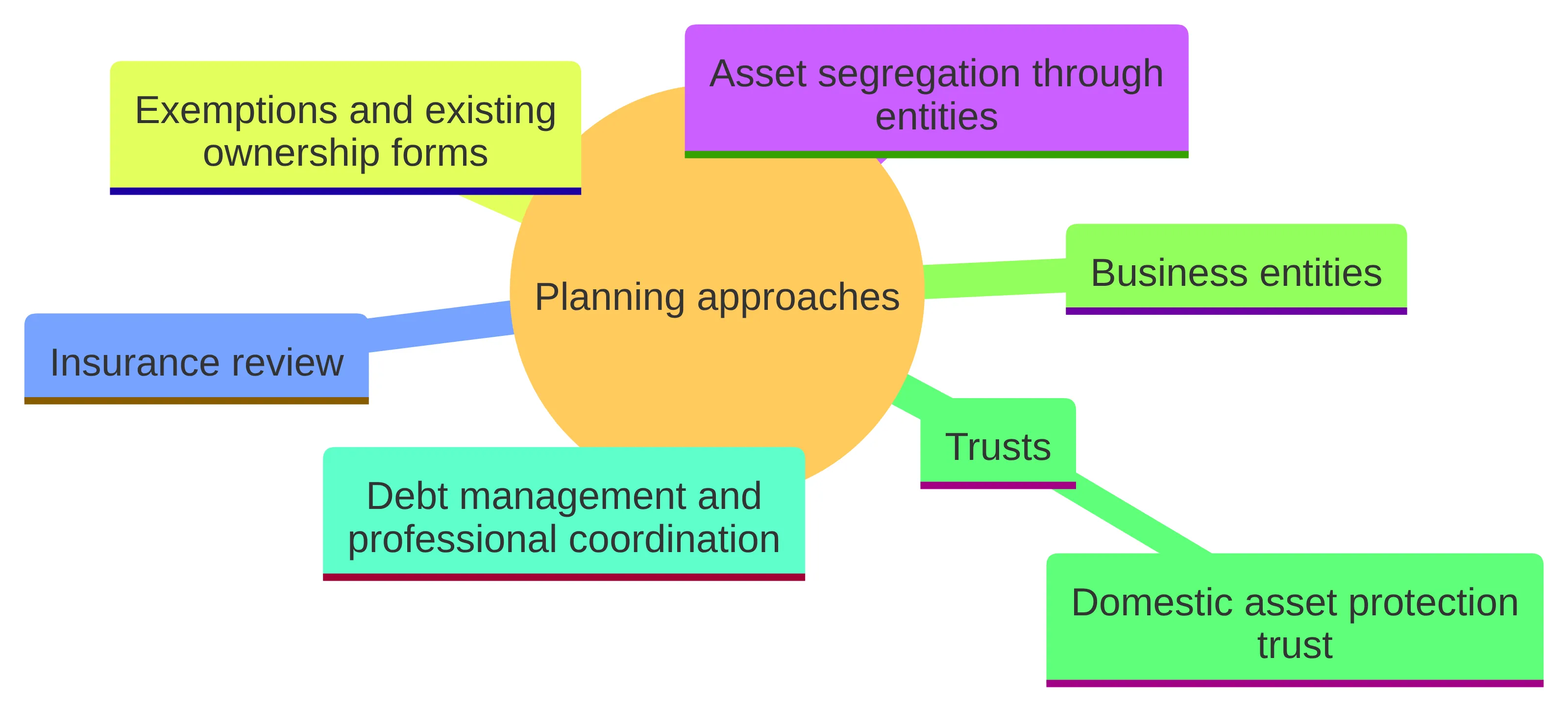
Planning approaches answer different questions, so compare them by purpose rather than by name. Common approaches include asset segregation, insurance review, jurisdiction-specific exemptions or trusts, legal consultation, and debt management. Exemptions may protect specified assets, while broader planning may use business entities or trusts for future-creditor concerns. When properly structured and administered, a domestic asset protection trust may help address future creditor claims and support estate-planning goals.
The table below gives you a screening framework. It does not determine which approach applies to your facts.
| Approach | Problem to examine | Questions to take into review | Boundary |
|---|---|---|---|
| Asset segregation through entities | Whether personal and business assets are separated from business-related liabilities | Which asset belongs to which entity? Are ownership, accounts, records, and operations kept distinct? | A multi-entity arrangement requires careful design, maintenance, entity formalities, and preserved legal separation. |
| Insurance review | Whether liability, business, or umbrella coverage belongs in the broader risk review | What coverage exists, what risk is it intended to address, and how does it fit with the proposed structure? | Insurance review is one planning approach; it does not by itself answer every ownership or creditor question. |
| Exemptions and existing ownership forms | Whether a specified asset or ownership arrangement already receives protection under applicable law | Which exemption or ownership form applies, to what asset, and under what conditions? | Exemptions protect specified asset types, and ownership protections depend on the applicable law. |
| Business entities | Whether a legal boundary between owners and business interests is relevant to the documented exposure | What liability is inside the entity, who controls it, and what formalities must continue? | The separation must be preserved in practice and maintained over time. |
| Trusts, including a domestic asset protection trust | Whether a trust addresses future-creditor or estate-planning concerns | What law governs the trust, who administers it, what control changes, and what conditions apply? | A domestic asset protection trust may help only when properly structured and administered. |
| The response must be matched to the documented facts rather than applied as a standard package. |
Use the comparison by writing one sentence for each approach: “This option is being considered because…” Then add the asset, liability, jurisdiction, condition, and maintenance requirement that make the sentence testable. If you cannot state the problem an approach addresses, pause before adding it to the plan.
Jurisdictional diversification is one cross-border approach to consider when political risk or financial instability is part of the documented exposure. It addresses a different question from an entity, trust, or insurance review. Label the objective first, then ask which professional should assess it.
Test whether the structure can remain legally separate in practice
Use this operating checklist during review:
- Ownership: Can you identify the owner of every relevant asset and interest?
- Accounts: Are funds and transactions assigned to the correct owner or entity?
- Records: What records show decisions, transfers, contracts, and administration?
- Formalities: Which entity formalities must be followed, and who tracks them?
- Maintenance: What changes in ownership, assets, liabilities, or operations require an update?
- Coordination: Which lawyer, accountant, tax adviser, banker, or registered agent handles each responsibility?
The checklist does not prove that legal separation exists. It exposes the practical points that need professional review. If the arrangement depends on conduct you cannot consistently maintain, the proposed complexity deserves particular scrutiny before implementation.
Treat cross-border planning as a separate jurisdiction and compliance question
Cross-border planning changes the questions because more than one legal system or institution may affect the arrangement. Described approaches include offshore trusts, international LLCs, multiple-jurisdiction strategies, offshore bank accounts, and private placement life insurance.
An offshore trust involves offshore governing law and financial institutions. That consequence is not automatically a benefit; it is a jurisdictional and institutional condition that belongs in the decision.
Build a cross-border matrix before comparing a foreign structure with a domestic one. For each asset and proposed approach, record:
- Governing law and the jurisdiction of the trustee, entity, bank, or insurer.
- Where the asset is held and where the owner, beneficiary, or controlling person is located.
- How a claim, judgment, or creditor remedy might interact with the relevant jurisdictions.
- Which United States institutional protections may not apply to an offshore arrangement.
- Which state-law exemptions or entity protections depend on where you live.
- Who will coordinate legal, tax, banking, registration, and ongoing administrative questions.
Asset-protection laws vary by state, so available exemptions and entity protections depend partly on where you live. A foreign option therefore does not replace a state-law review. It adds another layer to it.
Make compliance a decision criterion, not an afterthought. Ask which United States and foreign obligations may apply, who will identify them, which records must be retained, and how changes in residence, ownership, accounts, or beneficiaries will be handled. Ask the same questions about recognition, administration, and access to the relevant institution.
Do not treat the number of jurisdictions as a measure of protection. Treat each additional jurisdiction as a reason to document governing law, responsibility, maintenance, and the limits of the arrangement.
Compare protection against the control and complexity it requires
Asset-protection strategies may reduce the control and flexibility owners have over their assets. Weigh those trade-offs with attorneys and tax advisers before using irrevocable trusts, LLCs, LPs, or other structures.
State variation adds another limit. Available exemptions and entity protections depend partly on where you live, so a structure discussed in general terms cannot be treated as a uniform answer across the United States.
Compare any proposed approach against five decision criteria:
- Protection fit: Does the proposal address the documented exposure and asset, or does it address a different concern?
- Control: What decisions can you still make, and what authority or flexibility changes?
- Complexity: What entities, trustees, accounts, records, advisers, and recurring actions must be coordinated?
- Compliance and maintenance: What formalities and jurisdiction-specific requirements must continue?
- Failure conditions: What event, conduct, timing issue, or administrative breakdown could change the analysis?
A multi-entity plan requires careful design and maintenance. Its effectiveness depends on respecting entity formalities and preserving legal separation. Include those ongoing requirements in the comparison rather than evaluating formation alone.
Ask the professional to explain the trade-off in concrete terms: what you may gain in relation to the identified exposure, what control you may surrender, which costs or responsibilities continue, and which jurisdiction-specific limits remain. A clear answer should describe conditions and boundaries rather than offer an unconditional assurance.
Use a professional review to test the plan, not validate a label
A professional review should test the exposure-to-structure logic, the jurisdictional assumptions, the timing, and the work required after implementation. Use the proposed plan as a set of questions rather than accepting a label such as “global,” “offshore,” “protected,” or “multi-entity” as an answer.
Ask the provider or professional:
- Which documented exposure does each proposed step address?
- Which assets, owners, liabilities, and jurisdictions were included?
- Which assumptions could change the result?
- Which lawyer, accountant, tax adviser, banker, registered agent, or other professional is responsible for each part?
- Who prepares and maintains records, filings, accounts, and entity formalities?
- What changes require a new review?
- What control, flexibility, access, or administration changes should you understand before proceeding?
- Which questions remain outside the provider’s role and require another professional?
- What fees apply to the proposed work, and what ongoing costs or maintenance charges should you clarify before proceeding?
A plan that touches several professional disciplines needs defined responsibilities. A general review still does not become an individualized legal or tax determination; it identifies the participants who may need to examine different parts of the plan.
Request a responsibility map in plain language. The map should show who analyzes the exposure, who advises on law or tax, who forms or administers an entity or trust, who handles accounts or registration, and who monitors continuing requirements. A missing responsibility is a planning gap of its own.
Evaluate the quality of the discussion by the questions it can answer. A useful review should engage with your actual asset list, ownership, liabilities, timing, jurisdictions, and operating habits. It should also identify limits and maintenance requirements instead of presenting one structure as a universal solution. Bring the fact file from the next section so the discussion begins with circumstances rather than a product name.
Prepare the facts for an individualized next step
Your next step should begin with a decision file, not a preferred structure. Assemble:
- An inventory of assets, business interests, accounts, property, insurance proceeds, and valuable personal property.
- Ownership documents and a description of how each asset is used.
- Existing exemptions, trusts, entities, insurance, and ownership arrangements.
- The jurisdictions connected to you, your assets, your businesses, and any proposed arrangement.
- Timing facts, including any claim-related event or anticipated liability.
- Questions about control, maintenance, compliance, responsibilities, and coordination.
Start by identifying existing protections, assessing remaining exposure, and matching exposed assets to an appropriate structure. Only a qualified professional who understands your facts, assets, liabilities, jurisdictions, and applicable law can assess individual suitability.
We help investors in equity, real estate, crypto, and portfolios protect their wealth, gain second residency or citizenship, and optimize taxes across borders. We provide a Global Wealth Protection Service that builds legal structures to safeguard wealth against risks, creditors, and uncertainty.
Bring your documented protection gaps and questions into a coordinated review. The useful outcome is a clear understanding of what requires analysis, which professionals need to participate, and what conditions must be satisfied before you act.
What should you ask before pursuing an asset protection plan?
What is an asset protection plan?
An asset protection plan is a strategy designed to safeguard assets from potential lawsuits, creditor claims, or other financial risks. It involves assessing existing protections and identifying gaps that need to be addressed through legal structures or diversification.
What types of assets can be protected through asset protection planning?
Asset protection planning can address various types of assets, including cash, stocks, bonds, business interests, insurance proceeds, jewelry, art, antiques, and real property.
What are common strategies for asset protection?
Common strategies include asset segregation using legal entities like LLCs, reviewing insurance coverage, utilizing jurisdiction-specific exemptions or trusts, seeking legal consultation, and managing debt to reduce creditor risk.
What are the trade-offs involved in asset protection strategies?
Many asset protection strategies can reduce the control and flexibility owners have over their assets. It’s important to weigh these trade-offs with legal and tax advisors before implementing structures like trusts or LLCs.
How can cross-border considerations impact asset protection?
Cross-border planning introduces additional legal systems and compliance requirements. Strategies may include offshore trusts, international LLCs, and multiple-jurisdiction approaches, each with unique implications for asset protection.
What should I prepare before consulting a professional about asset protection?
Before consulting a professional, prepare an inventory of your assets, ownership documents, existing protections, debts, and any relevant timing facts related to potential claims.
Ask the team
Have a question about your own situation?
Tell us where you pay tax today and what you want to achieve. We will review your case and get back to you within 1 business day.