
Global Tax Reduction Planning: A Decision Guide for Entrepreneurs Considering International Relocation
Make the proposed transition year pass an obligation gate
Global tax reduction planning is easier to evaluate when the proposed transition year is treated as a dated release sequence rather than a search for a low-tax country. Each step—changing residence, changing business structure, or changing management—has its own status, income, reporting, and operating questions. The practical question is whether those questions have been answered for the date and person or entity involved before that step is carried out.
We also help entrepreneurs grow internationally by reducing taxes, protecting assets, and securing residency or citizenship to support global mobility. Your first task is to define the change you are considering and identify which facts could affect whether it produces the intended result.
Build a transition-year release record before comparing jurisdictions. For each proposed step, record the date, affected person or entity, dependency on another step, open obligation, and professional question that must be resolved.
- Map status checkpoints. Put proposed departure, arrival, residence-permission, entity, management, and filing dates on one calendar, then verify the applicable current rules.
- Separate owner and company dependencies. For an owner move, review the business activity, management location, income sources, assets, and continuing connections that may affect the analysis. For a business change, review the owner’s status and related reporting consequences instead of assuming both changes take effect together.
- Keep the transition-year basis visible. Link each date to the relevant citizenship-based filing, state connection, income-source rule, treaty condition, reporting duty, and business requirement for the person, the company, or both. Leave the entry open when a fact or current rule could change the conclusion.
- Release steps conditionally. Do not carry out a step while its date, status, income category, reporting duty, or business operation remains unresolved. Obtain fact-specific international tax or legal review for the open issue; if the combined obligations do not work for the proposed change, record a no-go decision.
This release record makes the transition year the unit of implementation: each relocation or restructuring step must stand on its own facts and dependencies before it proceeds.
Set a date-based status gate before comparing jurisdictions
Tax residency is a tax-law status; a residence permit is permission to live in a country; citizenship is a legal nationality status. These labels can overlap, but none should be treated as proof of the others. We assess tax residency using factors such as time spent in a country, primary residence, and significant personal or financial ties. Each country also has its own tax-residency and residence-permit rules, so the same travel pattern or family arrangement can require a different analysis in another jurisdiction.
A residence permit addresses permission to live in a country; it does not by itself answer a U.S. filing question. Treat the intended immigration result and the intended tax result as separate workstreams.
Use a date-based status schedule instead of ranking countries first:
- Before departure: Identify the current tax-residency, domicile, citizenship, and state questions and the facts that could change them.
- During the transition: Record travel days, residence-permission dates, homes, family or financial ties, and business activity for each relevant period.
- After arrival: Test the proposed country’s tax-residency rules, residence-permit conditions, and any treaty tie-breaker questions against the actual dates.
- At the filing stage: Check which U.S., state, foreign, and treaty-based filing or reporting obligations remain.
Do not advance a relocation timetable until these status questions are assigned to the relevant dates and tested under current rules. A permit, an arrival date, or a citizenship status answers only its own legal question; it does not settle the tax result or the business consequences.
Test the person’s continuing tax connections
State exposure can continue through facts that survive an international move. Some state rules may not allow credits for foreign taxes, so some income can face tax in both your current country of residence and a former home state. These outcomes depend on the applicable state rules and the facts supporting your departure, so do not treat an international address as proof that every state connection has ended.
Prepare a connection map with these entries:
- Every citizenship and immigration status.
- Each year’s travel days by country and any recurring pattern of presence.
- Former state domicile, statutory-residency contacts, property, voting activity, licenses, and family connections.
- Your primary residence, available homes, spouse or dependants, and personal or financial ties.
- Rental property, business interests, equity compensation, investment accounts, and other income-producing assets.
- The date you expect to leave, the date you expect to establish a new home, and any return or transition periods.
The purpose of this map is to expose questions that change the analysis. It is not a substitute for applying current federal, state, and foreign rules to your facts. Have each connection tested before you rely on a departure date or a claimed residency change.
Read the map as a set of continuing links rather than a single yes-or-no departure question. A former state may remain relevant because of domicile, statutory residency, property, compensation, or income source. The United States may remain relevant because of citizenship-based filing or U.S.-source income. The new country may add its own residence and source rules. Mark each link as continuing, ending, or unresolved, and record the rule and date that support the mark.
Sequence the business change separately from the owner’s move
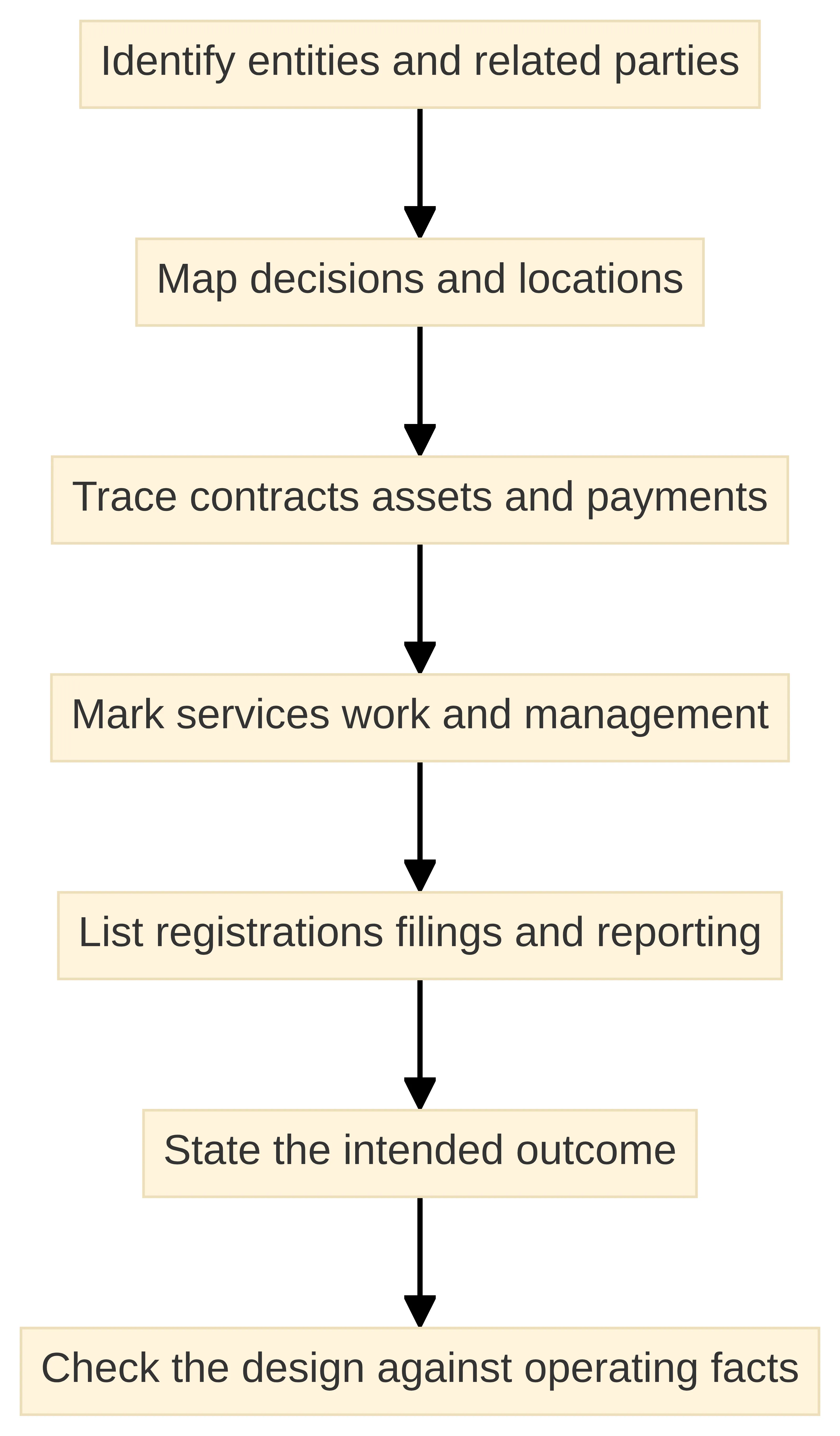
Our Global Tax Reduction Service includes cross-border planning, entity structuring, and tax strategies. Your review should connect any proposed structure to the actual operating business, not to a diagram that exists only on paper.
Sequence the business change around dependencies rather than around the owner’s new address:
- Before the owner moves: Identify the entities, owners, workers, contracts, assets, accounts, and management locations that must remain consistent with the proposed arrangement.
- Before any entity or management change: Identify the registrations, filings, payroll, reporting, banking, and contract steps that may be triggered.
- During the transition: Record where decisions are made, where services are performed, where customers are served, and where money and assets move.
- At implementation: Compare the actual operating facts with the proposed structure and pause if the business cannot function under it without informal workarounds.
- After implementation: Preserve the records needed to test management, work locations, contracts, payments, and continuing obligations for the relevant periods.
This sequence makes the business change a dated implementation question. It does not assume that changing the owner’s residence changes the company’s position.
Keep owner facts and company facts in separate columns. The owner column can include citizenship, residence history, travel, family connections, and personal income. The company column can include ownership, management, workers, contracts, customers, assets, and payment flows. Add a third column for links between them, such as compensation, related-party payments, intellectual property, or decisions made by the owner. This layout helps you ask which conclusion applies to you, which applies to the entity, and which requires both analyses.
Classify income and assets before estimating any benefit
Your income classification determines which planning tools can even enter the discussion. Separate earned income, dividends, pensions, capital gains, and other foreign-source income before estimating a reduction. Do not place every payment into an “earned income” category merely because you earned it through a business or received it while living abroad.
For tax year 2026, a qualifying person can exclude up to $132,900 of foreign earned income under the stated foreign earned income exclusion rules. The exclusion does not apply to dividends, pensions, or capital gains. The amount is therefore not a general ceiling for every type of income, and eligibility remains a condition rather than a result. Before using the ceiling, verify that the person has foreign earned income, a tax home in a foreign country, and meets the applicable requirements. Being abroad, holding a permit, or receiving money outside the United States does not by itself establish eligibility. For 2025, the stated ceiling was $130,000, which shows why the tax year must accompany any number used in your planning file.
Eligible foreign income taxes can reduce U.S. income tax on the same foreign-source income through a foreign tax credit, subject to the separate-category limitation. Carryovers may be allowed in some cases. A credit is not interchangeable with an exclusion: the income category, foreign tax, limitation, timing, and carryover rules can change the result. Keep the calculation tied to the specific income stream instead of treating the credit as a reduction of your entire tax bill.
Use an income-and-asset inventory when comparing strategies:
- Dividends, interest, pensions, capital gains, and distributions.
- Foreign accounts, investments, intellectual property, real estate, and ownership interests.
- Foreign taxes paid or expected, the tax period involved, and the income category to which each payment relates.
Include those items in the state review rather than limiting the inventory to federal income.
Use the inventory to separate three questions: whether an item is included in a relevant tax base, whether a particular exclusion or credit can apply, and whether another jurisdiction can still tax the item. Do not combine those questions into a single projected rate. A calculation that leaves income type, source, tax year, or continuing state exposure unspecified is a preliminary estimate, not an implementation decision.
Treat treaties and exclusions as conditional tools, not automatic relief
You may not meet foreign income exclusion requirements, including the continuous period of 330 days presence in a foreign country. Test the income category, tax paid, timing, and eligibility together rather than selecting whichever mechanism produces the larger preliminary number.
A tax treaty may change source, withholding, pension, or residence outcomes, but the result depends on the specific treaty article and saving clause. An income item must meet the applicable treaty requirements before it can be exempt from U.S. income tax, including any applicable remittance requirement. Most U.S. income tax treaties contain a saving clause that can prevent a U.S. citizen or resident from using treaty provisions to avoid tax on U.S.-source income. A treaty is therefore a set of conditional rules, not a blanket exemption for income connected to the treaty country.
Treaty-residency analysis starts with each country’s domestic residency rules and applies the treaty’s residence tie-breaker rules if both countries treat you as resident. A treaty-based return position may also trigger Form 8833 disclosure. The correct sequence is to establish what each domestic system says, identify whether both systems claim residence, read the specific treaty article, apply its tie-breaker and saving-clause language, and then determine what disclosure follows. Do not begin with the treaty result you want and work backward.
Put each proposed tool into a four-column worksheet:
- Income or status covered: What exact income, residence position, or tax connection is involved?
- Conditions: Which tax-home, presence, source, treaty, remittance, or classification conditions must be met?
- Continuing obligations: What remains reportable or taxable in the United States, a former state, or the new country?
- Failure condition: What fact would make the tool unavailable, limited, or subject to a different treatment?
A projected saving belongs in the file only after those four questions have documented answers under the rules applicable to your facts and tax year.
Apply go/no-go thresholds to the complete burden
A candidate jurisdiction should be screened against the full burden of the proposed arrangement, not against its advertised income-tax rate. Every country has different tax-residency and residence-permit rules. Becoming a tax resident in multiple countries could result in double taxation, and moving out of the United States does not automatically end state tax residency or state income-tax obligations.
After the fact inventory is complete, use a go/no-go gate for each candidate:
- Status and dates: Can the proposed residence, permit, domicile, and citizenship position be tested for the transition periods?
- Continuing exposure: Which U.S. federal, state, source-country, or host-country obligations remain?
- Income and treaty treatment: How would each income category be treated, and do the applicable treaty or exclusion conditions hold?
- Business operation: Do management, workforce, contracts, banking, customers, assets, and records fit the proposed structure?
- Reporting and administration: Which filings, disclosures, payroll, accounting, travel records, and recurring costs must be handled?
- Execution: What must occur before departure, during the transition, and after the arrangement begins?
Mark each condition as pass, unresolved, or no-go. Do not advance a candidate while a condition that could change residence, income treatment, reporting, or business operation remains unresolved. The comparison is between arrangements that can be implemented under their current conditions, not between headline rates.
A jurisdiction becomes a serious candidate only when it passes the status, income, business, reporting, and operating screens together. Mark each criterion as supported, unresolved, or adverse. An unresolved item is not a tax saving. It is a question for current professional review.
For each candidate, record the proposed fact, the rule that must be applied, the document or date supporting the fact, the obligation that remains, and the person responsible for resolving the question. This prevents a low projected rate from hiding a missing residence condition, an unresolved state connection, a reporting duty, or an operating problem. Compare the completed worksheets only after the same categories have been applied to every candidate.
Identify failure points before making the move
Relocation planning fails when an intended status is treated as a completed result. Test these failure points before you commit to a move:
- U.S. filing continues: Foreign residence may affect bona fide residence and treaty analysis, but it does not by itself end U.S. citizenship-based filing.
- State residency continues: Leaving the country does not automatically end state residency or state income-tax obligations; domicile and statutory-residency rules may still apply.
- Relief is limited: Foreign tax credits may be limited, and you may not meet the conditions for a foreign income exclusion, including the continuous period of 330 days presence in a foreign country.
- Treaty relief is narrower than expected: A saving clause can limit treaty treatment of U.S.-source income.
- Two systems claim residence: Becoming tax resident in multiple countries could result in double taxation. Also check whether a treaty exists and covers the particular income or residence question. A foreign-country connection does not create treaty relief when no applicable treaty provision addresses the item, and an existing treaty may still leave the item outside its relief.
Turn each failure point into a written pre-move condition. For example, require a documented answer for the departure state, the new country’s residency test, each income category, treaty access, reporting obligations, and the business operating model. If one condition remains unresolved, delay the implementation decision rather than treating the unresolved point as a minor administrative detail.
Review the transition year separately from the years before and after it. The transition may contain part-year residence, overlapping homes, travel across several countries, compensation earned before and after departure, entity changes, and filings that do not follow the same dates. List the actions that must occur before departure, on the departure date, after arrival, and at the first reporting deadlines. A plan that works only after the transition year is not complete until that transition has been tested.
Organize the transition-year file around decision points
Organize the file by transition-year decision points rather than as a general background folder. At each point, keep the records needed to test the next step:
- Before departure: Citizenship and immigration status, residence history, planned departure and arrival dates, travel days, homes, domicile indicators, family ties, property, licenses, voting activity, and state connections.
- Before a business change: Every entity, ownership interest, operating location, employee, contractor, customer group, contract, related-party payment, asset, and management location.
- Before income and reporting decisions: Income by category, asset location, equity compensation records, rental activity, investment accounts, foreign taxes paid, prior federal, state, and foreign returns, and account or entity reporting records.
- Before implementation: The jurisdictions and structures under consideration, the commercial reason for each, the rule or condition being relied on, and the intended date.
For every item, note the period, jurisdiction, amount or ownership percentage where relevant, and any fact that is estimated rather than confirmed. A dated record of where you lived, worked, traveled, owned property, managed the business, and received each type of income gives the reviewing professionals a basis for testing the transition rather than reconstructing it afterward.
Ask the reviewing professionals questions that force the assumptions into the open:
- Which domestic residency rules apply in each relevant country, and what facts would change the conclusion?
- If two countries treat you as resident, which treaty tie-breaker provisions apply and what saving-clause limits remain?
- Which income categories qualify for an exclusion, credit, or treaty position, and which do not?
- What state connections remain after departure, including income that may continue to be sourced there?
- Which filings or disclosures apply to foreign accounts, entities, treaty positions, and business activity?
- Does the proposed entity structure match the actual management, services, contracts, and ownership facts?
- Which assumptions should be revisited before the transition year and after implementation?
An international tax attorney can help navigate U.S. international tax law and treaties and may assist with FATCA, FBAR, international estate planning, and double-taxation issues.
Organize the file so each conclusion can be traced back to a fact. Keep travel records with the year they cover, income records with the category and source, entity records with ownership and operating details, and proposed changes with their intended dates. Add a short list of facts that are estimated rather than confirmed. Those estimates should be resolved before you rely on a residency position, treaty claim, entity change, or projected benefit. Add a priority label to each unresolved item. Mark it high priority when resolving it could change the proposed residency position, the category or source of income, access to a treaty or exclusion, the business structure, or a filing or reporting obligation. Mark it lower priority only when the conclusion would remain the same even if the estimate changed; have a professional confirm that assumption. For every high-priority item, state the question, relevant dates, jurisdictions, supporting records, and the decision it controls. For example, do not ask generally whether a move saves tax; ask whether the documented residence facts support the intended status for the transition period, whether the specific income item meets the proposed tool’s conditions, and whether the business facts support the proposed structure. This turns the consultation file into a list of decisions rather than an inventory alone. It also shows which unresolved facts must be answered before a timetable or implementation step can be released. Keep the source and date for each current rule used in the analysis, along with the tax year, treaty article, or eligibility condition it supports. If a rule or fact is not confirmed, label the conclusion conditional rather than filing it as a settled result.
Release each implementation step only after qualified review
Give the professionals a written decision brief containing your proposed change, intended timing, business reason, target jurisdictions, income and asset inventory, travel history, entity map, and questions from your screening file. Ask for conclusions that distinguish confirmed rules, assumptions, conditions, unresolved facts, and actions required before implementation. Keep the completed analysis and filing records with the planning file. If you request the business’s Global Strategy Session, each engagement starts with a pre-meeting form review, a one-hour deep-dive, research, and a 30-minute follow-up. Use that sequence to present the dated facts and unresolved questions; it is a review workflow, not a guarantee of eligibility, savings, or a particular implementation result.
Do not implement a residence change or structure solely because a projection shows a lower tax number. Require the proposed arrangement to survive the obligation review, the operating-facts review, and the reporting review first. A qualified professional must decide how current tax, legal, immigration, and financial rules apply to your circumstances before you act.
Request a tailored planning review without treating it as a guarantee
Before acting, have a qualified international tax and legal professional decide how the rules in force apply to your circumstances, then use your connection map, income inventory, entity map, and consultation questions to support that review. If your proposed move still makes sense after the full obligation test, take the next step with the facts and conditions documented.
What should you verify before requesting a global tax reduction planning review?
What is global tax reduction planning?
Global tax reduction planning involves reviewing your tax obligations before relocating to a low-tax country. It assesses how a move may impact your personal tax residency, state connections, business operations, income sources, and reporting duties.
How does tax residency differ from residence permits and citizenship?
Tax residency is a tax-law status that determines your tax obligations, while a residence permit allows you to live in a country, and citizenship is a legal nationality status. These terms can overlap but should not be treated as interchangeable.
What factors determine tax residency?
Tax residency is determined by factors such as the amount of time spent in a country, your primary residence, and significant personal or financial ties to that country.
What are the risks of double taxation when relocating?
Double taxation can occur if you become a tax resident in multiple countries, as both countries may tax the same income without providing relief. It’s essential to understand the tax laws of both jurisdictions.
What should I include in my consultation file for a tax review?
Your consultation file should include details such as your citizenship, immigration status, residence history, travel days by country, income and asset inventory, and any relevant entity information.
When should I consult a qualified international tax professional?
You should consult a qualified international tax professional before changing your residence, forming an entity, or relying on a treaty position to ensure compliance with all applicable laws and regulations.
What is the foreign earned income exclusion?
The foreign earned income exclusion allows qualifying individuals to exclude a certain amount of foreign earned income from U.S. taxation. For tax year 2026, the exclusion ceiling is $132,900.
How can I assess potential jurisdictions for tax reduction?
When assessing potential jurisdictions, consider factors such as tax residency rules, state exposure, income source classification, double taxation risks, treaty access, and the overall business fit.
Ask the team
Have a question about your own situation?
Tell us where you pay tax today and what you want to achieve. We will review your case and get back to you within 1 business day.