
Mexican Taxation: How Residence, Income Source, and Cross-Border Rules Fit Together
How to compare Mexican taxation beyond a headline rate
Mexican taxation is easier to compare when the proposed income, investment, or business activity is defined before any headline rate is assessed. This keeps the review centered on the Mexican rules relevant to what is being taxed, rather than treating relocation as the tax result. A relocation can change the facts without producing the tax result you expected.
The useful question is not simply, “What is the tax rate in Mexico?” The useful question is, “Which rules could apply to each person, entity, payment, asset, and activity after the proposed change?” That question produces a more reliable starting point for lawful planning.
A headline rate can also obscure the difference between personal and entity-level consequences. It may not show payroll or social-security items, withholding, reporting, accounting, transaction-related obligations, or taxes that continue in another country. The comparison becomes meaningful only after you identify what is being taxed, who receives or controls it, where the relevant activity occurs, and when the change takes effect.
A practical assessment should begin with five separate maps:
- Personal status: where you live, what immigration status you hold, and which tax-residence questions arise.
- Income: employment, independent services, business profits, pensions, investment returns, and other receipts that may require separate treatment.
- Activity: where you perform work, manage operations, own property, contract with customers, and receive or make payments.
- Continuing obligations: filing, information reporting, withholding, and other duties that may remain connected to your former country.
- Cross-border coordination: domestic rules, treaty provisions, and the timing of the proposed move or restructuring.
This structure does not determine your liability. It tells you what must be determined before a rate comparison or relocation decision can carry much weight. Keep the maps separate at the beginning, then connect them only where a fact creates a genuine tax or reporting question.
The taxes that may apply to individuals and businesses in Mexico
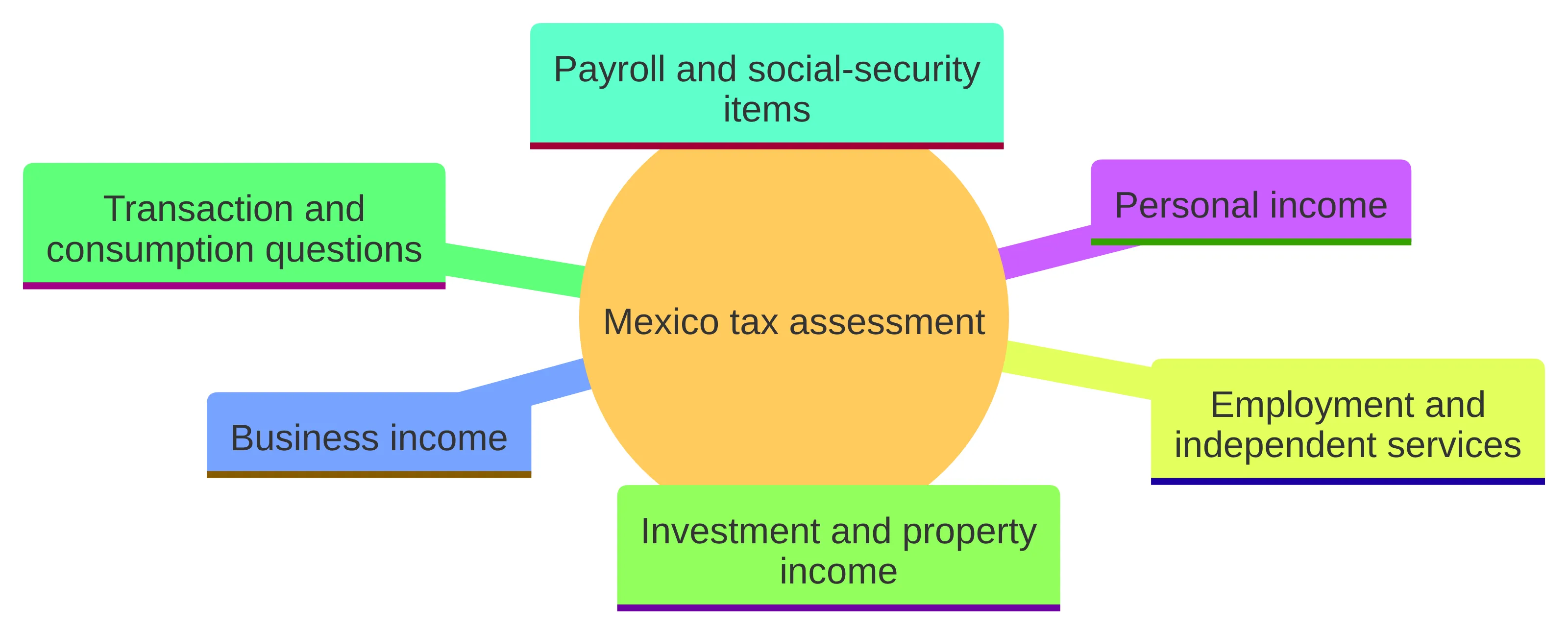
Before estimating any total, identify which Mexican tax categories may need review, including income tax, consumption or value-added tax, payroll and social-security charges, and property, transaction, or import-related taxes. The categories below are a working map for questions to answer, not a conclusion that every category applies to you:
- Personal income: Identify the person receiving the income, the capacity in which it is received, and whether the payment comes from work, business activity, investments, a pension, or another source.
- Business income: Identify the entity or individual carrying on the activity, the customers and suppliers involved, and where the activity is actually performed or directed.
- Employment and independent services: Keep wages, contractor payments, and professional or independent services separate because cross-border rules may treat those streams differently.
- Investment and property income: List interest, dividends, gains, rent, royalties, and proceeds from a sale separately rather than combining them under a general “investment” label.
- Transaction and consumption questions: Identify purchases, sales, imports, transfers, and other transactions that may need a separate Mexican review.
- Payroll and social-security items: Determine whether employee, employer, or payroll-related obligations enter the analysis for the people and activities involved.
For each category, record the recipient, payer, amount, currency, timing, location, ownership, and related activity. The point is not to assign a tax result from a label. The point is to give each item the classification and jurisdictional review it needs.
The OECD’s Taxing Wages 2025 report compared 2024 labor-tax and benefit positions across OECD countries, including personal income taxes, employer and employee social-security contributions, payroll taxes, and cash benefits. That comparison shows why a labor-tax assessment can involve more than personal income tax alone. It does not determine your Mexican liability or supply a personal rate.
Your working schedule should therefore record the amount, recipient, payer, source, activity, location, entity, currency, and timing for each material item. Keep the Mexican questions separate from the U.S. or Canadian questions. A combined total can be calculated only after the underlying classifications and applicable rules have been tested.
If you operate through a company, prepare a separate schedule for the company and for you as owner, employee, service provider, lender, or beneficiary. A payment can create a question for both schedules without producing the same result for both parties. That distinction should remain visible throughout the analysis.
Physical presence, residence permits, and tax residency are different questions
Physical presence, an immigration residence permit, and tax residency answer different questions. Physical presence describes where you spend time. A residence permit describes the immigration status that allows you to live in a country under stated conditions. Tax residency describes the classification that must be tested under the relevant tax rules.
Those labels can overlap, but you should not use one as a substitute for the others. Holding a permit does not, by itself, settle the tax analysis. Spending time in Mexico does not, by itself, tell you every consequence for income earned elsewhere. A tax assessment should record each status separately and identify the rule that connects the status to a tax result.
The distinction matters in both directions. A person may have permission to live in Mexico without having answered every tax-residence question, while a person’s tax position may require analysis of connections beyond an immigration document. Neither conclusion should be assumed from the other.
Build a status timeline before deciding that a move has a tax effect. Include:
- the date you first expect to enter Mexico;
- the expected pattern of days in Mexico and elsewhere;
- the immigration status you hold or plan to request;
- the location of your home, family, work, and business management;
- the country or countries where you have continuing connections;
- the date you expect a business, employment, investment, or ownership change to occur.
The timeline is a fact file, not a residency determination. Its immediate use is to give a qualified adviser the sequence needed to test Mexican rules, former-country rules, and any treaty analysis against the same dates. Keep planned dates distinct from completed events, because an assumption about timing can change the questions that must be examined.
What Mexican tax residency can change
Do not treat that question as answered merely because you moved to Mexico or obtained permission to live there.
A person treated as a Mexican tax resident may be taxed on worldwide income, subject to applicable Mexican rules, treaty provisions, and current verification. Salary, consulting receipts, company distributions, interest, dividends, rent, gains, pensions, and payments from related entities may not follow the same treatment. List each stream and attach its payer, source, recipient, and timing before drawing a conclusion about worldwide income.
Separate the question of what may enter a tax base from the question of how a payment is calculated, reported, withheld, or relieved. Those are connected questions, but they are not interchangeable. A schedule that identifies each stream makes it easier to see where a country-of-residence rule, source rule, treaty provision, or reporting requirement must be tested.
The United States–Mexico tax treaty applies to qualifying residents and sets rules for employment, independent services, pension, and Social Security income in cross-border cases. U.S. citizens can still have annual U.S. filing obligations while living abroad, and applicable filing thresholds can require worldwide income to be reported on a U.S. return. Mexican residence therefore does not answer the U.S. filing question.
Treat your residence analysis as a coordination exercise. Determine the possible Mexican scope first, then test the continuing U.S. or Canadian position, and then examine whether a treaty changes an allocation or relief question. Keep those steps separate from the decision to relocate. If the same income appears in more than one country’s analysis, preserve the original classification and identify the specific rule that could coordinate the two positions.
How income source and activity affect the analysis
Income source and activity should be tested stream by stream. For employment or services, record where the work is physically performed, who directs the work, who pays, and which entity or customer receives the service. For a business, record where operations occur, where management decisions are made, where contracts are negotiated, and where customers or suppliers are served. For investments or property, record the asset, payer, location, ownership, and transaction date.
This map does not decide which country may tax the income. It prevents several unlike questions from being treated as a single residence question. It also gives you a way to identify which facts would change the answer if the proposed move, contract, entity, or payment arrangement changed.
Use a separate row for each material income stream rather than grouping everything under “foreign income” or “business income.” A consulting payment, a company distribution, rental income, and a gain on an investment may involve different actors, locations, and timing. The classification should follow the underlying transaction, not the label used in a planning presentation.
The U.S.–Mexico tax treaty sets rules for income from employment and independent personal services, along with pension and Social Security income, in specified cross-border cases. Income not specifically addressed by the treaty may generally be taxed only in the country of residence, subject to the treaty’s conditions. The result depends on the income category and the facts that place the income within the treaty’s terms.
A treaty label is not a substitute for classification. Identify the income first, then test the source and residence facts, and then read the provision that could apply. If the payment does not fit the provision you are relying on, the expected treaty result may not follow. Keep treaty analysis tied to the specific payment and period under review rather than applying a general treaty conclusion to every income stream.
Why moving the owner does not settle the company’s tax position
An owner’s relocation and a company’s tax position are separate workstreams. Your personal residence question concerns you. The company question concerns the entity, its activity, its management, its contracts, its people, and the places connected to its operations. Changing the owner’s address does not answer those company questions.
Start with two parallel files:
- Owner file: personal residence, citizenship, employment or service income, distributions, investments, property, and continuing filing obligations.
- Company file: entity ownership, management location, operating activity, workers, contractors, customers, suppliers, contracts, bank flows, and accounting records.
Connect the files only where a payment, ownership interest, service, loan, transfer, or management decision creates a fact that must be tested in both analyses. Document who made each decision, in what capacity, on what date, and for which entity. That record helps distinguish an owner-level event from a company-level operating change.
A proposed structure should be described as an operating arrangement, not as a country label. Explain who performs the work, who makes decisions, which entity signs each contract, where the work occurs, and how money moves. Then ask which facts would remain unchanged after the move and which facts would actually change.
The practical boundary is simple: a personal relocation can be relevant without being sufficient. A company review must test the company’s own activity and records. Do not present a personal move as proof that the company has moved, that a tax connection has ended, or that a particular rate will apply.
Before comparing outcomes, write down the proposed operating model both before and after the change. Include owners, managers, workers, customers, suppliers, contracts, accounts, and decision locations. If the model changes only on paper while the underlying activity remains the same, that fact must remain visible in the analysis.
The continuing U.S. or Canadian obligations to examine
U.S. citizens abroad may still have annual U.S. filing and foreign-account or asset-reporting obligations, including FBAR or Form 8938 when applicable. If applicable filing thresholds are met, U.S. citizens must report worldwide income on a U.S. tax return even while living abroad.
Those obligations belong in the relocation file before you compare projected tax burdens. List your citizenship, filing status, income categories, foreign accounts, foreign assets, ownership interests, and any reporting forms that may be relevant. Do not assume that a change in residence ends U.S. filing or information-reporting duties.
Keep filing, reporting, and tax-payment questions separate. A continuing filing duty does not by itself establish the final tax payable, and a possible foreign-account report is not the same question as the treatment of the income or asset connected with that account.
Canadian cases require a Canadian-specific determination of filing and tax obligations. The U.S. and Mexican systems differ on residence, income source, filing, and reporting.
If you are Canadian, keep the Canadian analysis separate from the U.S. analysis. Record your Canadian residence history, departure facts, income sources, entities, investments, and expected continuing connections. A Mexico plan should not be evaluated by importing U.S. rules into a Canadian fact pattern.
For either country, identify the obligation that is being tested and the event that could change it. A move, sale, distribution, new contract, entity change, or altered management pattern may require a fresh cross-border review even when the personal plan appears unchanged.
Treaty rules allocate taxing rights only when their conditions are met
The U.S.–Mexico tax treaty sets rules for taxing employment, independent-service, pension, and Social Security income in cross-border cases. Treaty benefits are limited to qualifying residents of the United States and Mexico, with safeguards against inappropriate use by third-country residents.
The treaty is therefore a coordination instrument, not a general exemption. You must identify the relevant resident, income category, source, and treaty provision before relying on an allocation of taxing rights. A person connected with another country should also test whether the treaty’s residence and anti-abuse conditions are met.
Start with the domestic-law positions before applying the treaty. The treaty may change an allocation or provide relief under its terms, but it does not replace the need to establish the underlying facts or satisfy the conditions attached to the relevant provision.
For income not specifically addressed by the U.S.–Mexico treaty, the treaty generally assigns taxing rights to the country of residence, subject to its conditions. A treaty exemption from U.S. tax is not automatic: the applicable treaty requirements must be satisfied, including any required remittance condition.
Use the treaty only after the domestic-law questions have been identified. A treaty may affect which country can tax an item, whether relief is available, or how double taxation is addressed. It does not replace the need to classify the income, establish the relevant residence position, or satisfy procedural requirements.
For each proposed treaty result, write down the income item, relevant resident, provision, conditions, documentation, and period covered. If one of those links is unresolved, the result should remain an open question rather than being included as a definite reduction in a projected comparison.
How to compare the complete tax burden
A complete burden comparison should include more than the personal income-tax line. Use a written schedule with separate columns for:
- Mexican taxes connected with your personal income, business income, transactions, property, or activity;
- continuing U.S. or Canadian taxes and filing obligations;
- employer, employee, payroll, or social-security items where relevant;
- withholding, reporting, accounting, and administration;
- entity-level consequences and owner-level consequences;
- timing effects created by the move, sale, transfer, distribution, or restructuring;
- treaty relief, credits, or allocation rules that have actually been shown to apply.
The OECD’s Taxing Wages 2025 report compared labor-tax and benefit positions using personal income taxes, payroll taxes, social-security contributions, and cash benefits. That framework supports a wider comparison, but it does not supply a Mexico-specific outcome for your facts.
Add assumptions beside each line rather than hiding them in a single total. Note whether the item is confirmed, conditional, estimated, or unresolved. This makes it possible to see whether an apparent saving comes from a real change in the tax position or from an omitted obligation.
Compare at least three factual scenarios rather than comparing Mexico with a former country in the abstract:
- No move: Keep the current residence, entity, work pattern, and investment structure unchanged.
- Personal move: Change your living pattern while leaving the company and operating model substantially unchanged.
- Coordinated restructuring: Change personal residence, business activity, ownership, contracts, or payment flows together.
For each scenario, record the assumptions, tax questions, filing duties, administrative burden, and facts that could invalidate the analysis. A scenario is not a recommendation. It is a controlled way to see whether the proposed change affects the income, activity, entity, or obligation that matters.
Do not compare an existing arrangement with a future structure that has fewer facts. Use the same income streams, ownership interests, business activity, and time period in each scenario wherever possible. If a proposed change cannot be described precisely, it is not ready for a reliable burden comparison.
The mistakes that make relocation look simpler than it is
Several analytical shortcuts can produce a misleading relocation picture:
- Treating a residence permit as a tax conclusion: Immigration status and tax residency must be recorded separately.
- Using a single headline rate: A rate does not capture income classification, payroll items, reporting, entity effects, or continuing foreign obligations.
- Moving the owner on paper: A personal address does not describe the company’s actual activity, management, contracts, or records.
- Assuming a treaty erases tax: Treaty benefits depend on qualifying residence, income category, conditions, and applicable requirements.
- Assuming foreign filing ends after departure: U.S. citizens abroad may retain U.S. filing and information-reporting obligations when applicable.
- Treating every income stream alike: Employment, independent services, pensions, Social Security, business receipts, and investment income require separate classification.
- Counting a projected relief item too early: A possible exemption or reduction should not be included before its conditions and procedural requirements are addressed.
The correction for these mistakes is a traceable fact pattern. Write down the status, income, activity, entity, country, date, and rule associated with every material item. Then test each claimed benefit against the condition that makes it available.
A projected exemption or reduction should not enter the comparison merely because a treaty exists or because a move is planned. The applicable treaty requirements must be satisfied, and any required remittance condition must also be addressed. If a condition remains unresolved, mark the result as unresolved and keep it out of the projected total.
Apply the same discipline to the company and the owner. Identify the person or entity that would receive the income, perform the activity, sign the contract, hold the account, or claim the relief. This prevents a result attached to one taxpayer from being presented as though it automatically applies to another.
The facts to verify before making a Mexico tax decision
Prepare a fact file that answers the following questions before you act:
- What citizenships, immigration statuses, and current tax residences do you hold?
- Where have you lived and worked during the relevant period?
- Where will you spend time after the proposed move, and on what dates?
- Which income streams do you receive, who pays them, and where is the related work or asset located?
- Which entities do you own, manage, control, or serve?
- Where are company decisions made, contracts signed, services performed, and customers served?
- Which accounts, investments, properties, trusts, or foreign assets require separate reporting analysis?
- What filings, withholding, information reports, or tax payments continue in the United States or Canada?
- Which treaty provision, domestic rule, exemption, credit, or allocation result is being considered?
- What event could change the answer: a move, sale, distribution, new contract, new entity, or change in management?
Attach documents and dates to the facts that drive the decision. Keep assumptions clearly marked as assumptions, especially where the proposed arrangement has not yet been implemented. The file should let you distinguish a completed event from a plan, estimate, or intended future change.
Current rules, rates, thresholds, filing requirements, residency tests, and treaty interpretations should be checked for the jurisdiction and date that govern your action. Record the date of each conclusion, the assumptions used, and the fact that would require the conclusion to be revisited.
Ask for a written explanation that connects each proposed result to your facts. A useful explanation should distinguish Mexican domestic law, U.S. or Canadian domestic law, treaty treatment, filing obligations, and implementation steps. It should also identify what remains uncertain instead of converting an unresolved issue into a projected saving.
Use the fact file to organize the questions, not to make a residency determination or calculate a personal liability on its own. The decision-changing items are the ones that deserve focused professional analysis: status, source, activity, entity, timing, continuing obligations, and the conditions attached to any proposed relief.
Treaty conditions and continuing filing questions
A Mexico relocation or restructuring decision should begin with a fact map, not a headline rate. For readers with U.S. connections, the U.S.–Mexico tax treaty sets rules for employment, independent-service, pension, and Social Security income in cross-border cases. Treaty relief is not automatic: the applicable treaty requirements must be satisfied, including any required remittance condition.
Canadian readers should obtain country-specific review of whether they must file a Canadian tax return or pay Canadian taxes. These are questions for individualized review; a qualified international tax professional should determine suitability before you rely on a proposed move or structure.
Ask the team
Have a question about your own situation?
Tell us where you pay tax today and what you want to achieve. We will review your case and get back to you within 1 business day.