
Taxes in Mexico for Expats: A Records-First Guide to Residence, Income, and Cross-Border Questions
Three tax questions expats must keep separate
Mexican tax planning for expats starts with three separate questions: what permits you to enter or remain in Mexico, what immigration document records that position, and whether Mexican tax rules treat you as a tax resident. Those questions can overlap in your personal history, but they are not interchangeable conclusions.
Use these labels before you look at rates, forms, or deductions:
- Immigration status: Record the legal basis on which you enter or remain in Mexico.
- Residence permit: Record the permit type, validity, issue date, renewal history, and any conditions attached to it.
- Mexican tax residence: Analyze the tax-residence rules using your presence, home, professional activity, income connections, and any claimed change of tax residence.
The practical question is not simply whether you live in Mexico. The practical question is which facts connect you to Mexican tax rules, which facts connect you to your home country, and which records support each position. This article gives you an issue map rather than an individualized residence or filing determination. Keep the three labels separate as you build your records.
A records-first approach gives you a better starting point than assuming that a move, a permit, or a nationality determines every tax obligation. Begin with dates, documents, work locations, income sources, property use, and foreign taxes paid. Then test each connection against the rules that apply to the relevant tax year. The result should be a list of questions that can be checked, not a premature conclusion that every expat owes every Mexican tax.
Use a residence-status decision tree before reviewing income
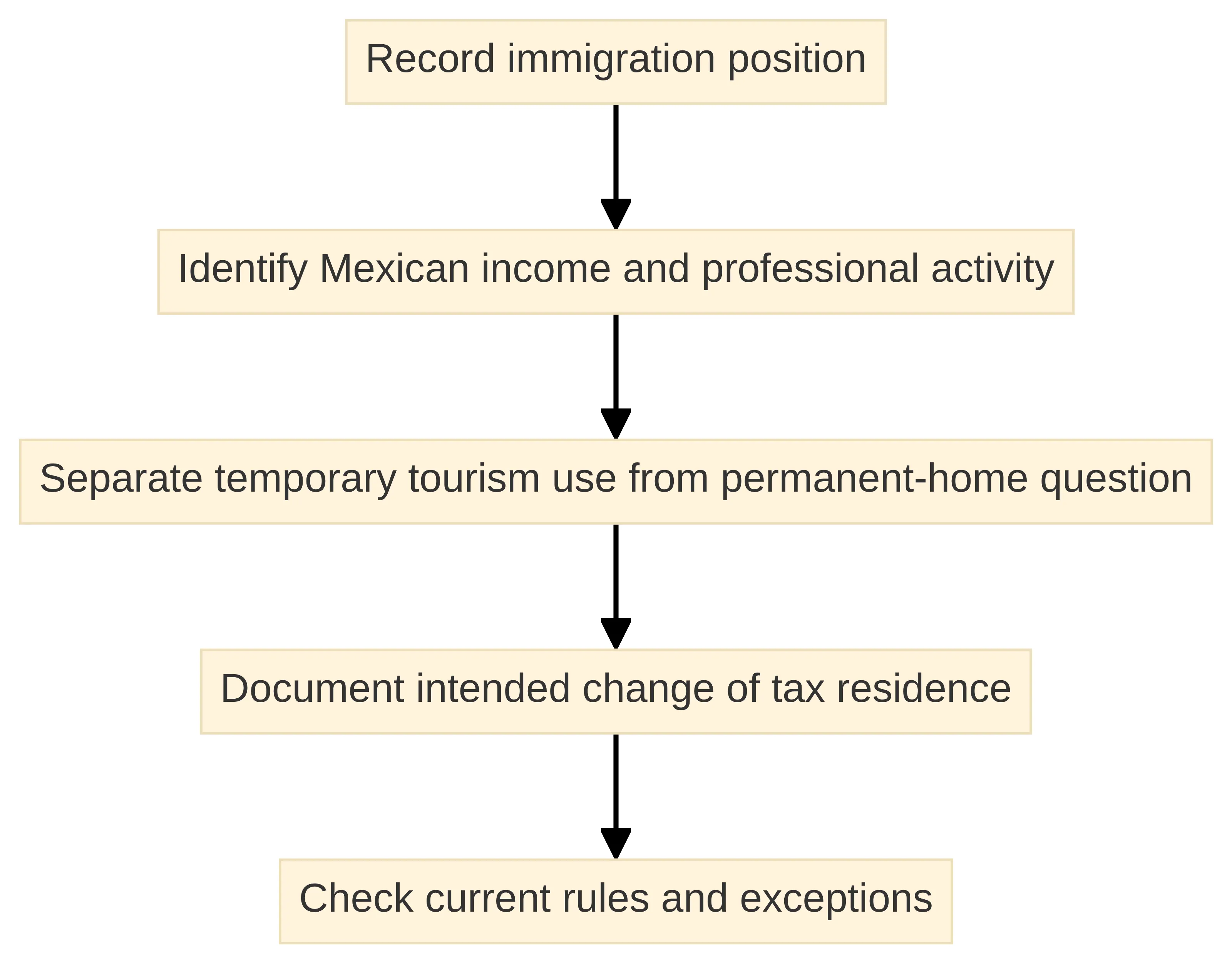
The residence-status decision tree should test your Mexican connections in a fixed order before you analyze individual income streams. Use the following sequence:
- Record your immigration position. Note your entry history, permit or visa documents, renewal dates, and periods spent in Mexico. Treat those records as inputs to the tax analysis, not as the tax conclusion. Your direct action is to create a dated presence and document file.
- Identify Mexican income and professional activity. Income obtained within a calendar year from sources within Mexico, or having your main center of professional activities in Mexico, can be relevant to Mexican tax residence. Record where each activity occurred, who paid you, and which contracts or invoices support the answer. Your direct action is to mark every Mexico-based source or work connection for further review.
- Separate temporary tourism use of property from a permanent-home question. Temporarily using real estate in Mexico for touristic purposes does not establish a permanent home in Mexico under the described rule. Record how you use any Mexican property, whether you own or rent it, and whether it is a home, an investment, or short-term accommodation. Your direct action is to describe the use rather than label it as a residence.
- Document any intended change of tax residence. An OECD description of Mexico’s rules says that, in described circumstances, Mexican tax-resident status can continue during the tax year when the notice is filed and during the five subsequent tax years, subject to stated exceptions. The circumstances include changing tax residence without evidencing the change or changing it to a country or territory where income receives preferential tax treatment. Your direct action is to preserve the notice, evidence of the change, destination-country details, and any treaty-related facts for current review.
This decision tree does not produce a residence determination from a single fact. Current residence rules, notices, evidence requirements, and exceptions must be checked against the applicable official material and tax year before you rely on a conclusion.
Mexican tax residence is a fact-pattern question rather than a label chosen from your immigration documents. Put the facts in separate columns: days and locations, homes available to you, professional activity, Mexican-source income, foreign-source income, and any formal notice about a residence change. The residence analysis can then show which facts need confirmation and which documents are missing. Keep the conclusion open until the current rule and its conditions have been applied to your records.
Map each income and activity connection separately
The income-source map should give every income stream its own line instead of placing all earnings under a single expat category. Mexico taxes residents on worldwide income and non-residents on Mexican-sourced income. That distinction makes residence status and income source separate review points.
Create a line for each category that applies to your facts:
- Employment: Identify the employer, work location, pay period, and where the services were performed.
- Independent services: Separate consulting, freelance, professional, or contract work from employment and identify the service location and payer.
- Business activity: Record the business entity, your role, where decisions and services occurred, and any payments made to you.
- Investments: List interest, dividends, capital transactions, funds, and other investment receipts with the account country and payment records.
- Property: Separate rent, a sale, personal use, and short-term furnished use. Property income has its own Mexican-source branch, covered below.
- Pensions and Social Security benefits: Record the payer, payment type, residence position, and any treaty question.
- Other income: Include payments that do not fit the first categories rather than leaving them unclassified.
The categories are issue flags, not conclusions. You may have several categories, and the same category may require both Mexican and home-country analysis. Your direct action is to attach the contract, statement, invoice, payroll record, or tax document that supports each line.
Employment and independent work deserve separate questions because the United States–Mexico Income Tax Convention sets conditions under which each country may tax income from independent personal services and employment, as well as pensions and Social Security benefits. The convention does not turn every payment into the same type of income.
For each activity, ask:
- Who paid you, and where was that payer located?
- What did you do to earn the payment?
- Where did you perform the work or service?
- Which country treated the payment as taxable, and under which income category?
- Did an entity pay you, or did you receive the payment personally?
- Which records show the payment date, amount, withholding, and underlying activity?
This process keeps a Mexican-source question distinct from a worldwide-income question and keeps personal income distinct from business income. Your direct action is to classify each payment before estimating tax or seeking relief.
Treat Mexican property income as its own research branch
Mexican property income needs its own branch because a foreign or non-resident owner who rents out property located in Mexico may owe Mexican income tax, known as ISR, on that rental income because it is treated as Mexican-source income. The property connection can matter even when the owner is not a Mexican tax resident.
Start by classifying the arrangement:
- Is the property rented, vacant, personally occupied, or used partly for each purpose?
- Is the rental short-term and furnished, or long-term and unfurnished?
- Who receives the rent and who manages the property?
- Which expenses, withholding records, invoices, and contracts relate to the property?
- Does a local representative or tax identification record appear in the arrangement?
Your direct action is to keep the property file separate from your general income file and describe the actual rental use.
Non-resident rental treatment should be compared by tax base and administrative condition, not by a headline rate alone. The two general ISR methods are:
| Route described | Tax base | Conditions or limitation described |
|---|---|---|
| Flat withholding | Gross rental income | 25 percent withholding with no deductions |
| Net-income route | Net rental income | Use of a Mexican legal representative and an RFC tax ID |
Which route applies depends on the arrangement’s facts and the current rules. The table does not decide which route applies to you. Your direct action is to collect gross rent, expense, withholding, legal-representative, and RFC records before comparing the treatment.
Rental format can also change the indirect-tax questions. Short-term, furnished vacation rentals typically carry 16 percent IVA and may carry a local lodging tax, while long-term unfurnished residential leases are generally exempt from IVA. These descriptions are not a substitute for checking the current rule, the municipality, and the exact use of the property.
Your direct action is to record the rental term, furnishings, platform or manager, invoices, IVA treatment, and any local charge separately. Do not treat a personal residence, a long-term lease, and a furnished vacation rental as the same property fact pattern.
Build the home-country layer alongside the Mexico analysis
The home-country layer belongs beside the Mexico analysis because the United States and Mexico use different rules for residence, income source, filing, and reporting. A Mexican residence conclusion therefore does not, by itself, resolve your home-country obligations.
For U.S.-connected individuals, the cited description states that all American citizens and Green Card holders must file U.S. federal taxes each year on worldwide income regardless of where they live. That rule is a U.S. filing point; it does not decide how Mexico treats your residence, income source, or Mexican filing position.
Your direct action is to build two parallel columns:
- Mexico: residence position, Mexican-source income, worldwide-income question if resident, Mexican property, local records, and Mexican tax paid or withheld.
- Home country: citizenship or status, residence position, filing history, worldwide-income rule, reporting categories, foreign tax paid, and any treaty or credit position.
Do not extend the U.S. rule to another country without checking that country’s current law. Identify your actual home-country connection first, then gather the returns, notices, statements, and reporting records that support it.
Cross-border filing questions often arise because the same income is visible from more than one country’s perspective. A Mexican income-source question, a Mexican residence question, and a home-country worldwide-income rule can all appear in the same file while remaining separate legal analyses.
Use a payment-by-payment worksheet with these fields:
- Income type and payer.
- Country connected to the payer and country where the work, property, or investment activity occurred.
- Mexican residence position for the relevant period.
- Home-country status and filing position for the same period.
- Tax paid, tax withheld, return filed, and relief considered.
- Open question requiring current review.
Your direct action is to reconcile the two columns without assuming that filing in one country eliminates a filing or reporting issue in the other.
Test treaty and foreign-tax-credit relief instead of assuming protection
The U.S.–Mexico Income Tax Convention should be tested against the income category and residence facts rather than treated as automatic protection from double taxation. The convention sets conditions under which each country may tax income from independent personal services, employment, pensions, and Social Security benefits. For income items not specifically addressed by the convention, the income may be taxed only in the country of residence under the treaty.
That framework creates several questions: Which treaty article fits the payment? Where were the services performed? Which country treated you as resident under the relevant rule? Which country sourced the income? Does an exception, limitation, or procedural condition apply?
Your direct action is to label each disputed payment with its income type and residence position before relying on a treaty provision. A treaty reference without those facts is incomplete.
Mexican foreign-tax relief has its own limitation. A Mexican resident may credit foreign income tax paid against Mexican income tax on taxable foreign-source income, subject to the lesser-of-the-two-tax limit. No credit is allowed for foreign tax on income exempt from Mexican taxation.
The relevant worksheet should therefore show the foreign-source income, the foreign tax paid on that income, the Mexican tax corresponding to that income, and whether the income is taxable or exempt in Mexico. Your direct action is to preserve the assessment, payment receipt, withholding certificate, and calculation behind any proposed credit.
U.S. foreign-tax-credit treatment also depends on the qualifying tax and the applicable limit. IRS guidance states that the foreign tax qualifying for a U.S. foreign tax credit is not necessarily the amount withheld; when a treaty provides a reduced rate, only that reduced tax qualifies for the credit. A U.S.–Mexico treaty guide says Mexican taxes paid above the U.S. foreign-tax-credit limit can generally be carried back one year and forward ten years.
Those rules make the payment record and the treaty position material. Keep the amount withheld separate from the amount that the law treats as creditable, and record any carryback or carryforward position separately. Your direct action is to have the proposed credit tested against the current form instructions, treaty conditions, income category, and limitation.
Assemble a records-first consultation file
The consultation file should organize the facts that can change the residence, source, filing, and relief analysis. Use one folder or digital index with a short description for every document. Gather the following groups:
- Travel and residence history: List each country and location, dates of presence, homes available to you, leases, ownership records, and periods of temporary travel. Flag any period that needs date confirmation.
- Immigration documents: Include passports, entry and exit records, permits, visas, renewals, notices, and correspondence about your immigration position. Keep the document dates visible.
- Mexican tax records: Gather tax identification information, registrations, notices, returns, payment receipts, withholding records, invoices, and communications with Mexican authorities or representatives.
- Employment and services: Include employment agreements, payroll records, invoices, consulting contracts, client locations, work-location notes, and records showing where services were performed.
- Business activity: List each entity, ownership interest, role, payment path, management activity, business account, and place where relevant work or decisions occurred. Keep entity records separate from personal income records.
- Investments and financial accounts: Collect statements, interest and dividend records, transaction confirmations, sale documents, account-country details, and tax forms received from payers.
- Property: Include title or ownership records, leases, rental agreements, platform statements, management agreements, repair and operating expenses, furnishings, rent received, withholding, IVA, and local-charge records.
- Foreign taxes and relief: Preserve assessments, payment confirmations, withholding certificates, treaty positions, foreign-tax-credit calculations, and any carryback or carryforward schedule.
- Home-country filings: Add prior returns, amendments, notices, reporting schedules, payment records, and documents supporting citizenship, residency, or other filing status.
Your direct action is to mark each item as available, missing, disputed, or needing translation. A missing document is a question to resolve, not a reason to fill the gap with an assumption.
The open-question index should sit at the front of the file. Write one question for each unresolved branch, such as whether a period of presence affects the residence analysis, whether an activity is employment or independent work, whether property use is short-term or long-term, whether a payment is Mexican-source, or whether foreign tax is creditable.
Add the period involved, the document that may answer the question, the country whose rule must be checked, and the consequence of each possible answer. This format keeps a consultation focused on decision-changing facts. Your direct action is to bring the index together with the underlying records rather than presenting a conclusion without its support.
Turn the issue map into the next verified action
The completed issue map should leave you with four practical outputs: a dated residence file, an income-and-activity map, a separate property branch if relevant, and a two-country list of unresolved questions. Mark the branches that apply to you, verify current Mexican and home-country rules for the relevant tax year, and attach the records supporting each position.
A qualified professional must decide how the current rules apply to your individual facts, including residence, filing, treaty, and foreign-tax-credit questions. Your role before that review is to preserve the facts, identify the gaps, and avoid treating a permit, a move, or a tax payment as a complete answer. Use the records file to request tailored review of the specific Mexican and cross-border issues that remain open.
Questions to resolve before requesting tailored tax guidance
What taxes do expats pay in Mexico?
Expats in Mexico may be subject to various taxes, including income tax on worldwide income for residents and on Mexican-sourced income for non-residents.
What records should expats gather before seeking tax advice?
Expats should compile records including immigration documents, travel history, income sources, property use, and any foreign taxes paid. This documentation will help clarify their tax obligations and support their inquiries with tax professionals.
How can home-country tax obligations interact with Mexican taxes?
Home-country tax obligations may require expats to file taxes on worldwide income, which can complicate their tax situation in Mexico. It’s important to understand how these obligations overlap and to gather relevant documentation for both jurisdictions.
What is the risk of double taxation for expats in Mexico?
Expats may face double taxation if both Mexico and their home country tax the same income. To mitigate this risk, they should explore tax treaties and foreign tax credits, which can provide relief, but these require careful analysis of individual circumstances.
What are the implications of the U.S.-Mexico tax treaty for expats?
The U.S.-Mexico tax treaty outlines how income from various sources is taxed and can help prevent double taxation. Expats should review the treaty provisions to understand their tax obligations and potential credits.
Ask the team
Have a question about your own situation?
Tell us where you pay tax today and what you want to achieve. We will review your case and get back to you within 1 business day.