
Taxes in Mexico for Expats: Residence, Income Source, and Cross-Border Obligations
Start a dated Mexico tax review file
Treat a move to Mexico as the opening entry in a dated cross-border tax review file, not as a tax conclusion. The United States and Mexico use different rules for residence, income source, filing, and reporting. Tax residency also depends on factors such as time spent in a country, primary residence, and significant personal or financial ties.
The file follows one decision path for each relevant period:
- Record the date and facts connecting you to Mexico and any other country.
- List each income stream and the activity, asset, or payment behind it.
- Separate Mexican questions from continuing home-country questions.
- Attach any treaty or possible dual-residence issue to the relevant entry.
- Mark unresolved issues for individualized review rather than deciding them from a status label.
A Mexican residence permit belongs in the immigration portion of the file; it does not settle every tax question. A move can also leave home-country filing or tax obligations in place. The purpose of the file is to show what changed, which country’s rules may need review, and what needs to be checked before acting.
Mexican tax rules and cross-border requirements can change by date, including rates, thresholds, forms, treaty applications, and administrative procedures. Use this overview to identify the questions that need checking for your circumstances and the rules in force on the relevant date.
Record the facts that can change your tax position
Begin the file with facts rather than an immigration label. For each relevant period, record:
- Time spent in Mexico and elsewhere.
- The location of your primary residence.
- Significant personal ties.
- Significant financial ties.
- The immigration status or document you hold, kept as a separate record.
These facts belong together in the residence review, but the immigration document should not be used as a substitute for them. The entry should end with the question it raises: which residence facts need current, individualized assessment?
Your first practical step is to prepare a timeline showing the dates and locations of your stays, your primary home, and your significant personal and financial connections. Keep immigration documents in a separate part of the file. That separation helps you ask two precise questions: what status do you hold under immigration rules, and what facts may determine tax residence?
Update the file when a fact or rule changes
Use one dated entry for each material change instead of overwriting a general summary. An entry can record the period affected, what changed—location, residence, work, business activity, investment, payment, or country connection—the income stream involved, the countries whose residence, source, filing, or reporting rules may need review, the document supporting the entry, and the unresolved question.
Keep earlier entries beside later ones. Before a planned move or other change, the open questions show what needs checking. Afterward, compare the new entry with the prior one and flag differences in residence, income category, business activity, or country connection. This creates a review trail for a professional without calculating liability or turning the record into a tax conclusion.
Place the relevant date beside treaty requirements, filing questions, and other time-sensitive rules because rates, thresholds, forms, treaty applications, and administrative procedures can change.
A worldwide-income rule means that residence can affect the scope of the Mexican review beyond income generated inside Mexico. A Mexican-source rule means that non-residence does not make Mexico irrelevant when income remains connected to Mexico. The practical boundary is clear: classify residence and source for each relevant stream, then verify the current rule before estimating tax or deciding how to report it.
Build a connection map before drawing conclusions
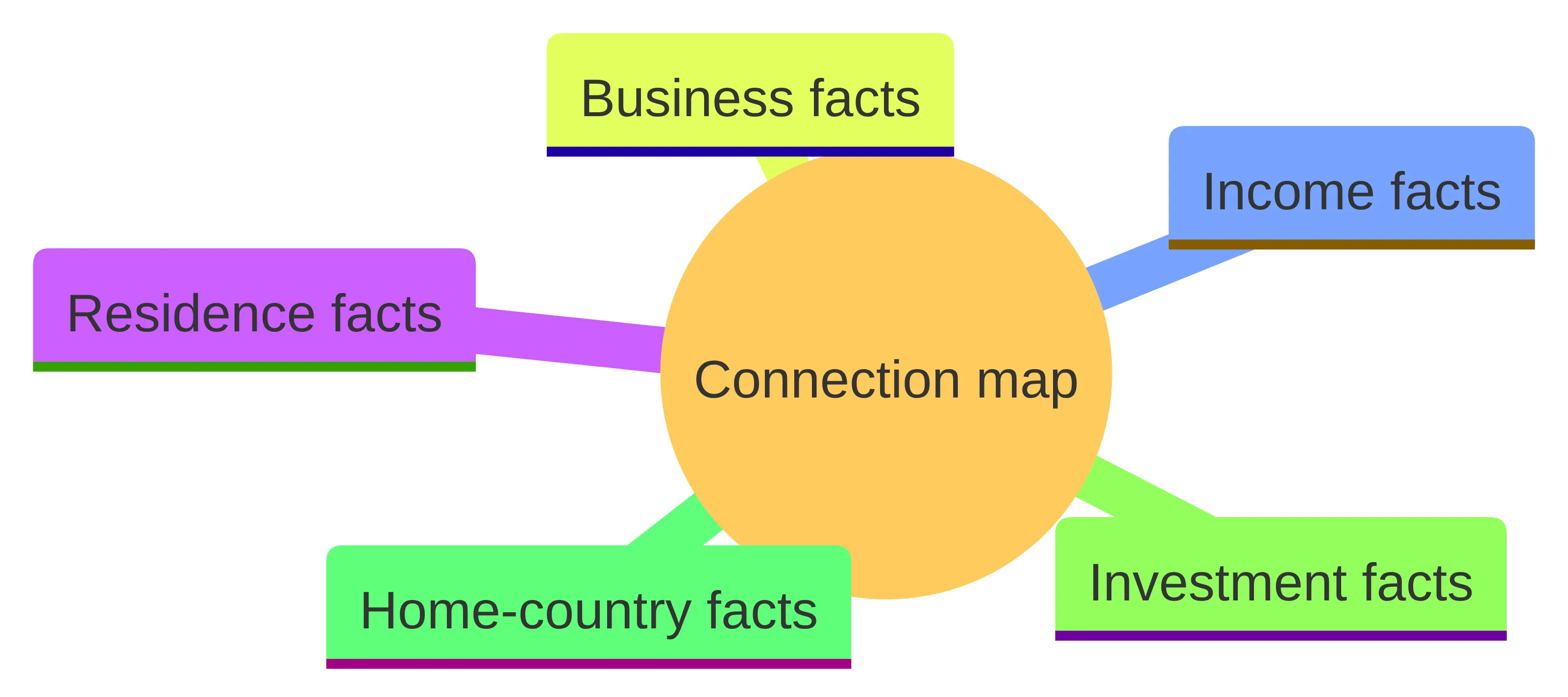
A connection map puts residence, income source, business activity, investments, and other-country ties in the same working document. The purpose is not to produce an automatic residency answer. The purpose is to show which facts may affect different parts of the analysis and where one change could alter the questions you need to ask.
Create five columns:
- Residence facts: days and periods in Mexico and elsewhere, primary residence, and significant personal or financial ties.
- Income facts: each income stream, its amount and timing, and the activity or asset that produces it.
- Business facts: the business activity you conduct, where relevant work or decisions occur, and the countries connected to the business.
- Investment facts: the investments or assets that produce income and the countries connected to them.
- Home-country facts: citizenship, prior residence, continuing accounts or activities, and any filing or reporting connection you need to examine.
The map is a record of questions and connections, not an individualized tax calculation.
The connection map matters because the same person can have Mexican residence questions, Mexican-source income questions, and continuing home-country questions at the same time. Mexican tax residents may face worldwide-income treatment, while non-residents may still face Mexican-source-income treatment. A single label such as “living in Mexico” cannot replace the separate entries in the map.
Use the map to mark facts that are uncertain, changing, or shared by more than one country. Those marked items are the questions to resolve first.
Open a separate home-country obligations record
Open a separate home-country entry when your facts remain connected to the United States. U.S. citizens remain liable for U.S. tax on worldwide income wherever they live, while U.S. citizenship alone does not automatically establish U.S. residence under the United States–Mexico Convention. The first point concerns U.S. tax liability; the second concerns treaty residence.
Record those questions in a home-country ledger rather than treating a Mexican entry as an answer to them. The United States and Mexico use different residence, income-source, filing, and reporting rules. Moving your home or paying Mexican income tax therefore does not, by itself, resolve the U.S. questions.
A published guide for Americans in Mexico states that U.S. federal filing and worldwide-income reporting continue every year, including when an American pays Mexican income tax, holds a Temporary Resident visa, or earns entirely Mexican-source income. Treat that statement as a separate U.S. filing issue to examine rather than as a conclusion about Mexican tax residence.
Your review should therefore keep two ledgers:
- Mexico ledger: residence, Mexican-source income, and Mexican filing or reporting questions.
- Home-country ledger: citizenship, prior residence, continuing income, and home-country filing or reporting questions.
Keeping the ledgers separate prevents a payment to one country from being mistaken for a resolution of the other country’s obligations.
Your non-U.S. home-country obligations require the same discipline: identify that country’s own residence, source, filing, and reporting rules instead of assuming that a move to Mexico ends them. The available U.S.–Mexico material does not answer another country’s rules. For any home country, place its questions on the connection map and keep them separate from the Mexican analysis.
Attach treaty questions to each income category
Attach a treaty note to the specific income entry that raises it. The United States–Mexico Convention sets conditions for taxing employment, independent personal-service, pension, and social-security income involving residents of the two countries. The note should identify the income category, the residence positions being considered, the Convention provision that may be relevant, and the requirements that still need checking.
This keeps the treaty question downstream of the recorded facts. The Convention is not a general exemption and does not replace the residence or income-source review. For income not specifically addressed, the country of residence may have the taxing right, subject to the Convention’s requirements and limitations.
For income not specifically addressed by the Convention, the country of residence may have the taxing right, subject to the Convention’s requirements and limitations. That wording has a defined boundary: it does not promise that every item is covered, that relief is automatic, or that filing and reporting duties disappear.
Your treaty question should be specific: which income category is involved, which country treats you as resident under its domestic rules, what Convention provision may apply, and what conditions must be met?
Escalate possible dual residence
Mark an entry for escalation when the recorded facts indicate residence under U.S. domestic law and residence in Mexico under Mexican domestic law. A person treated as resident in both countries is generally subject to tax in both, although treaty treatment may allow a claim of residence in a single country for treaty purposes. Becoming a tax resident in multiple countries could result in double taxation.
The file should preserve the competing residence facts and the relevant period instead of resolving the conflict by assumption. Add the specific treaty position, income categories, and filing or disclosure questions that require review. A U.S. resident alien claiming foreign treaty residence must timely file Form 1040NR with Form 8833 attached; that stated requirement belongs to the corresponding U.S. treaty-residence entry, not to every person living in Mexico.
A U.S. resident alien claiming foreign treaty residence must timely file Form 1040NR with Form 8833 attached. That requirement applies to the stated U.S. treaty-residence situation; it is not a general filing instruction for every person living in Mexico.
Write the exact proposed treaty position into your question list before preparing a return. Then identify the filing, disclosure, and timing conditions attached to that position rather than assuming that a treaty claim is complete once the residence argument has been made.
Treaty relief requires meeting all applicable treaty requirements, including any required remittance to the country of residence. A relief claim can therefore depend on conditions beyond the headline residence result. Flag the issue for fact-specific review when you have possible dual residence, a treaty-based position, income in more than one country, or uncertainty about a required disclosure or remittance.
Turn the review file into a question sheet
Turn the review file into a question sheet before requesting cross-border advice. Each question should identify the relevant period, country, and income or connection entry rather than ask only whether Mexico has a lower or higher tax burden.
The question sheet should address:
- Where you lived and how much time you spent in Mexico and elsewhere during the relevant period.
- The location of your primary residence and significant personal and financial ties.
- The activity, asset, or service producing each income stream and any Mexican connection.
- Business activities, investments, accounts, or obligations that remain connected to another country.
- Whether another country treats you as a citizen, resident, or filing person.
- Whether both countries could treat you as resident under their domestic laws.
- Which income category, if any, the United States–Mexico Convention may address.
The answers identify what needs individualized review; they do not determine liability or replace professional assessment.
Your preparation file should also identify any proposed treaty position, the tax year or period involved, and the rules that require date-specific checking. If a U.S. resident alien may claim foreign treaty residence, include the question of timely Form 1040NR filing with Form 8833 attached. If treaty relief is being considered, ask whether every requirement is satisfied, including any required remittance to the country of residence.
Bring a timeline, residence and immigration records, income summaries by category, business and investment details, prior returns, and notices or correspondence relevant to the countries involved. Label each document by country and tax period so that a question about one obligation is not mistaken for an answer to another.
Your warning signs are facts that make a single-country answer unreliable. Escalate the review when you have possible residence in both countries, a change in primary residence, substantial personal or financial ties in more than one country, income in several categories, or a treaty position with filing or remittance conditions. Those conditions can change the questions you must answer before acting.
Close each change cycle with a dated follow-up
Close each change cycle with a dated comparison between the earlier file and the current one. Reopen the review before a relocation and after a material change in time spent, primary residence, personal or financial ties, business activity, investments, or the country that pays you or produces your income.
Keep the earlier version, record the changed fact and affected period, and carry unresolved residence, source, filing, reporting, or treaty questions into the next review. This makes the next professional discussion specific to the change instead of treating the immigration document or a prior conclusion as permanent.
Consulting a tax professional who specializes in international law can help manage the complexities of tax residency and residence permits. Use the updated map and timeline to make that review concrete, especially when the change may create residence in more than one country or alter the income categories involved.
Get the relevant facts reviewed before acting
Before a consequential relocation, residence, income, or asset decision, consult an international tax professional about how current rules apply to your facts.
When should an expat seek individualized tax review?
What taxes do expats pay in Mexico?
Expats in Mexico are subject to Mexican income tax on their worldwide income if they are considered tax residents. Non-residents are taxed only on their Mexican-source income.
How does tax residency differ from immigration status in Mexico?
Tax residency in Mexico is determined by factors such as time spent in the country, primary residence, and significant personal or financial ties, while immigration status pertains to legal permission to reside in Mexico.
What should I consider before consulting a tax professional about my situation in Mexico?
Prepare a timeline of your stays, identify your primary residence, and list your income streams and their sources. This information will help the tax professional assess your tax obligations accurately.
What is the significance of the United States–Mexico tax treaty for expats?
The treaty provides conditions under which income earned by residents of one country may be taxed in the other, helping to avoid double taxation. However, it does not automatically exempt all income from tax.
What are the warning signs that indicate I may need to consult a tax professional?
Warning signs include having possible tax residency in both the U.S. and Mexico, significant personal or financial ties in multiple countries, or income from various sources that may complicate your tax situation.
How can I avoid double taxation as an expat in Mexico?
To avoid double taxation, ensure you understand your tax residency status, the source of your income, and any applicable tax treaty provisions. Consulting a tax professional can help navigate these complexities.
Ask the team
Have a question about your own situation?
Tell us where you pay tax today and what you want to achieve. We will review your case and get back to you within 1 business day.