
Taxes in Mexico for Expats: A Fact-Based Tax Triage Guide
Separate the tax questions before assessing a Mexico move’s tax effects
A Mexico move creates different tax events, and each event may require a different question. Sort the review by the tax question a fact may raise: residence, income source, business activity, a transaction, or a continuing foreign obligation. This event-by-event view gives you a more useful starting point than asking whether moving to Mexico will lower your taxes.
Residence is one status label in the event map, not a conclusion supplied by immigration permission. A residence right or citizenship does not automatically establish tax residence or end tax residence in a former jurisdiction. Tax residence is determined under each jurisdiction’s domestic laws, and you may be tax resident in more than one jurisdiction. We also warn that becoming tax resident in multiple countries could result in double taxation.
That does not mean you should assume that overlapping residence has produced double taxation in your case. It means that overlapping claims deserve early review before you reorganize a business, sell property, move investment assets, or change where services are performed.
Use the Mexico move as a tax-triage exercise. Start with these questions:
- Which jurisdictions might treat you as a tax resident under their own domestic rules?
- What income will you receive, and where will the relevant work, asset, business, or payer connection exist?
- Will your company remain where it is, operate across borders, or change its activities after you move?
- Will you earn employment income, professional fees, investment income, lease income, or proceeds from property or share transactions?
- Which country’s filing and reporting rules may continue because of your citizenship, residence status, or other connection?
- Do the facts create a possible treaty or double-taxation question?
This list is a screening tool. It does not determine your tax status, calculate a liability, or establish that a particular filing is required.
Place residence status inside the event map
Mexican immigration residence and Mexican tax residence are separate status labels that can affect different events. Immigration status concerns your permission to enter, remain, or reside under the applicable immigration framework. Tax residence is determined under the domestic tax laws of each jurisdiction. The mere right to reside in a jurisdiction, whether permanently or temporarily, does not automatically make you a tax resident there.
Citizenship is not a complete answer either. Holding citizenship in Mexico, retaining citizenship elsewhere, or obtaining a new residence status does not automatically establish tax residence in that jurisdiction or end tax residence in a former jurisdiction. A person may qualify as a tax resident in more than one jurisdiction at the same time.
The practical consequence is that your residence permit should be treated as one fact in the file, not as the conclusion of the tax analysis. Keep the immigration question and the tax-residence question in separate sections of your records.
A tax-residence review begins by separating three statements that are often collapsed into one:
- You have permission to live in Mexico.
- Mexico may treat you as a tax resident under its domestic rules.
- Another jurisdiction may continue to treat you as a tax resident or otherwise impose tax or filing obligations.
Those statements can have different answers. Relevant factors can include time spent, primary residence, and significant personal or financial ties, but the governing legal test remains the relevant jurisdiction’s law. A residence permit alone cannot settle it.
Record the type and timing of your immigration status, but do not use that document as a substitute for a tax-residence analysis.
Anchor each event to dates, homes, and ties
Residence-related events need a dated factual record. Tax residence is determined under each jurisdiction’s domestic laws, and relevant factors can include time spent in a country, primary residence, and significant personal or financial ties. Those factors should be documented rather than recalled from memory after the move.
Create an event timeline covering:
- The dates you entered and left Mexico and any other country during the relevant period.
- Where you maintained your main living arrangement and where you actually stayed.
- The location of important personal connections and financial relationships.
- The date your move was planned, announced, completed, or changed.
- Residence permits, citizenships, and other status documents held during the period.
- Changes in your home, family arrangements, banking relationships, business role, or investment activity.
The timeline is not a legal conclusion. It is a way to place the facts next to the domestic rules that may apply.
The same fact can matter differently in different jurisdictions. A period spent in Mexico may be relevant to Mexico’s domestic residence rules, while the same period may interact with another country’s residence rules in a different way. A primary home, personal connection, or financial tie may also require separate treatment under each jurisdiction’s law.
For that reason, avoid reducing the analysis to a single day count unless the applicable law makes that count decisive. Do not assume that reducing time in a former country automatically ends its tax residence, and do not assume that a residence permit establishes Mexican tax residence. Put the facts in chronological order, identify the jurisdictions involved, and ask which domestic rules must be applied to them.
Match each income item to its generating event and source
Classify each income item by the event that produced it before asking what tax applies. In Mexico, residents are taxed on worldwide income, while non-residents are taxed on Mexican-sourced income. For a Mexican tax resident, that worldwide-income rule includes global earnings.
Once each item has an event label, test residence status and income source as separate questions. A person treated as a Mexican tax resident may need to examine income earned outside Mexico as part of the worldwide-income analysis. A person treated as a non-resident may still need to examine income connected to Mexico. The labels resident and non-resident do not, by themselves, classify every payment or resolve every filing issue.
Do not begin with a preferred tax result. Begin by listing the income and identifying the connection that gives rise to each item.
Build an income map with a separate line for each category:
- Compensation for work or services, including where the work was performed.
- Revenue from a business and the activities that produced it.
- Investment receipts and the assets that generated them.
- Lease income and the location and type of property involved.
- Proceeds from selling property or shares.
- Income received from a payer in another country.
For every line, record the amount and currency in your working file, the relevant period, the payer, the asset or activity involved, and the countries connected to it. The list does not calculate Mexican tax. It helps you ask whether the item belongs in a worldwide-income analysis, a Mexico-source analysis, or both jurisdictions’ review.
Separate personal income, employment, and business activity
Personal income, employment, and business activity should be reviewed as separate categories. Mexico’s resident and non-resident income-source rules provide a starting point, but they do not turn every payment received by an entrepreneur into the same type of income. The work performed, the business activity, the payer, the entity involved, and the location connected to the income can each change the question you need to ask.
Employment income requires you to identify the employer, the services performed, and where those services were performed. Professional or independent services require you to identify the person or entity providing the service, the customer, the work, and the payment path. Business revenue requires a broader review of the operating activity and the entity or entities receiving it.
Keep those records distinct. A personal move does not, by itself, establish what happened to the business’s activities or income.
Cross-border business income can create an issue even when the residence analysis appears straightforward. The same source identifies competent-authority procedures as a possible route for addressing taxation that is inconsistent with the convention.
That example is not a Mexico-specific conclusion and does not establish that a permanent establishment exists or does not exist in your case. It shows why business income deserves its own cross-border review. Document where decisions are made, where services are performed, where customers are located, which entity contracts with them, and which entity receives payment. Then ask a qualified adviser to analyze the applicable domestic rules and any treaty conditions.
Review investments, property, and withholding events independently
Investments, property, leases, and transaction proceeds create questions that should not be answered solely by your residence status. A Mexican corporate-withholding table lists 25% for professional fees for services rendered in Mexico, 25% for lease payments involving real property, and 25% for lease payments involving personal property. The same table lists 25% withholding for sales of real property located in Mexico and 25% for sales of shares of Mexican companies.
Those percentages describe entries in a selected corporate-withholding table. They are not a universal rate for every expat, every transaction, or every final tax liability. The table’s context matters, as do the taxpayer, transaction, documentation, applicable conditions, and other rules. Treat each entry as a prompt for review rather than as a calculation to apply without context.
Separate your transaction file into distinct questions:
- Is the payment for professional services rendered in Mexico?
- Is the payment connected to a lease of real property or personal property?
- Is the transaction a sale of real property located in Mexico?
- Is the transaction a sale of shares of a Mexican company?
- Which entity or person is receiving or making the payment?
- Is the table’s corporate-withholding context relevant to the transaction?
Record the agreement, asset, parties, payment date, location, and entity involved for each event. Do not combine a property sale with recurring lease income, or a share sale with professional fees, simply because the same owner is involved.
Separate owner events from company events
Use separate event rows for the owner and the company. A business-owner move does not answer whether the business itself moved. The owner’s residence question and the company’s activity question concern different facts, although they may interact. They should not be merged into a single conclusion.
For the company’s events, map the operating facts:
- Which entity signs customer and supplier contracts?
- Where are services performed and where are decisions made?
- Which people perform the revenue-producing work?
- Which accounts receive business revenue and pay business expenses?
- Where are customers, assets, offices, contractors, and other operating connections located?
- Did the move change the company’s activities, management, contracts, or payment flows?
These questions identify the facts that need legal and tax analysis. They do not establish a business residence, a permanent establishment, or a particular filing requirement.
If you remain the owner but the company continues its previous operations, document that continuity. If you move management, services, contracts, or personnel, document those changes instead. Ask for the analysis to address the owner, the company, and each material flow of income separately.
Attach home-country rules to the events they govern
Treat relocation as one event among the foreign connections that may continue after the move. The right to reside in Mexico or citizenship in another country does not automatically establish Mexican tax residence or terminate tax residence elsewhere.
The United States and Mexico use different residence, income-source, filing, and reporting rules. Attach each rule to the event and jurisdiction where it applies rather than transferring an assumption from one system into the other. A result under Mexican rules does not, by itself, answer the question under the rules of your former or continuing home country.
Citizenship, residence status, business ownership, property, investment accounts, employment, and prior filings can all be relevant facts. Their significance depends on the country and the rule being applied.
Use a country-by-country review rather than a single relocation checklist:
- List every country connected to your citizenship, residence status, primary home, work, business, investments, property, or prior filings.
- Record which domestic tax-residence rules may apply in each country.
- Separate tax residence from filing, reporting, withholding, and payment questions.
- Identify income and transactions that connect to more than one country.
- Mark the facts that may require treaty analysis or coordination between jurisdictions.
The purpose of this map is to show where parallel questions exist. It does not predict whether two countries will impose the same tax, different taxes, or no tax on a particular item.
Make the map operational by giving each event its own row and each jurisdiction its own review columns. For every row, record: (1) the underlying event; (2) the country connection; (3) the residence or source rule being tested; (4) the filing, reporting, withholding, or payment question; and (5) the document or fact that supports the entry. If a column cannot be completed, mark it as unknown rather than inferring an answer from the relocation itself. This format helps separate a question about where income arose from a question about who must report it, and it shows an adviser which issues are factual gaps rather than legal conclusions.
For U.S.-connected readers, test worldwide-income and filing obligations separately
U.S. citizenship or U.S. resident-alien status can preserve U.S. tax questions after a move to Mexico. The IRS states that U.S. citizens and resident aliens living abroad remain subject to U.S. income tax on worldwide income, including wages, unearned income, and tips, regardless of where they live or earn that income. The same source states that they generally have the same income-tax filing requirements as U.S. citizens and resident aliens living in the United States.
This is a conditional example for U.S.-connected people, not a rule for every expat. Do not assume that living in Mexico ends U.S. worldwide-income taxation when the relevant U.S. status continues. Conversely, do not assume that a U.S. connection answers the Mexican tax question; the Mexican residence and source analysis remains separate.
U.S. filing questions require their own fact review. The IRS states that filing generally depends on income, filing status, and age, and that a return is usually required when worldwide gross income reaches the amount shown for the applicable filing-status table. The IRS also states that U.S. citizens and resident aliens abroad generally follow the same income-tax, estate-tax, and gift-tax filing and estimated-tax rules as people residing in the United States, subject to the applicable filing rules.
Gather your U.S. status, filing status, age, worldwide income, prior returns, estimated-tax history, estate-related facts, and gift-related facts before asking what continues after relocation. Do not substitute a general statement about living abroad for the specific filing rules that apply to your facts.
Apply treaty analysis only after identifying the event
Attach treaty review to an already-labeled event; a treaty is not a promise that tax disappears. The specific treaty provisions, domestic-law rules, income category, residence position, and procedural conditions all matter.
A treaty-country example shows why a cross-border business-income question may arise even when a permanent establishment is not present under the convention. Possible competent-authority relief may exist when taxation is inconsistent with the convention, but it does not guarantee relief or replace the underlying analysis.
Attach treaty questions to the income or transaction event that creates them. A broad statement that a treaty exists is not enough.
The U.S.–Chile treaty materials provide a separate illustration of the limits of treaty assumptions. Those materials state that the contracting states generally reserve the right to tax their residents and citizens under domestic law, subject to the treaty’s specified exceptions. That statement concerns the U.S.–Chile treaty, not Mexico, so it should not be presented as a U.S.–Mexico treaty conclusion.
The practical lesson is narrow: identify the actual treaty, the countries involved, the taxpayer’s residence and status, the income or transaction, and the provision being applied. Ask whether the treaty changes an allocation, provides a relief mechanism, or leaves a domestic-law obligation in place. Do not treat a treaty label as an exemption.
Escalate when one event touches multiple jurisdictions
Escalate an event when two jurisdictions may apply their own domestic residence rules to the same facts. The OECD material states that tax residence is determined under each jurisdiction’s domestic laws and that a person may be tax resident in more than one jurisdiction. We warn that accidentally becoming tax resident in multiple countries could result in double taxation.
A possible overlap is not proof that you owe tax twice. It signals that the event, residence position, income category, treaty provisions, filing obligations, and available relief should be examined together.
Escalate the review when any of these conditions appears:
- You may satisfy residence rules in Mexico and another jurisdiction.
- You maintain a primary home or significant personal or financial ties outside Mexico.
- You receive income connected to both Mexico and another country.
- You operate a business across borders or change where business activity occurs.
- You plan to sell property, sell shares, receive professional fees, or change a lease arrangement.
- You need to understand whether treaty rules coordinate the overlapping claims.
Mark the issue as unresolved in your fact file until the relevant domestic rules and treaty conditions have been analyzed. Do not describe a second residence as a tax solution without testing these connections.
Prepare a fact file before consulting an international tax professional
A fact file turns a broad relocation question into a set of reviewable issues. Tax residence is determined under each jurisdiction’s domestic laws; Mexico’s general framework distinguishes residents’ worldwide income from non-residents’ Mexican-sourced income; and the U.S. and Mexican systems use different residence, source, filing, and reporting rules. Your file should make those distinctions visible.
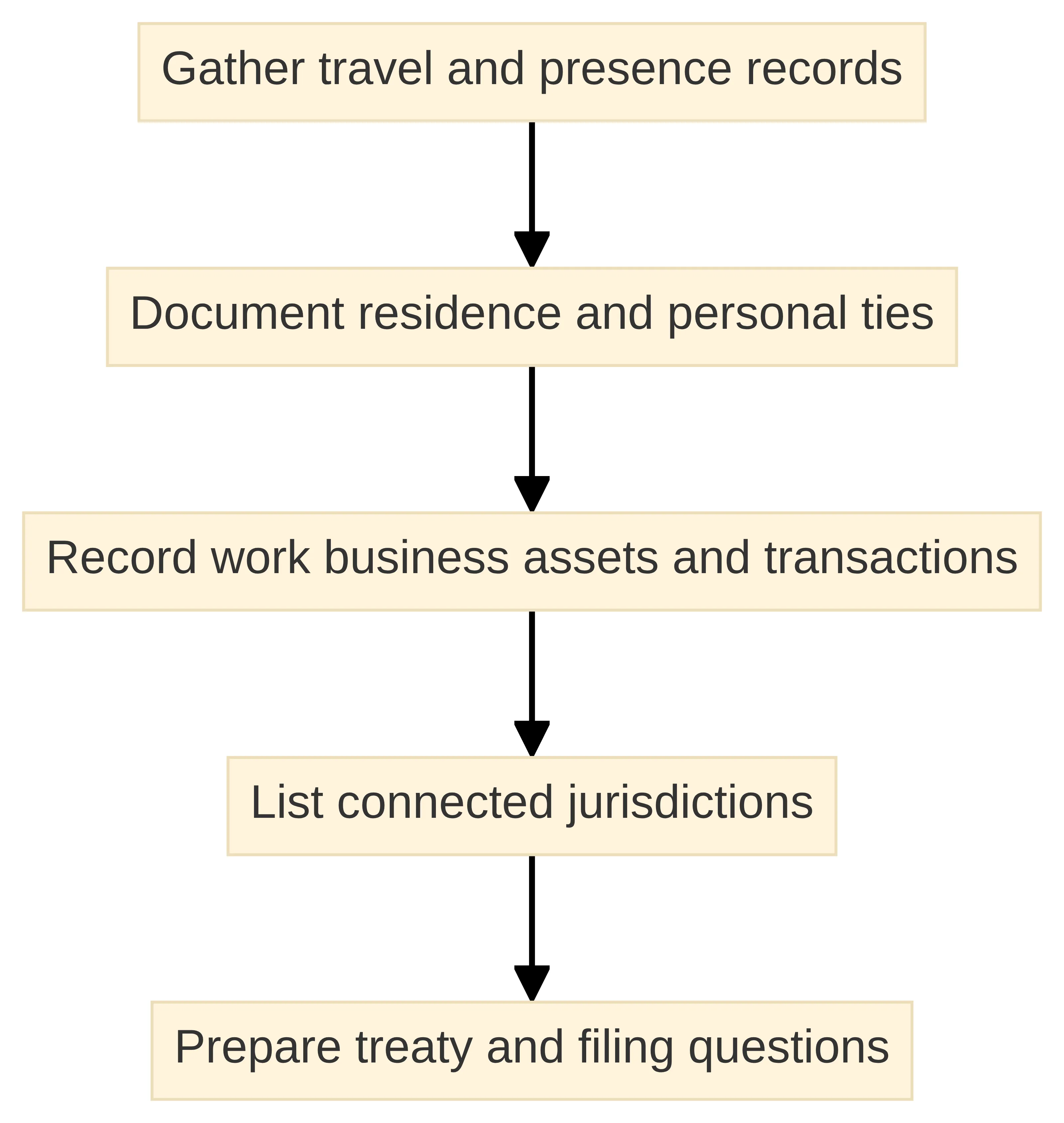
Include the following records:
- A dated travel and presence calendar for Mexico and every other connected country.
- Residence permits, citizenship information, primary-home details, and major personal or financial ties.
- Employment agreements, service contracts, invoices, payroll records, and descriptions of where work occurred.
- Business-entity documents, ownership records, contracts, management information, accounts, and payment flows.
- Investment statements, lease agreements, property records, share records, and planned transaction documents.
- Prior tax returns, tax registrations, notices, estimated-tax records, and relevant reporting history.
- A list of jurisdictions connected to you, your income, your entities, and your assets.
- A list of questions about treaty treatment, overlapping residence, withholding, and possible relief.
Use the file to preserve facts, not to announce a conclusion. For each income item, identify whether the person is a resident or non-resident under the rule being examined, whether the income is worldwide or Mexico-source for that analysis, and which entity or asset produced it. For each transaction, identify the property, shares, services, lease, or payment involved and the countries connected to it.
If you are U.S.-connected, add worldwide-income records and the filing facts identified by the IRS, including income, filing status, age, and prior filing information. If you are connected to another country, add the equivalent records for that country rather than assuming that U.S. rules apply. A complete factual inventory lets the adviser test the relevant questions in the right order.
Before the consultation, label each record as confirmed, incomplete, or needing interpretation. A travel date supported by a contemporaneous record is different from an estimated date; a contract showing the parties is different from an assumption about where services were performed. Keep the document, date, and relevant event together, and note contradictions rather than silently choosing one version. Then flag each unresolved item with the question it affects: residence, source, classification, business activity, transaction treatment, filing, or treaty coordination. This gives the adviser a prioritized set of factual gaps without turning your preparation into a self-determined tax position.
Turn the fact file into questions for the adviser
Your fact file becomes useful when it produces direct questions. Ask which Mexican residence rules apply to the documented facts, which income is treated as worldwide or Mexico-source for the relevant analysis, and which activities or transactions require separate treatment. The U.S. and Mexican systems use different residence, source, filing, and reporting rules, so ask for each country’s answer rather than requesting a single cross-border label.
Use questions such as:
- Which jurisdictions may treat me as a tax resident, and under which domestic rules?
- Does my residence permit change any tax conclusion, or is it only an immigration fact?
- How should each income category be classified for the Mexican analysis?
- Which facts connect my services, employment, business, investments, leases, property, or shares to Mexico?
- Does my company’s activity need review separately from my personal residence?
- Which home-country filing or reporting obligations may continue?
- Does dual residence or cross-border income require review of the applicable treaty?
Ask the adviser to connect each answer to the fact that produced it. For example, a business-income question should identify the entity, work, contracts, management, and countries involved. A residence question should identify the relevant domestic rules and the timeline, home, personal ties, and financial ties being tested. A treaty question should identify the actual countries, income category, residence positions, and treaty provision.
This approach prevents a broad promise or a single status label from substituting for analysis. It also gives you a way to identify missing records before you act on a relocation, restructure a company, sell an asset, or change how income is received.
Ask for the review to proceed from facts to rules to consequences. First, confirm which jurisdictions and events are in scope. Next, test residence and source under each relevant domestic law. Then classify the income, business activity, or transaction and identify separate filing or withholding questions. Only after those steps should the adviser assess treaty coordination or possible relief. This sequence does not guarantee a result, but it makes it easier to see whether a conclusion depends on a missing fact, a domestic rule, or a treaty provision. Request that any uncertainty and any action requiring further documentation be stated separately from the conclusion.
Understand what this overview cannot determine
This overview cannot determine your tax residence, filing status, tax liability, applicable rate, deadline, treaty result, or eligibility for a particular relief. Those conclusions depend on facts such as your nationality, immigration status, days and living arrangements, personal and financial ties, income, business structure, business activity, assets, transactions, and home-country connections. The governing rules are also jurisdiction-specific: tax residence is determined under domestic law, and Mexico distinguishes residents’ worldwide income from non-residents’ Mexican-sourced income.
The overview also cannot turn a selected withholding-table entry into your final liability. The table entries for professional fees, leases, property sales, and share sales are tied to a corporate-withholding context and require fact-specific application. They should not be treated as a universal answer for every expat or transaction.
Use the material for issue-spotting and preparation. If your facts involve possible residence in more than one jurisdiction, cross-border income, business operations, property, investments, or continuing home-country obligations, mark those issues for separate review. If a fact is uncertain, record the uncertainty instead of replacing it with an assumption about relocation or a residence permit.
A practical boundary is simple: the guide can help you organize the questions, but it cannot supply the individualized conclusion. Keep the fact file current as your travel, income, business, assets, or residence status changes.
Take the next step with a fact-specific international tax review
Consider a fact-specific international tax review when residence is uncertain, income crosses borders, business activity changes, transactions involve Mexican property or shares, or home-country obligations may continue. We recommend consulting a tax professional who specializes in international law to help manage tax-residency and residence-permit issues.
Bring your timeline, residence and citizenship records, income map, entity and business records, transaction documents, asset information, and prior filings. A qualified international tax professional can then decide how the applicable rules fit your facts and what should be investigated before you relocate or act.
Ask the team
Have a question about your own situation?
Tell us where you pay tax today and what you want to achieve. We will review your case and get back to you within 1 business day.